News headlines in 2017, page 19
Ending the Male Monopoly on Peace: Women Still Need More Seats at the Table
- Inter Press Service

NEW YORK, Oct 26 (IPS) - Whether targeted by perpetrators of sexual violence, oppressed by ideological extremists, or uniquely threatened by the bombing of hospital maternity units, women often bear the brunt of conflicts. Yet when it comes to peace negotiations, women too often don't have a seat at the table. The continuing reality that men, particularly armed men, enjoy an almost exclusive role in peace processes defies both logic and evidence.
Congo’s Wake Up Call
- Inter Press Service
GOMA, DR Congo, Oct 26 (IPS) - Late last week, the humanitarian community activated a Level 3 emergency for the Democratic Republic of the Congo (DRC). This trigger in the global humanitarian system is seldom used, and only after serious deliberation by the top echelons of the UN system.
Pollution or How the ‘Take-Make-Dispose’ Economic Model Does Kill
- Inter Press Service

ROME, Oct 26 (IPS) - The prevailing "Take-Make-Dispose" linear economic model consisting of voracious depletion of natural resources in both production and consumption patterns has proved to be one of the world's main killers due to the huge pollution it causes for air, land and soil, marine and freshwater.
Time Running Out for Somaliland’s Crumbling and Neglected Treasures
- Inter Press Service

BERBERA, Oct 26 (IPS) - The name alone—Berbera—ripples with exotic resonance, conjuring images of tropical quays, swarthy traders and fiery sunsets imbued with smells of spices, incense and palm oil.
Deliberate Famine Should Be a War Crime, UN Expert Says
- Inter Press Service
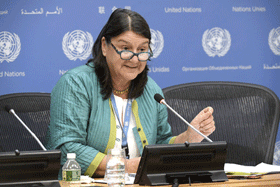
UNITED NATIONS, Oct 25 (IPS) - The deliberate starvation of civilians could amount to a war crime and should be prosecuted, said an independent UN human rights expert.
Russian & US Vetoes Protect Client States
- Inter Press Service
UNITED NATIONS, Oct 25 (IPS) - The vote on the latest American-sponsored resolution in the UN Security Council (UNSC) on Syria was predictable: of the five big powers, China abstained and Russia vetoed, while the US, UK and France voted for it.
Open or Closed Borders, or Something in Between?
- Inter Press Service
NEW YORK, Oct 25 (IPS) - Recent elections around the world have clearly shown growing public support for candidates and political parties advocating the deportation of migrants and stricter restrictions on immigration, including halting it altogether. At the same time, opposition,challenges and resistance to deportations and immigration restrictions have become more widespread, visible and vocal.
Latin America Heads to Climate Summit with Uneven Progress
- Inter Press Service
MEXICO CITY, Oct 25 (IPS) - Difficult to measure and unequal in their scope are the advances that the countries of Latin America will have to show, regarding their voluntary commitments to greenhouse gas emissions, during the climate summit to be hosted by Bonn, Germany in November.
Myanmar’s Democracy Feels Strain of Religious Fault Lines
- Inter Press Service
YANGON, Oct 25 (IPS) - I try to hold on tight as my driver navigates his motorbike over a bumpy and muddy track. His helmet is decorated with a swastika and an eagle, part of an ill-inspired fashion trend called Nazi chic. It's symbolic for a country where hate and racism seen to have become normalized.
Why 1997 Asian Crisis Lessons Lost
- Inter Press Service
KUALA LUMPUR, Oct 24 (IPS) - Various different, and sometimes contradictory lessons have been drawn from the 1997-1998 East Asian crises. Rapid or V-shaped recoveries and renewed growth in most developing countries in the new century also served to postpone the urgency of far-reaching reforms. The crises' complex ideological, political and policy implications have also made it difficult to draw lessons from the crises.
Powered by