

Afghan Women Defy Taliban Restrictions Through Online Protests
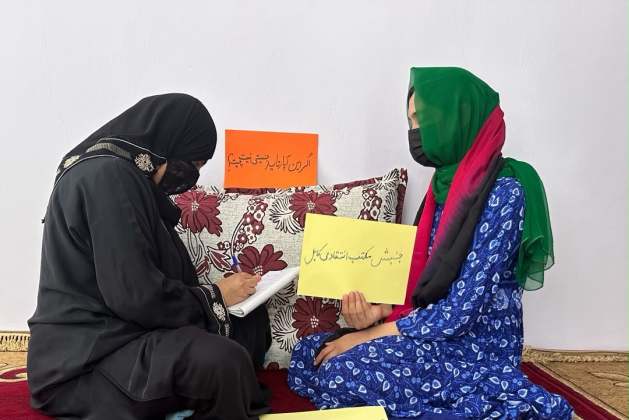
PARWAN, Afghanistan, October 20 (IPS) - Afghan women have resorted to online protests as their only available recourse, even though the risks of being caught are high and carry enormous consequences.
Dawn has not yet fully broken over the quiet streets of Parwan. The morning air carries the stillness of the early hours, and the footsteps of a few passersby are the only sounds that break the silence.
In one of the town’s more modest homes lives 28-year-old Gulsuum (name changed), who is effectively living two lives.
To her neighbors, she is a quiet young woman who goes out to buy food, lives with her family, and tries to lead an ordinary life. Yet behind this facade is a person fighting, under a pseudonym, for the education, freedom, and human dignity of Afghan women.
She uses the name Gulsuum to protect her identity. Her fears, hopes, and life story, however, are entirely real.
Gulsuum lives with her father, mother, aunt, and two brothers in a residential area of Parwan province. Her unmarried aunt has long been an integral part of the family.
Only her aunt knows Gulsuum’s secret
Her aunt has not only kept Gulsuum’s secret but has also supported her during her most difficult moments. She lets Gulsuum use her mobile phone when needed, keeps an eye on the situation, and warns her immediately if she senses danger.
Gulsuum’s biggest worry is her older brother. The reason lies in his traditional views: he considers women’s protests dangerous. Gulsuum is certain that if her brother found out about her activities, he would take away her phone, restrict her movements, or send her to live with relatives in another province.
Before the Taliban returned to power, Gulsuum studied law and taught at a private school. Back then, her life revolved around books, pens, and the voices of her students.
“My entire life was bound up with books, writing, and the classroom. I believed that Afghanistan’s future would be built by girls who could transform society through knowledge and education, not weapons.”
After the Taliban returned to power, universities and girls’ schools across Afghanistan were shut down one by one. The private school where Gulsuum taught ceased operations, and her own studies came to an end as well.
Gulsuum’s gaze drifts to the corner of the room, where her university books still sit on the shelf.
“My books are still there, but there is no longer a classroom, no students, and no dream I can pursue the way I used to.”
Gulsuum says she remained silent during the first few months, fearing arrest and that her family would be put in danger.
“But whenever I heard about the arrests of female protesters or girls being denied an education, I asked myself: Is silence, too, a form of surrender?”
That question changed the course of her life.
“Two years ago, a university friend introduced me to the Kabul Critical Thinking Movement. At first, I only followed the movement’s statements and writings. Gradually, I began participating in its online meetings under a pseudonym, and later, I became one of its active members.”
Most of the movement’s activities take place on its official Facebook page, where statements, campaigns, and public messages are published.
Even a small mistake could endanger everything
To protect their identities, members never share material on their own social media accounts. Instead, they record images and videos independently and submit them for publication via the movement’s official page. Pseudonyms are used to protect the identities of those involved.
Many images and videos are recorded indoors or in locations with few or no other people present. Members wear face masks, sunglasses, and black chadari robes to minimize the risk of being identified.
Gulsuum explains that every action requires careful planning and an assessment of potential risks, as even a single protest could lead to consequences for both her and her family.
“Every decision I make, every phone call, and every message I send could have serious consequences. My phone is protected by multiple passwords. I carefully manage messages, photos, and anything else that could put me in danger. I never reveal the identities of other members or where we meet to anyone. Even a small mistake could endanger my life and the lives of my family members.”
Gulsuum says she sometimes wonders whether her brothers, who browse through her phone, have found out about her activities.
“A moment later, I realize nothing has happened. They were just scrolling through social media. But those few minutes feel like hours to me. Fear has become a part of my everyday life.”
Once, while walking through the city, she noticed a Taliban pickup truck a few blocks behind her. She told a passing woman she was thirsty and was invited into her home for tea. The vehicle was still nearby when she left, but she was relieved to learn that Taliban members had rented a house in the neighborhood a few days earlier. The truck had nothing to do with her.
“I could breathe again, and I realized that sometimes fear paralyzes us long before any danger is even in sight. Every unknown call, every suspicious glance, and every unexpected question brings a new wave of fear. But I don’t think fear should define the lives of Afghan women.”
Despite fear, activism continues
Despite her fears, Gulsuum has not given up her activism.
“Sometimes I wonder if we will ever see the results of our efforts, if this path is worth all the fear and uncertainty. But whenever I think of the girls who have been denied the right to go to school, I know I must go on. If we stay silent today, the next generation might lose even the hope of protesting.”
The chadari robe she wears at demonstrations is more than just a garment.
“Every evening, I tuck it away in the corner of my room. Whenever I hide it, it feels as though I am concealing a part of my identity, my dreams, and my true life from the eyes of others.”
Gulsuum’s voice is calm, devoid of hesitation.
“I believe that no voice raised for justice goes to waste. Change may not happen today. But if no one speaks, there is no hope for tomorrow.”
“What matters most to me is that the world knows Afghan women, even under the most intense pressure, continue to stand up for freedom, justice, and human dignity. Our voice may be quiet, but it will never be silenced.”
Gulsuum’s story is not that of just one woman. It reflects the lives of thousands of Afghan women and girls, caught between fear and hope, continue the fight for education, freedom of choice, and human dignity.
Beneath the black chadar worn for safety, her voice still rings out. It is quiet, yet unwavering. Despite everything, that voice has not been silenced.
© Inter Press Service (20261020153749) — All Rights Reserved. Original source: Inter Press Service