

Coral Reefs
Author and Page information
- This page: https://www.globalissues.org/article/173/coral-reefs.
- To print all information (e.g. expanded side notes, shows alternative links), use the print version:
On this page:
Coral Reefs: Ecosystems of Environmental and Human Value

Coral reefs cover an area of over 280,000 km2 and support thousands of species in what many describe as the rainforests of the seas
.
Coral reefs benefit the environment and people in numerous ways. For example, they
- Protect shores from the impact of waves and from storms;
- Provide benefits to humans in the form of food and medicine;
- Provide economic benefits to local communities from tourism.
The World Meteorological Organization says that tropical coral reefs yield more than US$ 30 billion annually in global goods and services , such as coastline protection, tourism and food.
The US agency NOAA (the National Oceanic and Atmospheric Administration) puts the economic value even higher and says that coral reefs provide economic services — jobs, food and tourism — estimated to be worth as much as $375 billion each year.
In the past few years, however, global threats to coral reefs have been increasing and in the context of the wider environment, the value of coral reefs may be even greater:
Ecologically speaking the value of coral reefs is even greater [than these estimates] because they are integral to the well being of the oceans as we know them. … picture [reefs] as the undersea equivalent of rainforest trees. Tropical waters are naturally low in nutrients because the warm water limits nutrients essential for life from welling up from the deep, which is why they are sometimes called a
marine desert. Through the photosynthesis carried out by their algae, coral serve as a vital input of food into the tropical/sub-tropical marine food-chain, and assist in recycling the nutrients too. The reefs provide home and shelter to over 25% of fish in the ocean and up to two million marine species. They are also a nursery for the juvenile forms of many marine creatures.I could go on, but the similarity with the rainforest should now be clear. Eliminate the undersea
trees, which mass coral bleaching is in the process of doing, and you’ll eliminate everything that depends on it for survival.
Coral Reefs Are Dying Around the World
IUCN, the International Union for Conservation of Nature, is the world’s oldest environmental organization, working around the world.
Periodically, they produce the IUCN Red List of Threatened Species to highlight species that are extinct or extinct in the wild, critically endangered, endangered or vulnerable. Their spatial data shows the threats that coral reef species face around the world:
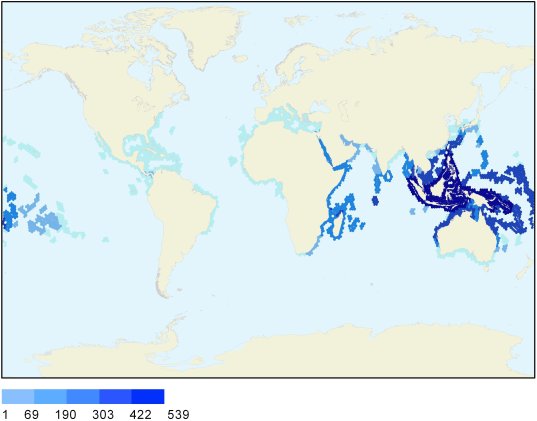
Australia’s Great Barrier Reef is perhaps the best managed in the world. A 2009 report by the Australian agency in charge of it (discussed further below) fears for the future and that catastrophic damage to the ecosystem may not be averted.
But concerns about coral reefs have been raised for many years around the world.
The Status of Coral Reefs Around the World, 2004 notes that:
- 20% of the world’s coral reefs have been effectively destroyed and show no immediate prospects of recovery;
- Approximately 40% of the 16% of the world’s reefs that were seriously damaged in 1998 are either recovering well or have recovered;
- The report predicts that 24% of the world’s reefs are under imminent risk of collapse through human pressures; and a further 26% are under a longer term threat of collapse;
A report from the World Resources Institute (WRI) in 1998 suggested that as much as 60 percent of the earth’s coral reefs are threatened by human activity.
Scientists have said that as much as 95 percent of Jamaica’s reefs are dying or dead.
Global Threats to Coral Reefs
All around the world, much of the world’s marine biodiversity face threats from activities and events such as
- Coastal development;
- Overfishing;
- Inland pollution;
- Global climate change.
- Ocean acidification caused by some of the excess carbon dioxide emissions being absorbed by the world’s oceans
The 2004 edition of Status of Coral Reefs Around the World lists the following top 10 emerging threats (p.19) in these three categories:
| Global Change Threats |
|
|---|---|
| Direct Human Pressures |
|
| The Human Dimension — Governance, Awareness and Political Will |
|
Climate change causing global mass coral bleaching
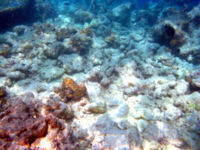

The above-mentioned Status of Coral Reefs Around the World, 2004 also notes (p. 21) that The major emerging threat to coral reefs in the last decade has been coral bleaching and mortality associated with global climate change.
As explained by Rob Painting on the popular Skeptical Science blog, bleaching can occur for a number of reasons such as
- Ocean acidification
- Pollution
- Excess nutrients from run-off
- High UV radiation levels
- Exposure at extremely low tides
- Cooling or warming of the waters in which the coral reside
Bleaching is not new. Past bleaching has often been localized and mild, allowing coral time to recover. But as Painting also adds, mass coral bleaching on the huge scale being observed certainly appears to be, and represents a whole new level of coral reef decline.
It is believed that almost all species of corals were affected by high sea surface temperatures during 1998 and the El Niño at the time, which resulted in global coral bleaching and mortality.
2002 was then the second worst year for coral bleaching after 1998.
Although there has been bleaching in the past, since 1998 it has become very severe:
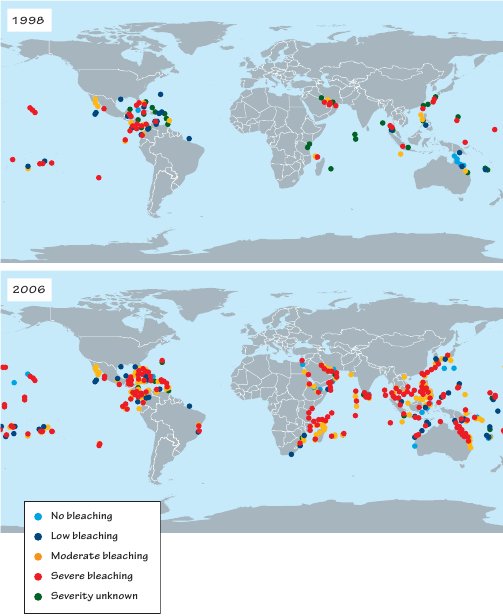
In 2010 scientists observed huge coral death which struck Southeast Asian and Indian Ocean reefs over a period of a few months following a large bleaching event in the region. Dr Andrew Baird of the ARC Centre of Excellence for Coral Reef Studies and James Cook Universities was quoted as saying, It is certainly the worst coral die-off we have seen since 1998. It may prove to be the worst such event known to science.
Scientists have long been pessimistic about the future, with some reefs expected to vanish by 2020.
Additional scientific research, reported by Greenpeace fears climate change will eliminate reefs from many areas:
If climate change is not stopped, coral bleaching is set to steadily increase in frequency and intensity all over the world until it occurs annually by 2030—2070.
This would devastate coral reefs globally to such an extent that they could be eliminated from most areas of the world by 2100. Current estimates suggest that reefs could take hundreds of years to recover. The loss of these fragile ecosystems would cost billions of dollars in lost revenue from tourism and fishing industries, as well as damage to coastal regions that are currently protected by the coral reefs that line most tropical coastlines.
Despite knowing the causes for many years, Australia’s The Great Barrier Reef Marine Park Authority has worried that identifying practicable and effective management responses has proven challenging because traditional management approaches do not work. Coral reef managers are unable to directly mitigate or influence the main cause of mass bleaching: above average water temperatures. This makes mass bleaching a uniquely challenging environmental management problem.
Despite knowing about these issues for many years, conditions have worsened.
At the beginning of September, 2009, the Australian agency looking after the Great Barrier Reef released an outlook report warning the Great Barrier Reef is in trouble:
Climate change, continued declining water quality from catchment runoff, loss of coastal habitats from coastal development and remaining impacts from fishing and illegal fishing and poaching [are] the priority issues reducing the resilience of the Great Barrier Reef.…
[Despite being] one of the most healthy coral reef ecosystems … its condition has declined significantly since European settlement….
While … there are no records of extinctions, some ecologically important species … have declined significantly.… Disease in corals and pest outbreaks … appear to be becoming more frequent and more serious.
…
Given the strong management of the Great Barrier Reef, it is likely that the ecosystem will survive better … than most reef ecosystems around the world. However … the overall outlook for the Great Barrier Reef is poor and catastrophic damage to the ecosystem may not be averted. Ultimately, if changes in the world’s climate become too severe, no management actions will be able to climate-proof the Great Barrier Reef ecosystem.
But it is not just the Great Barrier Reef at risk. They are all at risk as Charlie Veron, an Australian marine biologist who is widely regarded as the world’s foremost expert on coral reefs, says:
The future is horrific. There is no hope of reefs surviving to even mid-century in any form that we now recognize. If, and when, they go, they will take with them about one-third of the world’s marine biodiversity. Then there is a domino effect, as reefs fail so will other ecosystems. This is the path of a mass extinction event, when most life, especially tropical marine life, goes extinct.
A study published in mid-2012 also found that coral reefs face severe challenges even if global warming is restricted to a 2 degrees Celsius rise which many countries are struggling to agree to meet on given the way climate negotiations have been going for the past decade or more.
There are also concerns that some current assumptions may underestimate the future impact of climate change on corals. Malte Meinshausen, co-author of the study warned:
The window of opportunity to preserve the majority of coral reefs, part of the world’s natural heritage, is small. We close this window, if we follow another decade of ballooning global greenhouse-gas emissions.
Legacy of Nuclear Tests
In 1995, France started testing it’s Nuclear weapons in the Pacific despite huge protests (though other nuclear nations that are often critical of other countries doing nuclear tests, such as Britain, did not criticize France). It is now emerging that the coral in the French Polynesia regions where many Nuclear tests have been carried out have been harmed, as the French atomic energy commission has admitted. This is raising concern over what else they may have failed to tell the people who have to live through it in that area.
The political will to address this has long been lacking
It is recognized that the main way to address coral reef problems is to reduce greenhouse gas emissions and tackle climate change.
However, governments have shown they are unwilling to even commit to the watered down targets set by the Kyoto Protocol, so as The Guardian says, The coral community is not holding its breath.
And quoting another respected expert on coral reefs:
I just don’t see the world having the commitment to sort this one out. We need to use the coral reef lesson to wake us up and not let this happen to a hundred other ecosystems.
More Information
For more information on coral reefs you could start at the following:
- Mother Jones section on Coral Reefs
- Reefs and Risks section from the World Resources Institute provides various resources on coral reefs.
- Great Barrier Reef Marine Park Authority web site from Australia
- Coral Reefs Initiative from World Wildlife Fund
- Coral Reef Conservation Program from the NOAA, the US National Oceanic and Atmospheric Organization
- CORAL, Coral Reef Alliance, is an international non profit working to protect coral reefs
Author and Page Information
- Created:
- Last updated: