

Some Regional Free Trade Agreements
Author and Page information
- This page: https://www.globalissues.org/article/44/some-regional-free-trade-agreements.
- To print all information (e.g. expanded side notes, shows alternative links), use the print version:
Free trade agreements are numerous around the world. They are designed to enhance freer trade of goods (and often services), in the belief that it will be beneficial for all parties involved and lead to further economic development and growth (based on neoliberal economic ideology).
On this page:
Free Trade Agreements Between Rich and Poor Encouraging Unequal Trade?
There is criticism that some of these free trade agreements are between partners of unequal levels of development which then gives advantage to the more developed partners, as their businesses are then freer to expand and grow, at the expense of more fledgling nations and their industries.
Hence, as J.W. Smith wrote many years ago, an industrialized product-exporting/commodity-importing country is wealthy and an undeveloped product-importing/commodity-exporting country is poor.
(World’s Wasted Wealth II, Institute for Economic Democracy, 1994, p. 127).
As Richard Robbins explained further, free trade agreements between unequal partners implies unequal trade:
At first glance it may seem that the growth in development of export goods such as coffee, cotton, sugar, and lumber, would be beneficial to the exporting country, since it brings in revenue. In fact, it represents a type of exploitation called unequal exchange. A country that exports raw or unprocessed materials may gain currency for their sale, but they lose it if they import processed goods. The reason is that processed goods—goods that require additional labor—are more costly. Thus a country that exports lumber but does not have the capacity to process it must then re-import it in the form of finished lumber products, at a cost that is greater than the price it received for the raw product. The country that processes the materials gets the added revenue contributed by its laborers. (Emphasis is original)
But as J.W. Smith has also noted for many decades, much of these free trade agreements seem more like mercantilist policy. Another Smith (no relation), more famous, who noted this was Adam Smith, often regarded as the father of modern free trade capitalism.
In his 1776 classic, The Wealth of Nations, which is regarded as the Bible of capitalism, Adam Smith was highly critical of the mercantilist practices of the wealthy nations, while he recognized the value of local industry and the impact of imported manufactured products on local industries:
Though the encouragement of exportation and the discouragement of importation are the two great engines by which the mercantile system proposes to enrich every country, yet with regard to some particular commodities it seems to follow an opposite plan: to discourage exportation and to encourage importation. Its ultimate object, however, it pretends, is always the same, to enrich the country by the advantageous balance of trade. It discourages the exportation of the materials of manufacture, and of the instruments of trade, in order to give our own workmen an advantage, and to enable them to undersell those of other nations in all foreign markets; and by restraining, in this manner, the exportation of a few commodities of no great price, it proposes to occasion a much greater and more valuable exportation of others. It encourages the importation of the materials of manufacture in order that our own people may be enabled to work them up more cheaply, and thereby prevent a greater and more valuable importation of the manufactured commodities. (Emphasis Added)
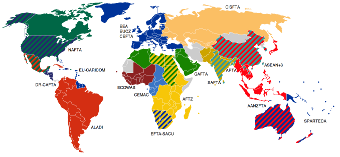

There are numerous free trade agreements around the world, some of which have come into being after much controversy, protest and debate.
This page was initially created in 1998 and was going to be updated with many more agreements, but it is clearly a futile effort to try and keep up with them all, so instead, listed below are just a handful of examples while the map of the world here shows many more:
Free Trade Area of the Americas (FTAA)
The FTAA is seen as a smaller version of the Multilateral Agreement on Investment (MAI) and a larger version of the North American Free Trade Agreement (NAFTA), which is further described below. On the one hand, the same fears as with the MAI, which would give even more powers to foreign investors over national governments, are seen here.
Yet, Latin American countries also fear that if they do impose some regulation, then that will likely pose an obstacle to investment in that country, as investors would simply go where there are less so-called restrictions. Given the need in many Latin American nations to provide for the large poor population, the investment takes on a slightly more sense of urgency. However, if corporations are able to invest in that country without regulations, then their accountability for any problems that may result is diminished. A nasty catch 22 or race to the bottom.
April 2001, Quebec, Canada, saw a meeting of leaders from the hemisphere to discuss the FTAA.
The United States, being the dominant economic power in the region, as well as the world is obviously a major factor in the FTAA. The U.S. is very supportive of the FTAA and the United States Trade Representative (USTR) wishes to expand the trade in services which would imply the privatization of health, education and other public services. It would be similar to what is promoted via the General Agreement on Trade in Services (GATS) at the World Trade Organization. (For more about GATS, visit this web site’s section on GATS).
As with NAFTA, the USTR proposals for the FTAA would result in greater rights for investors, without establishing any corresponding responsibilities. The USTR’s position is that investors should have the right to move funds into and out of countries without delay—meaning that provisions such as capital controls or performance requirements to ensure that investments serves to promote development goals would be illegal under an FTAA.
Furthermore, as pointed out in this radio show back in April 2001 leading up to the FTAA meeting in Quebec, it has been difficult for the public to get access to the FTAA documents, even though major corporations have ready access to it. Even the world’s largest journalists’ group, the International Federation of Journalists, has raised concerns about the secrecy around the FTAA despite the fact that it impacts the lives of roughly 800 million people.
Unfortunately, almost predictably, as with other protests around the world, the protests in Quebec at the FTAA meeting the weekend of April 20th, 2001, were accompanied by police violence, and even some protestor violence. The violence from a minority of protestors has served to discredit the movement a little bit, which is a shame and cannot be accepted by others who are also against the FTAA and the current forms of globalization. The media concentrated on the sensationalism and the minority of violent protestors, ignoring in that respect, the majority of the non-violent protestors. As this commentary suggests, many in the mainstream either didn’t really want to, or try to understand what protestors were protesting.
End of October 2002 saw another FTAA round in Quito, Ecuador. As Food First reported, after the worst of the police violence [on October 31, 2002] against the tens of thousands of indigenous people, farmers, students and other members of civil society from the across the Americas had taken place, a police platoon, including various officers, rebelled against their own government, and joined with indigenous leaders and other protesters in demanding that the trade ministers from 34 countries meeting to negotiate the FTAA agree to receive a delegation from the protesters carrying a declaration of opposition to the FTAA.
The protestors voices heard in the negotiations led to some embarrassment for key delegates, such as those from the U.S., and as the above article continued, quoting Peter Rosset, director of Food First, 'After today’s Seattle-like protests,' concluded Mr. Rosset, 'the U.S. government and the transnational corporations can never again claim that opposition to free trade comes only from a small group of northern environmentalists. It is abundantly clear that people from all walks of life, across all of Latin America, do not want anything to do with the FTAA, the World Trade Organization or any other manifestation of trade liberalization.'
For more about the FTAA, check out the following links:
- The Quebec part of the ZMagazine web site provides many articles, analysis and reports leading up to, during and since the FTAA protests, as well as numerous articles on first hand accounts from Quebec, and on neoliberal free trade in general.
- The MAI Shell Game. This is a good primer on the FTAA, with comparisons to NAFTA.
- A20.org Stop the FTAA web site provides information about the FTAA and is opposed to it. April 20, 2001 saw protests from some 20,000 people, in Quebec. Many links to other sites are provided as well as additional articles.
- FTAA official web site
- Free Trade Area of the Americas, by Karen Hansen-Kuhn, from The Development GAP, appearing in Foreign Policy In Focus Volume 6, Number 12 April 2001.
- April Archives of the radio show Democracy Now! has a number of shows on the FTAA.
- "Chasing the holy grail of free trade" from le Monde Diplomatique, April 2001, criticizes the FTAA.
- The Preamble Center has a section on the FTAA. A noteworthy article of theirs includes:
- This briefing paper entitled:
Recent Experiences with International Capital Markets: Lessons for the Free Trade Area of the Americas (FTAA)
explains well some of the problems we have seen in the Latin American and Asian financial crisis in the last few years and how still, the FTAA ignores these.
- This briefing paper entitled:
- "Sovereign Corporations" by William Greider is an example of structuring inequality into law.
- "Free Trade? Someone Always Has to Pay" by B.Kite, May 2, 2001, from Business Week looks at some of the realities.
- "Brazil Increasingly Unenthusiastic about U.S. FTAA Proposals" by Matthew Flynn, Americas Program, February 1, 2002
- "Many Oppose Trade Deal" by Marc Cooper, The Nation Magazine, February 11, 2002
NAFTA
A predecessor to the Multilateral Agreement on Investment (MAI) we have the North American Free Trade Agreement, NAFTA, set up by the United States of America, Canada and Mexico. It gives an indication of the potential impact a worldwide agreement like the MAI would have had if it had been allowed to formulate. Under the NAFTA agreement for example, corporations can sue a country if it is deemed to obstruct free trade. What could constitute an obstruction? Well, take the following for example:
- Canada’s attempt to protect its citizen’s health from the effects of a fuel additive was overturned and deemed as an obstruction to free trade. Canada was sued by a US chemical manufacturing corporation that produces this additive.
- Mexico wanted to prevent a hazardous waste disposal plant from being set up by a US firm. It also extended the proposed area into an environmental zone as it was found to be an ecologically sensitive area. That was enough for a US firm to claim grounds to sue under the NAFTA treaty. In fact, it turns out that Mexico is ordered to pay the US company $17 million.
- A Canadian-based company, Methanex Corporation, filed against the United States, claiming that California’s decision to phase out the use of its gasoline additive methyl tertiary butyl ether (MTBE) cost the company 970 million dollars. There were potentially high levels of MTBE in California’s drinking supply.
The priorities of aid and development, combined with trade agreements can also affect hunger, as the following quote illustrates:
[The] monolithic control over agricultural production, along with structural adjustment policies that brutally favor exports, results in floods of exports of foods from the United States and Europe to the Third World. As a result, of the North American Free Trade Agreement (NAFTA), the proportion of Mexico’s food supply that is imported has increased from 20 percent in 1992 to 43 percent in 1996. After 18 months of NAFTA, 2.2 million Mexicans have lost their jobs, and 40 million have fallen into extreme poverty. One out of two peasants is not getting enough to eat. As Victor Suares has stated,
Eating more cheaply on imports is not eating at all for the poor in Mexico.
(The above example is related to the issue of world hunger as well. Where trade agreements like this mean that more food is imported (and exported) in the name of trade, without first being allowed to meet the needs of the people, then local farmers are often undersold and driven out of business and national currencies earned do not get to circulate within that society. Hunger increases as a result. For more details on this, refer to this site’s section on food dumping. For more about structural adjustment, visit this site’s section on structural adjustment policies.)
The above examples just hint at environmental consequences but also reveal the potential impact on innocent citizens; while a country appears to have introduced some regulation that will help protect the health of the environment and its people, this can all be blown away by some agreement on the grounds that this prevents free trade.
Human Rights Watch for example, have also published a report that criticizes NAFTA’s labor agreements as being ineffective.
These are the types of concerns that people have about the effects of the World Trade Organization, as well. It may be that market economies within regions could help nations develop, but they would need to be fair and equitable, taking into account various issues, such as the environment and labor considerations. If there is any imbalance there, then there is a downward pressure on those issues in the entire region. We see above just three examples, where each nation’s environmental concerns are affected. Decreasing wages in Mexico is also having a downward pressure on some US wages, as corporations make more moves out of the US and set up in Mexico. This is less free markets and more mercantilism. Both Mexicans and Americans lose out. Corporations win.
As this Economic Policy Institute paper from April 2001 mentions, Mexican wages have decreased 27% since NAFTA, while hourly income from labor is down 40%.
(See also these collections of articles from the National Security Archives project from the George Washington University. It contains links to various documents from NAFTA’s secret tribunals where decisions have favored corporate threats to profit, over the laws of the three participating countries.)
The European Union and its Common Market
The European nations attempting to come together and form a more open status between them is an example of a free trade zone between like nations, that are equally developed. This is a possible scenario where free trade is beneficial, because of the equality between nations though there is often hostile opposition to it from within.
Free Trade between US and Africa
Some of the attempts and conditions suggested by USA in an effort to improve trade relationships and agreements with Africa have been criticized by South Africa and various NGOs as being too much in favor of multinational corporations and foreign investors at the expense of the vast number of poor Africans.
US and Vietnam Trade Agreement
The US-Vietnam trade deal in the summer of 2000, is also about more economic liberalization of capital flows in and out of Vietnam (one of the things the US wanted to achieve in its war with that nation). US corporations stand to benefit.
China and Asean Free Trade Agreement
January 2010 sees the start of a new free trade agreement between China and the six founding members of Asean (the Association of South East Asian Nations).
In terms of population involved, this is the largest free trade agreement to date and includes some leading export driven economies. This may work to China’s benefit more than most others, because it will be importing raw materials at more favorable prices, in order to produce even more finished goods for export.
Asean members are Brunei, Cambodia, Indonesia, Laos, Malaysia, Myanmar, the Philippines, Singapore, Thailand and Vietnam though the initial members in this agreement will be Brunei, Indonesia, Malaysia, Philippines, Singapore and Thailand. Others will join later.
Author and Page Information
- Created:
- Last updated: