Despite knowing about biodiversity’s importance1 for a long time, human activity has been causing massive extinctions2. As the Environment New Service, reported back in August 1999 (previous link): the current extinction rate is now approaching 1,000 times the background rate and may climb to 10,000 times the background rate during the next century, if present trends continue [resulting in] a loss that would easily equal those of past extinctions. (Emphasis added)
A major report, the Millennium Ecosystem Assessment3, released in March 2005 highlighted a substantial and largely irreversible loss in the diversity of life on Earth4, with some 10-30% of the mammal, bird and amphibian species threatened with extinction, due to human actions. The World Wide Fund for Nature (WWF) added that
Earth is unable to keep up in the struggle to regenerate
5 from the demands we place on it.
The International Union for Conservation of Nature (IUCN) notes in a video that many species are threatened with extinction. In addition,
At threat of extinction are
1 out of 8 birds
1 out of 4 mammals
1 out of 4 conifers
1 out of 3 amphibians
6 out of 7 marine turtles
75% of genetic diversity of agricultural crops has been lost
75% of the world’s fisheries are fully or over exploited
Up to 70% of the world’s known species risk extinction if the global temperatures rise by more than 3.5°C
1/3rd of reef-building corals around the world are threatened with extinction
Over 350 million people suffer from severe water scarcity
Is this the kind of world we want, it asks? After all, the short video concludes, our lives are inextricably linked with biodiversity and ultimately its protection is essential for our very survival:
What kind of world do we want?6, IUCN, December 2008
(Updated Jan 22, 2010)
In different parts of the world, species face different levels and types of threats. But overall patterns show a downward trend in most cases.
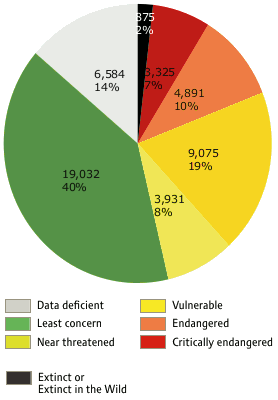
Proportion of all assessed species in different threat categories of extinction risk on the IUCN Red List, based on data from 47,677 species. Source: IUCN, pie chart compiled by Secretariat of the Convention on Biological Diversity (2010) Global Biodiversity Outlook 3, May 20107
As explained in the UN’s 3rd Global Biodiversity Outlook8, the rate of biodiversity loss has not been reduced because the 5 principle pressures on biodiversity are persistent, even intensifying:
Habitat loss and degradation
Climate change
Excessive nutrient load and other forms of pollution
Over-exploitation and unsustainable use
Invasive alien species
Most governments report to the UN Convention on Biological Diversity that these pressures are affecting biodiversity in their country (see p. 55 of the report).
The International Union for the Conservation of Nature (IUCN) maintains the Red List9 to assess the conservation status of species, subspecies, varieties, and even selected subpopulations on a global scale.
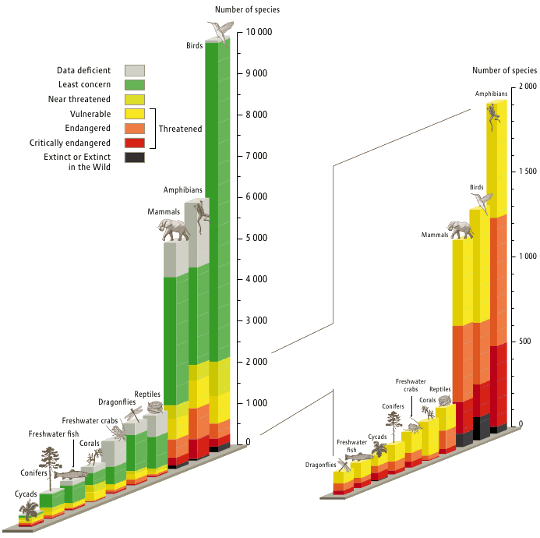
Extinction risks out pace any conservation successes. Amphibians are the most at risk, while corals have had a dramatic increase in risk of extinction in recent years.
Threat status of comprehensively assessed species by IUCN. Source: IUCN, compiled by Secretariat of the Convention on Biological Diversity (2010) Global Biodiversity Outlook 3, May 201010, p. 28 (visit for larger image)
The reasons vary from overuse of resource by humans, climate change, fragmented habitats, habitat destruction, ocean acidification and more.
Global Biodiversity Outlook 3 official video11, Convention on Biological Diversity, UNEP, May 2010
Research of long term trends in the fossil record suggests that natural speed limits constrain how quickly biodiversity can rebound12 after waves of extinction. Hence, the rapid extinction rates mean that it could take a long time for nature to recover.
Consider the following observations and conclusions from established experts and institutions summarized by Jaan Suurkula, M.D. and chairman of Physicians and Scientists for Responsible Application of Science and Technology (PSRAST13), noting the impact that global warming will have on ecosystems and biodiversity:
The world environmental situation is likely to be further aggravated by the increasingly rapid, large scale global extinction of species. It occurred in the 20th century at a rate that was a thousand times higher than the average rate during the preceding 65 million years. This is likely to destabilize various ecosystems including agricultural systems.
…In a slow extinction, various balancing mechanisms can develop. Noone knows what will be the result of this extremely rapid extinction rate. What is known, for sure, is that the world ecological system has been kept in balance through a very complex and multifaceted interaction between a huge number of species. This rapid extinction is therefore likely to precipitate collapses of ecosystems at a global scale. This is predicted to create large-scale agricultural problems, threatening food supplies to hundreds of millions of people. This ecological prediction does not take into consideration the effects of global warming which will further aggravate the situation.
Industrialized fishing has contributed importantly to mass extinction due to repeatedly failed attempts at limiting the fishing.
A new global study concludes that 90 percent of all large fishes have disappeared from the world’s oceans in the past half century, the devastating result of industrial fishing. The study, which took 10 years to complete and was published in the international journal Nature, paints a grim picture of the Earth’s current populations of such species as sharks, swordfish, tuna and marlin.
…The loss of predatory fishes is likely to cause multiple complex imbalances in marine ecology.
Another cause for extensive fish extinction is the destruction of coral reefs. This is caused by a combination of causes, including warming of oceans, damage from fishing tools and a harmful infection of coral organisms promoted by ocean pollution. It will take hundreds of thousands of years to restore what is now being destroyed in a few decades.
…According to the most comprehensive study done so far in this field, over a million species will be lost in the coming 50 years. The most important cause was found to be climate change.
…NOTE: The above presentation encompasses only the most important and burning global environmental problems. There are several additional ones, especially in the field of chemical pollution that contribute to harm the environment or upset the ecological balance.
Jaan Suurkula, World-wide cooperation required to prevent global crisis; Part one— the problem14, Physicians and Scientists for Responsible Application of Science and Technology, February 6, 2004 [Emphasis is original]
Additionally, as reported15 by UC Berkeley, using DNA comparisons, scientists have discovered what they have termed as an evolutionary concept called parallelism, a situation where two organisms independently come up with the same adaptation to a particular environment. This has an additional ramification when it comes to protecting biodiversity and endangered species. This is because in the past what we may have considered to be one species could actually be many. But, as pointed out by scientists, by putting them all in one group, it under-represents biodiversity, and these different evolutionarily species would not be getting the protection otherwise needed.
Amphibians are particularly sensitive to changes in the environment16. Amphibians have been described as a marker species or the equivalent of canaries of the coal mines meaning they provide an important signal to the health of biodiversity; when they are stressed and struggling, biodiversity may be under pressure. When they are doing well, biodiversity is probably healthy.
Unfortunately, as has been feared for many years now, amphibian species are declining at an alarming rate.
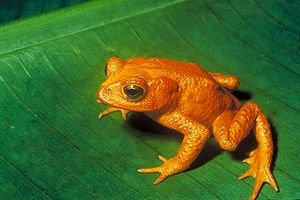
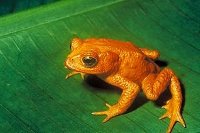
The Golden Toad of Monteverde, Costa Rica was among the first casualties of amphibian declines. Formerly abundant, it was last seen in 1989. (Source: Wikipedia17)
Malcom MacCallum of the Biological Sciences Program, Texas A&M University calculated that the current extinction rate of amphibians could be 211 times the background amphibian extinction rate18.
He added that If current estimates of amphibian species in imminent danger of extinction are included in these calculations, then the current amphibian extinction rate may range from 25,039–45,474 times the background extinction rate for amphibians. It is difficult to explain this unprecedented and accelerating rate of extinction as a natural phenomenon. (Emphasis added)
The BBC reported on a global-scale study published in the journal Science that found
climate change could wipe out 20% of the world's lizard species by 2080
20.
Global projection models used by the scientists suggested that lizards have already crossed a threshold for extinctions caused by climate change.
The fear of lowland species moving to higher elevations has long been predicted as an effect of climate change. This has been observed with lizard populations too, as the leader of the research team told the BBC.
Why are lizards so sensitive to climate change? The BBC summarizes:
Lizards, the researchers say, are far more susceptible to climate-warming extinction than previously thought. Many species live right at the edge of their thermal limits.
Rising temperatures, they explained, leave lizards unable to spend sufficient time foraging for food, as they have to rest and regulate their body temperature.
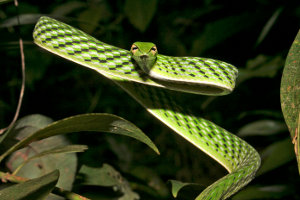
More generally, 19% of the world’s reptiles are estimated to be threatened with extinction23, according to a study by the International Union for Conservation of Nature (IUCN) and the Zoological Society of London.
Reptiles include species such as snakes, lizards, crocodiles, turtles and tortoises.
The study noted that the extinction risk is not evenly spread. For example, the study estimated 30% of freshwater reptiles to be close to extinction. Freshwater turtles alone are at a 50% risk of extinction, as they are also affected by national and international trade.
Why are reptiles so sensitive to environmental conditions? The lead author on the paper summarizes:
Reptiles are often associated with extreme habitats and tough environmental conditions, so it is easy to assume that they will be fine in our changing world. However, many species are very highly specialized in terms of habitat use and the climatic conditions they require for day to day functioning. This makes them particularly sensitive to environmental changes.
Dr Monika Böhm, Almost one in five reptiles struggling to survive24, IUCN, February 15, 2013
The UN’s 3rd Global Biodiversity Outlook report, mentioned earlier, notes that,
About 80 percent of the world marine fish stocks for which assessment information is available are fully exploited or overexploited.
Fish stocks assessed since 1977 have experienced an 11% decline in total biomass globally, with considerable regional variation. The average maximum size of fish caught declined by 22% since 1959 globally for all assessed communities. There is also an increasing trend of stock collapses over time, with 14% of assessed stocks collapsed in 2007.
Secretariat of the Convention on Biological Diversity (2010), Global Biodiversity Outlook 325, May, 2010, p.48
IPS reports that
fish catches are expected to decline dramatically in the world’s tropical regions because of climate change
26. Furthermore, in 2006, aquaculture consumed 57 percent of fish meal and 87 percent of fish oil as industrial fisheries operating in tropical regions have been scooping up enormous amounts of fish anchovies, herring, mackerel and other small pelagic forage fish to feed to farmed salmon or turn into animal feed or pet food. This has resulted in higher prices for fish, hitting the poorest the most.
As Suurkula mentioned above, mass extinctions of marine life due to industrialized fishing has been a concern for many years. Yet, it rarely makes mainstream headlines. However, a report warning of marine species loss becoming a threat to the entire global fishing industry did gain media attention.
A research article in the journal, Science, warned commercial fish and seafood species may all crash by 204828.
At the current rate of loss, it is feared the oceans may never recover. Extensive coastal pollution, climate change, over-fishing and the enormously wasteful practice of deep-sea trawling are all contributing to the problem29, as Inter Press Service (IPS) summarized.
As also explained on this site’s biodiversity importance section, ecosystems are incredibly productive and efficient—when there is sufficient biodiversity30. Each form of life works together with the surrounding environment to help recycle waste, maintain the ecosystem, and provide services that others—including humans—use and benefit from.
For example, as Steve Palumbi of Stamford University (and one of the authors of the paper) noted, the ocean ecosystems can
Take sewage and recycle it into nutrients;
Scrub toxins out of the water;
Produce food for many species, including humans
Turns carbon dioxide into food and oxygen
With massive species loss, the report warns, at current rates, in less than 50 years, the ecosystems could reach the point of no return, where they would not be able to regenerate themselves.
Dr. Boris Worm, one of the paper’s authors, and a world leader in ocean research, commented that:
Whether we looked at tide pools or studies over the entire world’s ocean, we saw the same picture emerging. In losing species we lose the productivity and stability of entire ecosystems. I was shocked and disturbed by how consistent these trends are—beyond anything we suspected.
Dr. Boris Worm, Losing species31, Dalhousie University, November 3, 2006
Current is an important word, implying that while things look dire, there are solutions and it is not too late yet. The above report and the IPS article noted that protected areas show that biodiversity can be restored quickly. Unfortunately, less than 1% of the global ocean is effectively protected right now and where [recovery has been observed] we see immediate economic benefits, says Dr. Worm. Time is therefore of the essence.
In an update to the above story, 3 years later, 2009, Dr. Worm was a bit more optimistic that
some fish stocks can rebound, if managed properly
32. But it is a tough challenge since 80 percent of global fisheries are already fully or over-exploited.
An example of overfishing that has a ripple-effect on the whole fish-food chain is shark hunting.
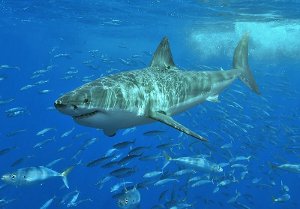
The Great White Shark is the largest predatory fish. (Source: Wikipedia33)
An estimated 100 million sharks are being killed each year34 according to the journal, Marine Policy which published a report in 2013 representing the most accurate assessment to date (although the challenge in obtaining the data was reflected in their estimate range: 63 – 270 million, of which 100 million is the median estimate.
Millions are killed from overfishing and trade. Many die accidentally in fishing nets set for tuna and swordfish, while others are caught for their meat or just for their fins.
A demand for shark-fin soup in places like China and Taiwan is decimating shark populations. Shark fin soup is considered a delicacy (not even a necessity) and can be extremely lucrative. So much money can be obtained just from the fin that fishermen hunting sharks will simply catch sharks and cut off their fins while they are alive, tossing the wriggling shark back into the ocean (to die, as it cannot swim without its fin). This saves a lot of room on fishing boats. Some video footage shown on documentaries such as National Geographic reveal how barbaric and wasteful this practice is.
Sharks are known as the apex predator of the seas. That is because in general sharks are at the top of the food chain. Without sufficient shark numbers the balance they provide to the ecosystem is threatened because nature evolved this balance through many millennia.
As WWF, the global conservation organization notes, Contrary to popular belief, shark fins have little nutritional value and may even be harmful to your health35 over the long term as fins have been found to contain high levels of mercury.
The additional concern is that many of the most threatened species are slow to reproduce, so their populations cannot keep up with the rate they are being needlessly killed.
Another effect of overfishing has been the rise in illegal fishing36. But even legal, high-tech fishing has caused other social problems. Poor fishermen in Somalia have found themselves without livelihoods as international fishing ships have come into their area destroying their livelihoods. Some of them have then resorted to piracy in desperation. Clearly not all blame should be laid at the international fishing system as it is also individual choice, but the desperation and other geopolitical issues in the region can turn people to do things they normally would not.
It is not just fish in the oceans that may be struggling, but most life in the seas. This includes mammals (e.g. whales, dolphins, polar bears), birds (e.g. penguins), and other creatures (e.g. krill).
Ocean degradation has been feared to be faster than previously thought.
The health of the ocean is spiraling downwards far more rapidly than we had thought. We are seeing greater change, happening faster, and the effects are more imminent than previously anticipated. The situation should be of the gravest concern to everyone since everyone will be affected by changes in the ability of the ocean to support life on Earth.
Professor Alex Rogers of Somerville College, Oxford, and Scientific Director of IPSO,
Latest Review of Science Reveals Ocean in Critical State From Cumulative Impacts
37, The International Programme on the State of the Ocean (IPSO), October 3, 2013
The factors affecting the ocean’s health includes:
De-oxygenation
Acidification
Warming
These impacts will have cascading consequences for marine biology, including altered food web dynamics and the expansion of pathogens, the IPSO also notes. These factors are also looked at in further detail on this site’s article on climate change and biodiversity38 as well as covered in more depth by IPSO’s report, State of the Ocean39.
The Census of Marine Life40 is a global network of researchers and scientists. They’ve been involved in a decade-long initiative to assess diversity, distribution and abundance of life in the oceans. A better understanding of these complex systems is clearly important given our dependence on the marine ecosystem in various ways.
Brief explanation of why we need to monitor ocean biodiversity, Ocean Observations Biodiversity Video41, Census on Marine Life, November 28, 2007
Australian, Japanese, Chinese, Mediterranean and Mexican Gulf waters most biodiverse; What Lives in the Sea?42, Census on Marine Life, August 2, 2010
This first Census of Marine Life (CoML) hopes to act as a baseline of how human activity is affecting previously unexplored marine ecosystems. A database of global marine life43 has also published as well as numerous videos44 (also on YouTube45) and images46.
Although it is a large project (in terms of cost, scope and duration), there are still many unknowns that will need further research. For example, the current number of known marine species is estimated at 250,000. However, scientists believe that there as many as three times this number are yet to be discovered and named. (See page 3 of their main 2010 report47.)
The Census was able to determine, however, that over-fishing was reported to be the greatest threat to marine biodiversity in all regions followed by habitat loss and pollution. One of the summary reports48 also added that the fact that these threats were reported in all regions indicates their global nature. A collection of regional and overview reports were also published on the Public Library of Science web site
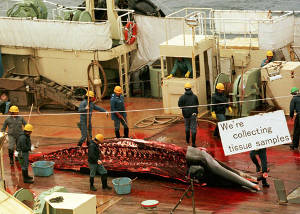
In the past century, commercial whaling has decimated numerous whale populations, many of which have struggled to recover.
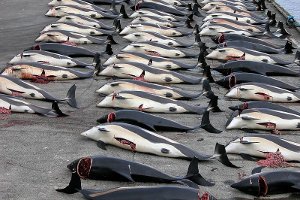
Whaling stations like this one in the Faroe Islands is also used to hold hunted dolphins and other animals. (Image source: Wikipedia49)
Commercial whaling in the past was for whale oil. With no reason to use whale oil today, commercial whaling is mainly for food, while there is also some hunting for scientific research purposes.
Large scale commercialized whaling was so destructive that in 1986 a moratorium on whaling was set up by the International Whaling Commission50 (IWC). As early as the mid-1930s, there were international attempts to recognize the impact of whaling and try and make it more sustainable, resulting in the actual set up of the IWC in 1946. Many commercial whaling nations have been part of this moratorium but have various objections and other pressures to try and resume whaling.
Japan is the prime example of hunting whales for the stated aim of scientific research while a lot of skepticism says it is for food. Greenpeace and other organizations often release findings that argue Japan’s whaling to be excessive or primarily for food, and for research as secondary.
General public negativity of commercial whaling has also led to a difference between traditional whaling communities in the arctic region and conservationists. Traditional indigenous communities have typically hunted whale in far smaller numbers commercially, mostly for local food consumption, but the impacts of large-scale commercial whaling has meant even their hunting is under pressure.
Some have argued for whale hunting as a way to sustain other marine populations. National Geographic Wild aired a program called, A Life Among Whales (broadcast June 14, 2008). It noted how a few decades ago, some fishermen campaigned for killing whales because they were apparently threatening the fish supply. A chain of events eventually came full circle and led to a loss of jobs:
The massive reduction in the local whale population meant the killer whales in that region (that usually preyed on the younger whales) moved to other animals such as seals
As seal numbers declined, the killer whales targeted otters
As otter numbers were decimated, the urchins and other targets of otters flourished
These decimated the kelp forests where many fish larvae grew in relative protection
The exposed fish larvae were easy pickings for a variety of sea life
Fishermen’s livelihoods were destroyed.
This may be a vivid example of humans interfering and altering the balance of ecosystems and misunderstanding the importance of biodiversity52.
Dr. Sylvia Earle, described as a Living Legend by the US Library of Congress, is a world-renowned oceanographer, explorer, author, and lecturer. In the early 1990s she was the Chief Scientist of the National Oceanographic and Atmospheric Administration in the US. In 2009 she won the prestigious TED prize53. As part of the prize, she was able to share a wish, which captured some major concerns about dwindling ocean biodiversity and its importance to all life on earth:
Sylvia Earle, Here’s how to protect the blue heart of the planet54, TED Talks, February 2009
Increasing rapid ocean acidification, caused by the oceans absorbing more carbon dioxide than usual (because it is emitted by humans more than it should) also affects marine ecosystems, as explained on this site’s climate change and biodiversity55 page.
We use water for a variety of purposes from agricultural, domestic and industrial uses. This has involved activities that alter surrounding ecosystems, such as drainage, diversion of water for irrigation, industrial and domestic use, contaminating water with excess nutrient run-off (e.g. from fertilizers) and industrial waste, building damns, etc.
The UN’s 3rd Global Biodiversity Outlook report56 also mentioned earlier notes that shallow-water wetlands such as marshes, swamps and shallow lakes have declined significantly in many parts of the world. (p.42).
The report also notes that water quality in freshwater ecosystems is an important biodiversity indicator, yet global data is quite lacking. But there are numerous examples that are known. Quoting a number of examples from the report,
Between 56% and 65% of inland water systems suitable for use in intensive agriculture in Europe and North America had been drained by 1985. The respective figures for Asia and South America were 27% and 6%.
73% of marshes in northern Greece have been drained since 1930.
60% of the original wetland area of Spain has been lost.
The Mesopotamian marshes of Iraq lost more than 90% of their original extent between the 1970s and 2002, following a massive and systematic drainage project. Following the fall of the former Iraqi regime in 2003 many drainage structures have been dismantled, and the marshes were reflooded to approximately 58% of their former extent by the end of 2006, with a significant recovery of marsh vegetation.
More than 40% of the global river discharge is now intercepted by large dams and one-third of sediment destined for the coastal zones no longer arrives. These large-scale disruptions have had a major impact on fish migration, freshwater biodiversity more generally and the services it provides. They also have a significant influence on biodiversity in terrestrial, coastal and marine ecosystems.
The report also notes that The number of observed dead zones, coastal sea areas where water oxygen levels have dropped too low to support most marine life, has roughly doubled each decade since the 1960s. Many are concentrated near the estuaries of major rivers, and result from the buildup of nutrients, largely carried from inland agricultural areas where fertilizers are washed into watercourses. The nutrients promote the growth of algae that die and decompose on the seabed, depleting the water of oxygen and threatening fisheries, livelihoods and tourism. (p. 60)
Source: Updated from Diaz and Rosenberg (2008). Science. Graph compiled by Secretariat of the Convention on Biological Diversity (2010) Global Biodiversity Outlook 3, May 201057, p.60
We can be optimistic and believe human ingenuity will solve these kind of problems. For example,
The report does add that combating nutrient pollution can work and overtime reverse the pressure on ecosystems. A number of European nations have been doing this recently.
Additionally, an estimated 12% of the area of the world’s inland waters are included within protected areas.
Governments of 159 countries have ratified the Ramsar Convention on Wetlands, currently committed to conserving 1,880 wetlands of international importance, covering over 1.8 million square km, and to the sustainable use of wetland resources generally.
In many countries, steps are being taken to restore wetlands, often reversing previous, sometimes recent land-use policies as there is increased recognition of the multiple benefits such as purification of water, protection from natural disasters, food and materials for local livelihoods and income from tourism.
However, it is not all rosy. As the report also notes. For example, despite the Ramsar Convention, conditions of those protected areas continue to deteriorate. Furthermore,
In some areas, depletion and pollution of economically important water resources have gone beyond the point of no return, and coping with a future without reliable water resources systems is now a real prospect in parts of the world. UNESCO’s Third World Water Development Report predicts that nearly half of humanity will be living in areas of high water stress by 2030.
Secretariat of the Convention on Biological Diversity (2010), Global Biodiversity Outlook 358, May, 2010, p.43
This site’s section on water and development59 looks into water related issues in more depth.
A 20-year study has shown that deforestation and introduction of non-native species has led to
about 12.5% of the world’s plant species to become critically rare
62. (In fact, as an example, a study suggests that the Amazon damage is worse than previously thought63, due to previously undetected types of selective logging and deforestation.)
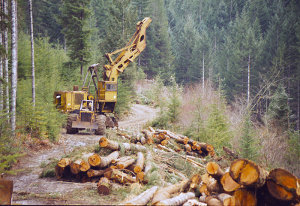
A report from the World Commission on Forests and Sustainable Development suggests that the forests of the world have been exploited to the point of crisis64 and that major changes in global forest management strategies would be needed to avoid the devastation.
What also makes this a problem is that many of the endangered species are only found in small areas of land, often within the borders of a single country.
New species of animals and plants are still being discovered. In Papua New Guinea, 44 new species of animals were discovered recently in the forests. Logging may affect these animals’ habitats, though. The loss of rainforests around the world, where many species of life are found will mean that potential knowledge, whether medicinal, sustenance sources, or evolutionary and scientific information etc. could be lost.
Brazil, which is estimated to have around 55,00065 species of flora, amounting to some 22% of the world’s total and India for example, which has about 46,00066 and some 81,000 animal species (amounting to some 8% of the world’s biodiversity), are also under various pressures, from corporate globalization, deforrestation, etc. So too are many other biodiverse regions, such as Indonesia, parts of Africa, and other tropical regions.
The UN’s 3rd Global Biodiversity Outlook report, mentioned earlier, also notes the extent to which deforestation is occurring as well as measures to address associated concerns.
The report notes (p.32) that forests
Are approximately 31% of the Earth’s land surface,
Contain more than half of all terrestrial animal and plant species (mostly in the tropics), and
Account for more than two-thirds of net primary production on land – the conversion of solar energy into plant matter.
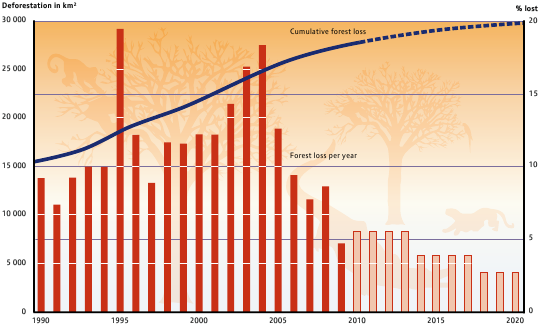
Deforestation, however, continues at an alarming rate, despite recent decreases in several tropical countries.
Comparing actual area of Brazilian portion of the Amazon deforested each year between 1990 and 2009 including the projected rate based on Brazilian government targets to reduce deforestation by 80% by 2020, and cumulative total deforestation as a percentage of the estimated original extent of the Brazilian Amazon (4.1 million km2).
Source: Brazilian National Space Research Agency (INPE), graph compiled by Secretariat of the Convention on Biological Diversity (2010) Global Biodiversity Outlook 3, May 201067, p.33
The significant decline noted in the Brazilian Amazon is not enough to prevent the World Bank worrying about the future. The Global Biodiversity Outlook report notes that According to a recent study co-ordinated by the World Bank, 20% Amazon deforestation would be sufficient to trigger significant dieback of forest in some parts of the biome by 2025, when coupled with other pressures such as climate change and forest fires.
Furthermore, some of the reversals in deforestation is because of reforestation, but the report raises the same concerns as also noted further below. Namely, Since newly-planted forests often have low biodiversity value and may only include a single tree species, a slowing of net forest loss does not necessarily imply a slowing in the loss of global forest biodiversity. Between 2000 and 2010, the global extent of primary forest (that is, substantially undisturbed) declined by more than 400,000 square km, an area larger than Zimbabwe. (p. 32)
Sustainable Forests or Sustainable Profits?
The overly corporate-led form of globalization that we see today also affects how natural resources are used and what priorities they are used for.
It is true that cutting down forests or converting natural forests into monocultures of pine and eucalyptus for industrial raw material generates revenues and growth. But this growth is based on robbing the forest of its biodiversity and its capacity to conserve soil and water. This growth is based on robbing forest communities of their sources of food, fodder, fuel, fiber, medicine, and security from floods and drought.
Vandana Shiva, Stolen Harvest, (South End Press, 2000), p.1(Image source: Wikipedia68)
We hear more about sustainable forestry practices by the large logging multinationals. However, what does that really mean? Who is it sustainable for? Society and the environment, or for the logging companies? By replanting trees that will grow quickly and allow them to be felled for sustained logging sounds like a good strategy. However, the trees that are favored for this (eucalyptus) require a lot of water to grow so quickly. As John Madeley points out:
[T]he [eucalyptus] trees achieve this rapid growth by tapping large quantities of groundwater, impoverishing surrounding vegetation and threatening to dry up local water courses.
John Madeley, Big Business Poor Peoples; The Impact of Transnational Corporations on the World’s Poor, (Zed Books, 1999) p.76.
Madeley continues by describing the impact that the use of chemicals to treat woodpulp from the eucalyptus has on local fisheries and on food production. This has had terrible effects on indigenous people within such regions.
10 years on from the above, Inter Press Service notes similar things, as activists around the Amazon complain about
tree plantations
69.
Illegal Timber Trade on a Large Scale
Some government institutions even buy illegal timber70 from pristine forests. For example, it is claimed71 that UK buys all of its Mahogany from pristine forests in Brazil where 80% of all timber is traded illegally. Even though Brazil has now tried to introduce a moratorium on Mahogany logging for two years, this has been slammed72 by some as too little, too late.
Legal Timber Trade on a Large Scale
Under much secrecy, there is a push from USA and Asian economies to reduce73 tariffs for wood and paper products. Also at the WTO Ministerial meeting in November 1999, opening more markets for easier access74 was the agenda, which included forests.
People and Forests
Quite often we make blanket statements or generalized conclusions that people are the cause of deforestation. While that is true, unfortunately all people around the world are not equal, and it also also follows that some are more responsible for deforestation than others. Often, in forests of the Amazon, Africa, or Asia, forest protection schemes have been promoted that go against indigenous peoples and cultures, rather than work with them.
As Indian activist and scientist Vandana Shiva and others have shown in countless work, indigenous people often have their cultures and lifestyle structured in a way that works with nature and would not undermine their own resource base. For example, in her book Stolen Harvests (South End Press, 2000) she describes how their traditional knowledge has been beneficial to the environment and has been developed and geared towards this understanding and respect of the ecosystems around them.
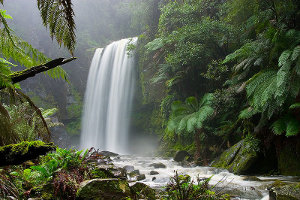
Hopetoun falls, Australia; an example of trying to preserve nature while allowing tourism. (Source: Wikipedia75)
Yet because of blanket conclusions that humankind is responsible for deforestation, we risk assuming all types of societies are equally responsible for deforestation that is damaging to the environment. (This hints then, that for sustainable development projects, a more participatory approach can be accepted by local people, reducing the chance for conflict and distrust and therefore be more likely to succeed as well.)
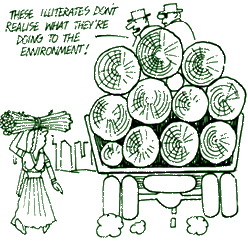
As the cartoon, further above, from the Delhi-based Centre for Science and Environment notes, logging companies and others can often have a larger impact on deforestation. Industrial agriculture and beef76 production for example, is a major cause of deforestation in the Amazon, to raise cattle. This is not even for local needs, but to meet fast food restaurant demands in the Northern countries. A combination of geopolitics and economic agreements foster a scenario for such results to occur.
The UN’s 3rd Global Biodiversity Outlook report, mentioned earlier, also notes how indigenous communities can benefit their local environments and is quoted at length:
Indigenous and local communities play a significant role in conserving very substantial areas of high biodiversity and cultural value.
In addition to officially-designated protected areas, there are many thousand Community Conserved Areas (CCAs) across the world, including sacred forests, wetlands, and landscapes, village lakes, catchment forests, river and coastal stretches and marine areas. These are natural and/or modified ecosystems of significant value in terms of their biodiversity, cultural significance and ecological services. They are voluntarily conserved by indigenous and local communities, through customary laws or other effective means, and are not usually included in official protected area statistics.
Globally, 4 to 8 million square km (the larger estimate is an area bigger than Australia) are owned or administered by communities. In 18 developing countries with the largest forest cover, over 22% of forests are owned by or reserved for communities. In some of these countries (for example Mexico and Papua New Guinea) the community forests cover 80% of the total. By no means all areas under community control effectively conserved, but a substantial portion are. In fact, some studies show that levels of protection are actually higher under community or indigenous management than under government management alone.
Secretariat of the Convention on Biological Diversity (2010), Global Biodiversity Outlook 377, May, 2010, pp.40 – 41
For more on this aspect of people and biodiversity, you can see also the following:
Centre for Science and Environment78 have a lot of resources on such issues. As an example, you can see:
Pining for More80, an article from their Down to Earth magazine (Vol 10, No 18 February 15, 2001). This article describes how Pine-based sustainable forests are not sustainable at all, and that Pine trees even make forest fires spread rapidly, while degrading local ecology, but grow fast, which is good for business.
Participatory Forest Management—Restoring Ecological Health and Enhancing Economic Opportunity in Sub-Saharan Africa81, by Todd Beer, Grassroots Globalization Network, Summer 2002. This is a report looking at how local communities in Sub-Saharan Africa can be beneficial to sustainable forest management.
On this web site’s population and environmental stress83 section, there is in-depth discussion on flawed and missed out assumption regarding ecological limits and factors that affect environmental degradation. These errors lead to often blaming the wrong groups of people for the problems and therefore lead to the promotion of inappropriate policies to deal with the issues.
Beef84 from this web site describes many aspects of deforestation and provides links and sources to other information.
Ogiek85 web site. This web site is about the Ogiek indigenous people of Kenya’s Mau Forest, and highlights an example of how they are being denied to live on their lands, for fears of deforestation issues. Yet, logging companies have an interest in this forest as well.
Saving forests: an inspiring success story from India86 from ID21 provides a summary of findings in India.
More Information
Some possible starting points for additional information include the following:
Climate, Biodiversity, and Forests89 report, which looks at the link between forests, land-use and global warming.
World Commission on Forests and Sustainable Development90
This article titled Forests and Deforestation91. This is a good article which also points out that humans are not inherently harmful to forest, and have in some cases positively contributed to forest evolution. It has a good look at various factors involved.
The Forests93 section from the Global Warming part of this web site, describes some of the relations between things like deforestation, carbon sinks and climate change.
How land is used to produce food can have enormous impacts on the environment and its sustainability. And this often has nothing to do with populations. Take the following as an example:
Junk-food chains, including KFC and Pizza Hut, are under attack from major environmental groups in the United States and other developed countries because of their environmental impact. Intensive breeding of livestock and poultry for such restaurants leads to deforestation, land degradation, and contamination of water sources and other natural resources. For every pound of red meat, poultry, eggs, and milk produced, farm fields lose about five pounds of irreplaceable top soil. The water necessary for meat breeding comes to about 190 gallons per animal per day, or ten times what a normal Indian family is supposed to use in one day, if it gets water at all.
… Overall, animal farms use nearly 40 percent of the world’s total grain production. In the United States, nearly 70 percent of grain production is fed to livestock.
… In Indian Agriculture, women use up to 150 different species of plants (which the biotech industry would call weeds) as medicine, food, or fodder. For the poorest, this biodiversity is the most important resource for survival. … What is a weed for Monsanto is a medicinal plant or food for rural people.
Vandana Shiva, Stolen Harvest, (South End Press, 2000), pp. 70-71, 104-105.
Because industrial agriculture promotes the use of monocultures, rather than a diversity of crops, the loss of biodiversity is leading to more resource usage, as described above. This as well as other political situations such as the motives for dumping surplus food on to developing countries to undersell the local farmers, leads to further hunger around the world.
For more information on land and hunger issues, this web site provides sections on:
If ecosystems deteriorates to an unsustainable level, then the problems resulting can be very expensive, economically, to reverse.
In Bangladesh and India, for example, logging of trees and forests means that the floods during the monsoon seasons can be very deadly98. Similarly, many avalanches, and mud slides in many regions around the world that have claimed many lives, may have been made worse by the clearing of so many forests, which provide a natural barrier, that can take the brunt of such forces.
As the Centre for Science and Environment mentions, factors such as climate change and environmental degradation can impact regions more so, and make the impacts of severe weather systems even worse than they already are99. As they further point out, for poor regions, such as Orissa in India, this is even more of a problem.
Vanishing coral reefs100, forests and other ecosystems can all take their toll and even make the effects of some natural events even worse.
The cost of the effects together with the related problems that can arise (like disease, and other illness, or rebuilding and so on) is much more costly than the maintenance and sustainable development practices that could be used instead.
As an example, and assuming a somewhat alarmist scenario, if enough trees and forests and related ecosystems vanish or deteriorate sufficiently:
Then the oxygen-producing benefits from such ecosystems is threatened.
The atmosphere would suffer from more pollution.
The cost to tackle this and the related illnesses, problems and other cascading effects would be enormous (as it can be assumed that industrial pollution could increase, with less natural ecosystems to soak it up)
Furthermore, other species in that ecosystem that would depend on this would be further at risk as well, which would lead to a downward spiral for that ecosystem.
Compare those costs to taking precautionary measures such as protecting forests and promoting more sustainable forms of development. Of course, people will argue that these situations will not occur for whatever reasons. Only when it is too late can others say told you so — a perhaps very nasty Catch 22.
The Economics of Ecosystems and Biodiversity (TEEB)101 is an organization — backed by the UN and various European governments — attempting to compile, build and make a compelling economics case for the conservation of ecosystems and biodiversity.
It has also attempted to put a value on the ecological services provided to humanity. It found, for example, implementing REDD (Reducing Emissions from Deforestation and Forest Degradation) could help
Halve deforestation by 2030, and
Cut emissions by 1.5 Gt of CO2 per year.
From a cost perspective (p.18), it is estimated that
It would cost from US$ 17.2 – 33 billion per year
The estimated benefit in reduced climate change is US$ 3.2 trillion
In addition, they cited another study that estimated that 3,000 listed companies around the world were responsible for over $2 trillion in environmental externalities (i.e. costs that have to be borne by society from ignored factors, or social costs). This is equivalent to 7% of their combined revenues and up to a third of their combined profits.
The benefits of these silent parts of our economy is also summarized in these videos by TEEB’s Pavan Sukhdev:
What the global economy would look like with nature on the balance sheetWhat is the world worth?102, TEEB, November 15, 2010
The hidden environmental and social costs from corporationsThe Invisible Economy103, TEEB, January 12, 2011
Social costs to some segments of society can also be high. Take for example the various indigenous Indians of Latin America. Throughout the region, as aspects of corporate globalization spread, there is growing conflict between land and resources of the indigenous communities, and those required to meet globalization related needs. The following quote from a report on this issue captures this quite well:
Many of the natural resources found on Indian lands have become more valuable in the context of the modern global economy. Several factors have spurred renewed interest in natural resources on Indian lands in Latin America, among them the mobility of capital, ecological limits to growth in developed countries, lax environmental restrictions in underdeveloped nations, lower transportation costs, advances in biotechnology, cheap third world labor, and national privatization policies. Limits to logging in developed countries have led timber transnationals overseas. Increased demand and higher prices for minerals have generated the reopening of mines and the proliferation of small-scale mining operations. Rivers are coveted for their hydroelectric potential, and bioprospecting has put a price tag on biodiversity. Originally considered lands unsuitable for productive activities, the resources on Indian lands are currently the resources of the future.
Indian land rights and decisionmaking authority regarding natural resource use on territories to which they hold claim threaten the mobility of capital and access to resources—key elements of the transnational-led globalization model. Accordingly, increased globalization has generally sharpened national conservative opposition to indigenous rights in the Americas and elsewhere in the name of making the world safe for investment. The World Trade Organization (WTO), free trade agreements, and transnational corporations are openly hostile to any legislation that might create barriers to investment or the unlimited exploitation of natural resources on Indian lands. The result has been a growing number of conflicts between indigenous communities and governments and transnational corporations over control of natural resources.
Laura Carlsen, Indigenous Communities in Latin America: Fighting for Control of Natural Resources in a Globalized Age104, Americas Program, (Silver City, NM: Interhemispheric Resource Center), July 26, 2002.
Many military forces of the world also have an effect on the environment105. Sometimes, the scale of problems106 they leave when they move out of a training area or conflict is considerable. In some nations, such as the United States, the military can be exempt from many environmental regulations107.
By no means a complete set of examples, the following illustrate some of the issues:
In the Gulf War and Kosovo crisis, the US and UK used depleted Uranium which have environmental consequences108 as well.
In the Vietnam war, the US used Agent Orange to defoliate the entire Vietnamese rainforest ecosystem. The effects are still being felt.
In the Democratic Republic of Congo109, various forces often kill gorillas and other animals as they encroach upon their land.
In Okinawa, the large US military bases also affect the environment for the local population110.
Vieques, Puerto Rico, the US use live rounds in bombing ranges, and low altitude flying for training. This also has had an effect on the environment.
A report prepared by the Institute for Policy Studies, April 2000, called The International Grassroots Summit on Military Base Cleanup111 provides a lot of details and many more examples.
Attempts to promote biodiversity outweighed by activities against it
At the 1992 UN Conference on Environment and Development (the Earth Summit), the Convention on Biological Diversity112 (CBD) was born. 192 countries, plus the EU, are now Parties to that convention. In April 2002, the Parties to the Convention committed to significantly reduce the loss of biodiversity loss by 2010.
Perhaps predictably, that did not happen. As the Global Biodiversity Outlook report summarizes, despite numerous successful conservations measures supporting biodiversity,
The 2010 biodiversity target has not been met at the global level. None of the twenty-one sub-targets accompanying the overall target of significantly reducing the rate of biodiversity loss by 2010 can be said definitively to have been achieved globally, although some have been partially or locally achieved. Despite an increase in conservation efforts, the state of biodiversity continues to decline, according to most indicators, largely because the pressures on biodiversity continue to increase. There is no indication of a significant reduction in the rate of decline in biodiversity, nor of a significant reduction in pressures upon it.
Secretariat of the Convention on Biological Diversity (2010), Global Biodiversity Outlook 3113, May, 2010, p.17
Furthermore,
Action to implement the Convention on Biological Diversity has not been taken on a sufficient scale to address the pressures on biodiversity in most places. There has been insufficient integration of biodiversity issues into broader policies, strategies and programmes, and the underlying drivers of biodiversity loss have not been addressed significantly. Actions to promote … biodiversity receive a tiny fraction of funding compared to … infrastructure and industrial developments. Moreover, biodiversity considerations are often ignored when such developments…. Actions to address the underlying drivers of biodiversity loss, including demographic, economic, technological, socio-political and cultural pressures, in meaningful ways, have also been limited.
…
Most future scenarios project continuing high levels of extinctions and loss of habitats throughout this century, with associated decline of some ecosystem services important to human well-being.
Secretariat of the Convention on Biological Diversity (2010), Global Biodiversity Outlook 3114, May, 2010, pp.9–10
Most indicators of the state of biodiversity show negative trends, with no significant reduction in the rate of decline:
Summary of available biodiversity indicators. Graphs compiled by Secretariat of the Convention on Biological Diversity (2010) Global Biodiversity Outlook 3, May 2010115, p.68 (which has further details)
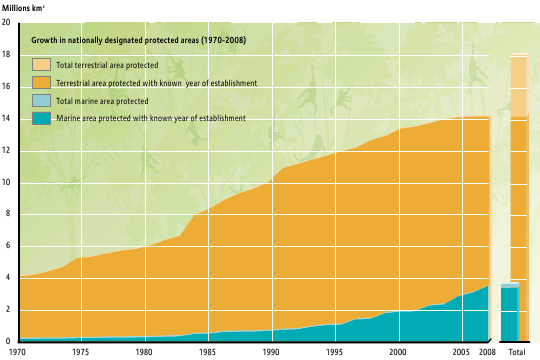
An example of the positive efforts has been the growth in protected areas in recent years, including more protected marine areas:
The extent of nationally designated protected areas, 1970 to 2008 has generally increased.
Source: UNEP-WCMC, graph compiled by Secretariat of the Convention on Biological Diversity (2010) Global Biodiversity Outlook 3, May 2010116, p.36
However, the level of protection in protected areas is mostly basic:
Despite more than 12 per cent of land now being covered by protected areas, nearly half (44%) of terrestrial eco-regions fall below 10 per cent protection, and many of the most critical sites for biodiversity lie outside protected areas. Of those protected areas where effectiveness of management has been assessed, 13% were judged to be clearly inadequate, while more than one fifth demonstrated sound management, and the remainder were classed as basic.
Secretariat of the Convention on Biological Diversity (2010), Global Biodiversity Outlook 3117, May, 2010, p.35
Although some dislike the thought of trying to put an economic value on biodiversity (some things are just priceless), there have been attempts to do so in order for people to understand the magnitude of the issue: how important the environment is to humanity and what costs and benefits there can be in doing (or not doing) something.
For example, In a recent report, The Economics of Ecosystems and Biodiversity for National and International Policy Makers 2009118, the UN-backed TEEB organization noted the following (p.18):
Implementing REDD (Reducing Emissions from Deforestation and Forest Degradation) could help
Halve deforestation by 2030, and
Cut emissions by 1.5 Gt of CO2 per year.
From a cost perspective (p.18), it is estimated that
It would cost from US$ 17.2 – 33 billion per year
The estimated benefit in reduced climate change is US$ 3.2 trillion
The above would be a good return on the initial investment. By contrast, waiting 10 more years could reduce the net benefit of halving deforestation by US$ 500 billion.
(The BBC119 puts that saving in a range, of $2 - 5 trillion, dwarfing costs of the banking crisis.)
Another BBC article notes that biodiversity is fundamental to economics120. For example,
The G8 nations, together with 5 major emerging economies — China, India, South Africa, Brazil, Mexico — use almost three-quarters of the Earth’s biocapacity
An estimated 40% of world trade is based on biological products or processes.
Regardless of what one thinks about trying to put a monetary value on parts of the environment, the above numbers add to the case that taking care of the environment is important. (This particular issue is explored a bit further on this site’s page on why biodiversity is important121.)
Why is it that these problems seem to be in developing countries? Don’t they know how to take care of their environment? That is what many ask in the industrialized nations. What people in the richer countries often fail to realize is that often their very own lending hand has been the one that takes most of what the environment has to offer, often in an unsustainable way. The debt that the poor countries are in has led to the stripping of resources in order to pay back what is owed. To learn more:
This web site’s look at Consumption and consumerism122 provides a deeper look at the enormous costs to society and to the environment by certain consumption habits. Given that the culture of consumption is so central to most societies today, it is often the system itself that is very wasteful.
This web site’s page on Debt and the Environment123 has more about the effects of debt on poverty and the environment.
this web site’s page on structural adjustment124 has more details of how debt has occurred and the structural adjustment policies that have led to governments stripping their environmental resources, reducing the cost of labor, exporting more to the industrialized countries, often without feeding their own people first, repaying more debt than spending on health or education, and so on.
We have seen a glimpse of how the environment is related to global policies that have caused poverty and how poverty can affect the environment. Slowly, projects are helping at the local level for people to take ownership of their environment and help foster a sustainable development cycle. However, globalization, in its current form may have additional effects on the environment too. To learn more about how trade and poverty in general are related, go to this web site’s section on Trade, Economy, & Related Issues125.
The Genetically Engineered Food126 section in this web site also discusses issues to do with patenting foods and seeds and introduces issues to do with the importance of agricultural diversity and other issues related to patents on genetic resources.
Priscila Néri, from the social justice organization, Witness, posts an informative video asking if environmental rights are human rights. The point made is that for many communities, the environment provides a means for them to live. Environmental degradation jeopardizes that and as such, threaten their human rights too; the two are interwoven:
Earth Day: Do Environmental Rights = Human Rights?127, The Hub, Witness, April 20, 2009
(See also this site’s section on human rights128.)
The variety of life on Earth, its biological diversity, is commonly referred to as biodiversity. The number of species of plants, animals, and microorganisms, the enormous diversity of genes in these species, the different ecosystems on the planet, such as deserts, rainforests and coral reefs are all part of a biologically diverse Earth. Appropriate conservation and sustainable development strategies attempt to recognize this as being integral to any approach. In some way or form, almost all cultures have recognized the importance of nature and its biological diversity for their societies and have therefore understood the need to maintain it. Yet, power, greed and politics have affected the precarious balance.
Environmental issues are also a major global issue. Humans depend on a sustainable and healthy environment, and yet we have damaged the environment in numerous ways. This section introduces other issues including biodiversity, climate change, animal and nature conservation, population, genetically modified food, sustainable development, and more.
Added notes about 19% of reptiles under threat of extinction and 100 million sharks being killed each year.
Added a couple of videos about measuring environmental costs to society
Added a some notes about the Census on Marine Life cataloging global marine biodiversity
Added additional notes based on the UN’s Global Biodiversity Outlook report
Added short note about activists worried over tree plantations replacing forests
Added short note about climate change and overfishing and amount of fish catch being used as feed for aquaculture
Added short video from IUCN and statistics on some biodiversity indicators
Added some notes on whaling and its impacts and a video looking at the link between human rights and environmental rights.
Added notes on declining amphibian species, on declining shark species and shark fin hunting and on declining ocean biodiversity, including images and a video
Added a note on declining species populations by about one-third in the last 30 years, and a new subsection on dwindling fish stocks and massive marine life extinction threatening fish industries, globally.
Added a small note from the Millennium Assessment that there has been an irreversible loss in diversity of life
Added information on the impact of global warming to ecosystems
 Global Issues



 The variety of life on Earth, its biological diversity, is commonly referred to as biodiversity. The number of species of plants, animals, and microorganisms, the enormous diversity of genes in these species, the different ecosystems on the planet, such as deserts, rainforests and coral reefs are all part of a biologically diverse Earth. Appropriate conservation and sustainable development strategies attempt to recognize this as being integral to any approach. In some way or form, almost all cultures have recognized the importance of nature and its biological diversity for their societies and have therefore understood the need to maintain it. Yet, power, greed and politics have affected the precarious balance.
 Environmental issues are also a major global issue. Humans depend on a sustainable and healthy environment, and yet we have damaged the environment in numerous ways. This section introduces other issues including biodiversity, climate change, animal and nature conservation, population, genetically modified food, sustainable development, and more.