Resilient People & Institutions: Ecuador’s Post-Earthquake Challenge
QUITO, Ecuador, Dec 08 (IPS) - No one is really prepared for an emergency until they've had to live through one. And the 16 April earthquake in Ecuador put us to the test.
With the drawdown in the humanitarian response phase that is providing relief to survivors and victims, the hustle and bustle is dying down. Remnants of the disaster can be seen everywhere, and an idea of what the near future will bring and people's resilience – their capacity to cope – is taking shape.
During tours of the affected areas, I saw that people have, to a greater or lesser extent, a natural conviction that pushes them to overcome the situation they are in. Shortly after a catastrophe hits, whether from the need to survive or from attempts to recover the normality that has been ripped from them, men and women begin to help each other out.
Disasters hit poor people the hardest. This is why it is crucial to work on recovery of livelihoods starting in the emergency response period. People who can manage to earn a living can overcome the psychological impact of adversity more quickly. This has been a key factor in the post-earthquake process in Ecuador.
The institutional structure is another element that affects how fast communities recover. Having a response system, with mechanisms to quickly and strategically identify needs, makes recovery efforts more effective.
Communities are more vulnerable if local authorities are absent and exercise less authority to ensure, among other things, compliance with building and land-use standards.
Nationally, strong institutions and clarity in carrying out specific roles have enabled timely and appropriate disaster relief to affected communities. This undoubtedly will influence how quickly the country will recover the human development gains and how well it will design mechanisms to alleviate poverty caused by the earthquake.
The third important element is coordination. The extent to which organizations and institutions contribute in an orderly and technical fashion to response and recovery efforts reflects directly on the effectiveness of relief efforts.
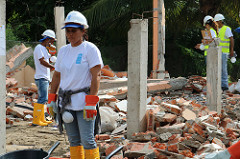
As a result of all these efforts, UNDP has helped 533 families to get their businesses financially back on their feet in Manta, Portoviejo and Calceta (Manabí Province), and 490 people—half of them women—obtained emergency jobs on demolition and debris removal projects under our Cash-for-Work programme. Through this initiative, some 20,000 m3 of debris has been removed.
Additionally, 300 rice farmers and their families benefited from the repair of an irrigation canal; 260 families will restart farming, fishing and tourism activities; and 160 shopkeepers will get their businesses up and running again with the support of economic recovery programmes.
With regard to construction, UNDP supported development of seven guides for the assessment and construction of structures, to build back better and incorporate disaster risk reduction into urban development plans. And in Riochico Parish (Manabí Province), UNDP trained 500 affected homeowners on the principles of earthquake-resistant construction.
Poor people who have been hit by an earthquake live on the edge, where one thing or another can lead them to either give up or to survive. Therefore, it is crucial for actions to be fast, but also well thought-out.
Resilience is something that permeates survivors and is passed down to future generations. Building resilience should be one of our main objectives and responsibilities as institutions in a country such as Ecuador, where we live with the constant threat of natural disasters.
© Inter Press Service (2016) — All Rights Reserved. Original source: Inter Press Service
Where next?
Browse related news topics:
Read the latest news stories:
- Resilience Is Not Enough: OCHA Sounds Alarm on Underfunded Humanitarian Crisis in Afghanistan Tuesday, August 11, 2026
- Saudi Arabia, Türkiye and Pakistan Forge Mutual Defence Pact, as Iran Pursues New Shipping Framework Tuesday, August 11, 2026
- The Earth Is Burning — And We Are Still Choosing to Let It Monday, August 10, 2026
- Living Longer at Age 80 Monday, August 10, 2026
- Asia’s Energy Progress Is Great, But Must Pick Up Pace Monday, August 10, 2026
- Where Some See Waste, Others See Opportunity: Young Sierra Leoneans Fight Against Electronic Waste, Plastic Pollution Monday, August 10, 2026
- INDIA: ‘The Cockroach Janta Party Brings Together Everyone Who Has Been Neglected for Years’ Monday, August 10, 2026
- Palestinian Children Deserve Education, not Ethnic Cleansing Monday, August 10, 2026
- Fighting deepens needs and fuels further displacement in Sudan Monday, August 10, 2026
- Lebanon: UN peacekeepers count hundreds of Israeli strikes and incursions in a single weekend Monday, August 10, 2026
Share this
Bookmark or share this with others using some popular social bookmarking web sites:
 Bluesky