

Putting humans at the centre: UN AI panel begins work on global impact study
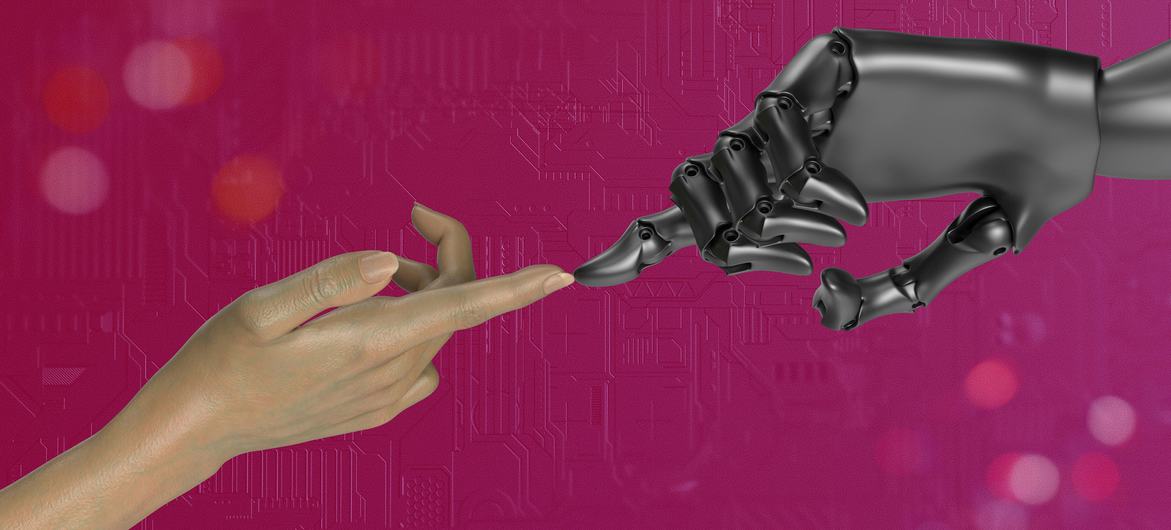
The UN’s Independent International Scientific Panel on AI – the first global body of its kind – is gearing up for its inaugural in-person summit.
Tasked with navigating the volatile intersection of innovation and ethics, this group of world-leading experts is launching a landmark study into the forces transforming modern life.
“We are not just focusing on AI as a mathematical or algorithmic field: we are also looking at ensuring that humans are central to decision-making,” says Menna El-Assady, an assistant professor at the Swiss Federal Institute of Technology (ETH) in Zurich.
Ms. El-Assady is one of the founding members of the UN’s independent panel on AI, recommended to serve by the UN Secretary-General.Independent International Scientific Panel on AI, the first global scientific body on Artificial Intelligence (AI), which brings together leading experts to assess how AI is transforming our lives.
An Egyptian national, she is one of 40 members, who were formally appointed by the General Assembly in February. They are from various different backgrounds – including academia, the private sector, civil society, government/international organisations, and the technical community – and have backgrounds in core technical AI expertise; applied AI, safety and infrastructure experience; and AI policy, ethics and impact.
Augmented Intelligence
“A human in the machine” is a phrase that is often used in relation to the use of AI. It refers to the idea that a human should always be involved in decisions made by AI tools.
“We are trying to work out when we need to rely on humans and their expertise, and when things can be automated,” she says. “We need to understand the link between AI and human models, what's known as the co-adaptation loop, and the evolution that occurs whenever humans receive new information, or when AI does.
At ETH Zurich, Ms. El-Assady has developed the concept of “augmented intelligence,” using AI to enhance human capabilities rather than replacing humans altogether, and building cooperation between AI and people in various fields.
This expertise is particularly useful for the work of the AI Panel, which is examining the ways that the use of AI is affecting different areas of society, such as the labour market and the health system.
Ms El-Assady is advocating for a “public digital infrastructure,” so that everyone who wants to develop AI has the resources they need.
“We also need to look at how to incorporate different cultures and languages within AI models so that they are not limited to a small number of countries,” she adds.
Trust, ethics and watermarks
The launch of the panel was a reflection of the growing concerns about the risks of unregulated AI, not least within the UN.
UN Secretary-General António Guterreswarned the Security Council in September 2025 that “humanity’s fate cannot be left to an algorithm,” whilst Volker Türk, the UN High Commissioner for Human Rights, said in February that AI developers building models without an understanding of fundamental social and ethical principles risk creating “Frankenstein’s monster.”
Ms. El-Assady agrees that ethics and trust are crucial to the sector, as is an awareness of the limitations of AI models.
One possible solution put forward by Ms. El-Assady is “AI watermarking”, which would make it clear whether or not content has been human-originated or AI-generated, and how to distinguish between them.
These are examples of the kinds of topics that could be included in the Scientific Panel’s first report, which is due to be released at the Global Dialogue on AI Governance, which takes place on 6–7 July in Geneva.
The Independent International Scientific Panel on AI
- The Independent International Scientific Panel on AI serves as the first global scientific body on Artificial Intelligence (AI), bringing together leading experts to assess how AI is transforming our lives.
- The Panel has been mandated to produce an annual report with evidence-based scientific assessments related to the opportunities, risks and impacts of artificial intelligence, which will be presented at the United Nations Global Dialogue on AI Governance.
- The Panel is not a regulatory body, and will not set rules, enforce standards or prescribe policy. It will provide the rigorous, evidence-based, policy-relevant but non-prescriptive analysis that informed decision-making requires.
- Find out more about the work of the Panel here.
© UN News (2026) — All Rights Reserved. Original source: UN News