

Climate Change Flexibility Mechanisms
Author and Page information
- This page: https://www.globalissues.org/article/232/flexibility-mechanisms.
- To print all information (e.g. expanded side notes, shows alternative links), use the print version:
Flexibility mechanisms were defined in the Kyoto Protocol (COP3) as different ways to achieve emissions reduction as part of the effort to address climate change issues. These have been highly controversial as they were mainly included on strong US insistence and to keep the US in the treaty. These fall into the following categories discussed below:
On this page:
Emissions Trading
Emissions Trading, or Carbon Trading as it is alternatively known, involves trading carbon emission credits within nations.
- Allowances turn emissions into a commodity that can be traded between industries.
- By starting with a limit which would gradually be reduced each year, the remainder emissions are then available to use, or trade if you do not use them yourself.
- As limits are reduced each year companies have to find ways to reduce their emissions, through innovation and change or trade.
Supporters say that this mechanism will bring in private corporations by putting a price on carbon, creating market pressures driving for efficiency, innovation and the best results.
The Kyoto Protocol says that it is ok to trade in emissions, but that it should not be the major means to achieve one’s commitments.
Some European countries and corporations have started implementing such programs to get a head start and to see how well it will work, while in Chicago, USA, a green house gas emissions trading market is emerging. Chicago and Mexico City are, for example, joining the carbon trading initiative.
The proponents of carbon trading believe that such markets can be useful in gaining experience and developing standard framework for monitoring emissions. It can also help in discovering the price of reducing GHGs [greenhouse gases]. But opponents feel that stress should be on undertaking real reductions by cutting fossil fuel use causing GHG emissions rather than on purchasing the right to pollute by buying emission allowances.
Critics argue that it will be easier to buy credits than to reduce emissions hence it won’t really work and will just be a license to pollute.
Because of the collapse of the former Soviet Union, the emissions from the countries of the former Soviet Union is much reduced, but under the Kyoto agreements, they can emit up to their 1990 limits. In essence then, trading at 1990 limits could lead to more emissions, as summarized by the following:
[I]n the period up to 2012,
hot-airtrading could actually lead to an increase in global emissions. Under the Kyoto Protocol, Russia and the Ukraine secured the right to stabilise their emissions at 1990 levels by 2012. Since their economies collapsed after 1990, Russia and the Ukraine’s emissions are currently far below 1990 levels. On paper, these two countries will thus be allowed to increase their emissions by 50% and 120% respectively by 2012. However, their industries will not conceivably be able to grow this fast. Instead, they will be able to sell much of that entitlement to other countries. The United States has already made clear its intention to purchase thishot airin order to achieve a substantial proportion of its reduction requirement.
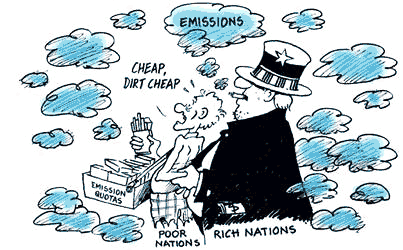
Most of the above was written over a decade ago, around 2001 or earlier when carbon trading was initially being discussed. Around a decade later, it is still quite a topic, in the US in particular. Annie Leonard, known for her web video, The Story of Stuff provides a video summarizing a number of concerns about cap and trade
:
The above video was created in the lead up to the Copenhagen climate summit, December 2009. It was a summit that promised a lot (but didn’t deliver much in the end). Also during that summit, Democracy Now! interviewed an author on the subject and an economist working in this area. One of the points, amongst many, was that carbon trading may have its place but it should not be seen as the only solution, and as Annie Leonard’s video also suggests, other dimensions, such as massive investment away from fossil fuels (cap and trade appears to prolong it) is missing.
In addition, because it is hard to verify certain aspects, it is not easy to be sure there isn’t corruption in the process. On paper, the scheme seems sensible if it is not gamed. There is also the fear that the big financial giants are interested in this market to speculate on — as they now find it harder to speculate on the tech industry as they did around 2000 or the housing market that helped create the global financial crisis.
Joint Implementation
Joint Implementation (also known as Activities Implemented Jointly) is where developed countries invest in emission-reducing activities in other industrialized countries, and gaining reduction units as a result.
Clean Development Mechanism
The Clean Development Mechanism (CDM) is similar to the joint implementation, but where developed countries invest in Southern, or developing countries. It is aimed to be a part of a program of sustainable development.
For some developing countries, this is important because of the possible attraction of foreign investment.
However, there have been many concerns:
- Critics argue that rich countries can avoid responsibilities at home and that it will actually increase emissions because the credits earned will allow rich countries to emit more, while developing countries are not tied to reduction at this stage (because it is unfair to penalize them for what is internationally recognized as largely something caused by the rich countries. See the Climate Justice and Equity section for more about this aspect.)
- It is also criticized that instead of important technology transfer to developing countries (so that they are empowered to develop and produce themselves), the free-trade mechanisms will instead lead to further dependency (and, ironically, on the very multinational corporations that are criticized for being the heaviest polluters.)
- By treating emissions as commodities, the structural inequity we see between North and South in commodity trading in general is feared to continue.
- In essence then, this is criticized for allowing the rich countries to continue using and burning fossil fuel while paying the third world not to.
- Additionally, as Centre for Science and Environment (CSE) points out, the rich get to use the poor countries’ land to tackle their own emissions issues, not to help the poor, while not actually concentrating on reducing emissions. The Corporate Europe Observatory also has concerns in this area:
Many corporate ventures that might become eligible for emissions credits — nuclear power plants, so-called
clean coal
plants as well as industrial agriculture and large-scale tree plantations (including genetically engineered varieties) — have extremely serious negative social and environmental impacts. Investments incarbon sinks
(such as large-scale tree plantations) in the South would result in land being used at the expense of local people, accelerate deforestation, deplete water resources and increase poverty. Entitling the North to buy cheap emission credits from the South, through projects of an often exploitative nature, constitutescarbon colonialism
. Industrialised countries and their corporations will harvest thelow-hanging fruit
(the cheapest credits), saddling Southern countries with only expensive options for any future reduction commitments they might be required to make.Saving
the Kyoto Protocol Means Ending the Market Mania, Corporate Europe Observatory, July 2001 - It is also controversial because many questions were raised for the Hague conference. For example:
- Limits have not been agreed to (or it has not even been agreed if there should be limits.)
- It is not clear what the range of activities are that can be included. Nuclear energy, hydropower, renewable energy only are some of the uncertainties.
- Public participation and monitoring is paramount.
- Will a form of energy tax work?
- Accountability and verifiability of emissions and credits etc is very difficult as stocks and flows of emissions are hard to quantify.
- Futhermore, as the Corporate Europe Observatory points out, the trade in emissions resulting in carbon credits would lead to
unequal property rights to the atmosphere
which in turnwould consolidate the historic overuse by Northern industry at the expense of the South (80% of all CO2 emitted since 1850 has come from the North). A market without clearly defined property rights can never function and the unfair property rights that underlie the currently proposed emissions markets will eventually be rejected by those losing out.
- As CSE further point out to the lead up to the COP8 meeting in October 2002, CDM is still an issue:
Strong rules for permanence, additionality, leakage, assessing the impact on the local population and measures to reduce uncertainty need to be applied otherwise CDM would just end up being a cheap way for industrialised countries to meet their targets without making any changes domestically.
What’s Up for Discussion at CoP-8?, CSE Briefing Note, October 25, 2002 (link is to a PDF-formatted article.)
Three years after writing the above, it seems a number of those concerns are becoming reality. CSE, in their publication Down To Earth, reports how a few major companies in India are implementing CDM projects, and using advice from some of the world’s largest consultancy companies, such as Ernest & Young, and PricewaterhouseCoopers.
However, the way in which these projects have been designed, set up, and run is highlighting many problems in the CDM implementation. Summarizing from Down To Earth:
- Private companies have dominated the field in a way that has reduced public participation. For example:
- Private companies have hired private consultancy firms to create the projects and deals;
- There is a lot of secrecy in how much the company sells its earned carbon credits;
- There is very little public accountability, verification, and transparency.
An imperative to mitigate climate change using the market as an instrument, has reduced itself to using the worst tools of an unfair market. For instance, it thrives on non-transparency so that future sellers do not know the price of CERs and are forced to sell cheaply in the face of competition.
(Emphasis added) - Investigations from Down To Earth revealed that some of these big name consultancy companies had copied text from one project document to another, spelling mistakes and all, and was done in such a way as to suggest that some tasks had not actually been done even though it was reported as so;
- Commoditization, as feared, is occurring. As was noted in a side note that accompanied the main article:
Within the European Union, carbon is traded at US $26.7 per tonne of carbon dioxide equivalent. However, outside Europe CERs are being traded for a pittance. The only advertised price is by the World Bank, which pays about US$ 5. Other deals are being made in the range of US $5-10. It isn’t clear why this price difference exists.… CER are sold in deals where prices are not revealed, so a fair price is difficult to arrive at.
This is the old commodities problem again,
says Mukul Sanwal, special advisor, UNFCCC, referring to the situation where commodities like coffee are sold at subsistence levels in developing countries, yet earn huge windfalls for companies in the developed world. Clearly, non-transparency makes for an unfair market in the interest of the rich buyer.Ritu Gupta, Shams Kazi and Julian Cheatle, Acting pricey; Why is a tonne of tradable carbon worth US $5 in India and US $27 in Europe?, A side note to the main article, Newest Biggest Deal, Down To Earth Magazine, November 15, 2005 Issue - Promises of sustainable development, helping local communities, and consulting with them has not happened.
- In some cases, local communities have been promised jobs from new factories and chemical cleanup plants being opened up as part of the CDM initiative, but in the end those jobs are never given to them;
- In other cases, those plants end up damaging nearby ecosystems, pollute waters, destroy forests, or damage crops in nearby fields;
- Locals are not seeing this as a
clean
development mechanism;
More generally, CSE charges that the whole process has become convoluted
to ensure that
each project is additional, so that only that project which would not have happened without CDM can qualify. This simply means whatever a government does to mitigate climate change — as a matter of policy — cannot qualify as CDM work. For instance, if the Indian government specifies tough emission norms for buses, the public transport sector does not get credits under CDM. The argument is: isn’t that something they were mandated to do? If a country has standards for tighter emissions on all electric appliances, resulting in huge efficiency gains and lesser emissions, it cannot apply for CDM. These projects will not be seen as additional, but
business as usual. The current design provides countries with perverse incentives to keep polluting as long as they have the money to pick up carbon credits. In this respect, is not CDM actually against sustainable development?In all this, the basic criterion — CDM must
assistdeveloping countries for sustainable development — has got lost. Poor countries, with financially-strapped governments, are forced into a mindless competition to facilitate the selling of credits, cheaply and as fast as possible. Woe betide a government if it interferes or makes regulations. The drive forcheapreduction is reflected in the kind of projects currently registered or under validation. Wind energy projects constitute 7 per cent of all projects; they bring less than 3 per cent of cers being considered for sale. There are no afforestation projects on the anvil. No high-end energy efficiency projects, no urban public transportation projects.
The Clean Development Mechanism is thus far, Down To Earth feels, a Cheap and Corrupt Development Mechanism.
The Bretton Woods Project also reports how UN documents showed rule-breaking and possible fraud from CDM projects, faults with up to 20 per cent of the carbon credits already sold, and gross incompetence from three out of the 17 specialist companies that validate and verify the projects.
The Project also criticizes the World Bank, which plays a key role in the CDM process and has promoted it for Africa. Yet one of the Bank’s own report, the Project notes, has not helped Africa:
Africa accounted for just three per cent of certified emission reduction permit sales last year, with the majority going to China and India. The Bank recognized that the CDM lacks a facility through which developing countries with
obvious energy needs can be rewarded for clean development.Most African countries’ emissions are too low for them to qualify to earn credits for carbon reductions.
The Project also notes an Oxfam study finds that the World Bank has grossly underestimated the cost of dealing with climate change for developing countries, because they mostly count macro factors, not more local factors and local costs. (The World Bank’s widely cited figure is between $10 and $40 billion dollars. Oxfam’s study says it is at least $50 billion.)
In another report by Down To Earth, CDMs are criticized for thriving on non-transparency, conflict of interests and is beyond regulation:
It is for this reason that the South offers huge business possibilities. The CDM market here has already been taken over by large companies, global consultants, traders and brokers. In this market, CDM has become a mere financial mechanism — not a measure to combat climate change. As a result, its outcome has been small and cheap. Small, because it has failed to move the world towards tangible solution for climate change like clean energy and public transport, and cheap because the focus is to provide cheapest possible CERS (certified emission reductions) to the developed world, and not make the transition to clean energy necessary.
The low-hanging fruit, the easy things are usually done by CDMs they argue:
There are two problems with this cheap reduction approach: one, it does little to move the world towards cleaner energy. In fact, it subsidizes the fossil fuel energy in the developing world.
Two, it takes away the cheap and easy options for emerging south countries and credits them into the carbon balance sheet of the industrialized world. This means that the South will be shortchanged when it has to take on legally binding commitments—it would have
soldoff by then its cheap options and would not have the money left to invest in the more high-end of transition options.
The previous link, as well as an earlier Down To Earth article quoted further above note that because CDM projects are only considered if they are additional
to business-as-usual projects, many projects lack the funding they need. Inter Press Service reported an example of this when noting that, a hugely successful solar energy project in India that helps poor people get electricity has not seen any benefits from the CDM.
The poor should be able to get more benefits from things like CDM if used in projects such as sustainable development, to preserve or improve forests, etc. However, as Inter Press Service notes, the rural poor are often likely to miss out because of various problems such as the complexity and cost of participating in CDM, weak or non-existent land rights, the aggressive push for mechanisms that favor market mechanism benefactors such as the larger, more influential companies, etc.
The other complexity with forestation projects is their ability to not only soak up carbon, but also emit it when forests burn or are cleared for agricultural purposes. That’s why the UN has not always counted Land Use, Land Use Change and Forestation
(LULUCF) into some of its measures and targets.
The UNFCC fears that LULUCF emission reductions are not reliable or a good indicator because the main drawback of LULUCF activities is their potential reversibility and non-permanence of carbon stocks as a result of human activities, (with the release of GHG into the atmosphere), disturbances (e.g. forest fires or disease), or environmental change, including climate change.
In a recent UN climate change conference, African nations pushed to get the Clean Development Mechanism to include afforestation, reforestation, agro-forestry, re-vegetation of degraded lands, reduced soil tillage and sustainable agricultural practices. This was opposed by environmental groups and others for reasons similar to that above.
However, an African representative argued that if you have standing forests and people make a commitment that they are not going to cut these trees: why don’t you reward them? Why do you only want to reward them for planting trees? If you reward them for [conserving existing forest] in the trading mechanisms, then they are able to generate incomes to have alternative energy sources.
The representative was also aware of concerns that reforestation would mean commercialization of forests and indigenous people being marginalized, but he wanted to stress that their initiative would put them at the center.
Traditionally it has been difficult to truly measure reductions from the broad range of activities being considered, and whether it can empower or marginalize the rural poor is hard to tell. If sustainable development and empowerment of local communities really is central, then this proposal could empower them while conserving forests, but it is hard to know for sure. This time round African nations were unsuccessful in getting this considered, but they and some other developing countries may push for this in future meetings.
Kevin Smith, from the Transnational Institute, echoes arguments from earlier above, that CDM is fundamentally flawed, allowing companies from rich countries to benefit at the expense of the poor, and also at times resulting in projects where local communities have not been consulted, and sometimes faced with the loss of their lands and livelihoods.
So should CDMs be scrapped or reformed?
Lambert Schneider, an expert with Germany’s Institute for Applied Ecology, was interviewed by IPS (Inter Press Service) and answered that CDM’s ability to make money for participants isn’t the problem (by making money the carbon market tells decision-makers: reducing emissions in this way saves costs
Schneider notes).
Instead, it is that the CDM is a zero sum game
: For each tonne of gas eliminated in a developing country, one more tonne can be emitted in an industrialized country.
So reform may involve the following, according to Schneider:
- Go beyond mere compensation. For example, for two tonnes of reductions of emissions in one developing country, an industrialised country should only be allowed to increase emissions by one tonne. That way there would be a clear atmospheric benefit;
- Improve rules to evaluate which projects should be approved;
- Strengthen incentives so that the certifiers evaluate the projects in detail. That can be obtained, Schneider suggests, if the UN pays evaluators’ salaries, rather than the entities that receive the carbon credits.
In the long term, however, Schneider feels the CDM should be replaced by emissions trading schemes that function in the most advanced developing countries.
Author and Page Information
- Created:
- Last updated: