

Free Trade and Globalization
Author and Page information
- This page: https://www.globalissues.org/issue/38/free-trade-and-globalization.
- To print all information (e.g. expanded side notes, shows alternative links), use the print version:
It is yet another Civilized Power, with its banner of the Prince of Peace in one hand and its loot-basket and its butcher-knife in the other.
For globalism to work, America can’t be afraid to act like the almighty superpower that it is.…The hidden hand of the market will never work without a hidden fist—McDonald’s cannot flourish without McDonnell Douglas, the designer of the F-15. And the hidden fist that keeps the world safe for Silicon Valley’s technologies is called the United States Army, Air Force, Navy and Marine Corps.
The world is becoming more globalized, there is no doubt about that. While that sounds promising, the current form of globalization, neoliberalism, free trade and open markets are coming under much criticism. The interests of powerful nations and corporations are shaping the terms of world trade. In democratic countries, they are shaping and affecting the ability of elected leaders to make decisions in the interests of their people. Elsewhere they are promoting narrow political discourse and even supporting dictatorships and the stability
that it brings for their interests. This is to the detriment of most people in the world, while increasingly fewer people in proportion are prospering.
The western mainstream media, hardly provides much debate, gladly allowing this economic liberalism (a largely, but not only, politically conservative stance) to be confused with the term political liberalism (to do with progressive and liberal social political issues). Margaret Thatcher's slogan of there is no alternative
rings sharply. Perhaps there is no alternative for such prosperity for a few, but what about a more equitable and sustainable development for all?
14 articles on “Free Trade and Globalization” and 2 related issues:
Global Financial Crisis
 Following a period of economic boom, a financial bubble — global in scope — burst, even causing some of the world’s largest financial institutions have collapsed. With the resulting recession, many governments of the wealthiest nations in the world have resorted to extensive bail-out and rescue packages for the remaining large banks and financial institutions while imposing harsh austerity measures on themselves.
Some of the bail-outs have also led to charges of hypocrisy due to the apparent socializing of the costs while privatizing the profits.
Furthermore, the institutions being rescued are typically the ones got the world into this trouble in the first place. For smaller businesses and poorer people, such options for bail out and rescue are rarely available when they find themselves in crisis.
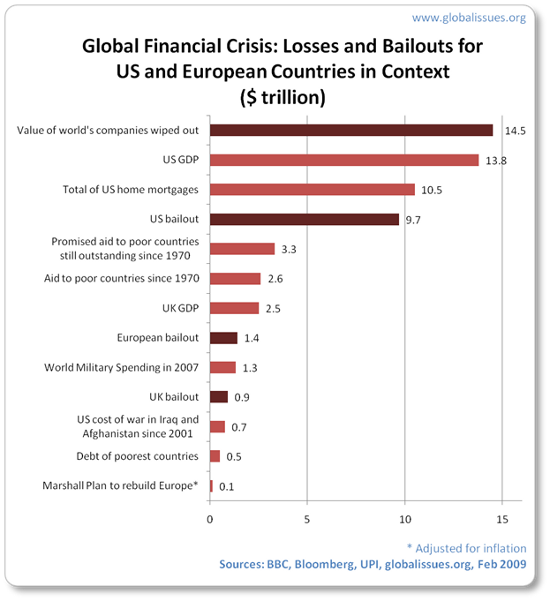
Plummeting stock markets at one point wiped out 33% of the value of companies, $14.5 trillion. Taxpayers bailed out their banks and financial institutions with large amounts of money. US taxpayers alone have spent some $9.7 trillion in bailout packages and plans. The UK and other European countries have also spent some $2 trillion on rescues and bailout packages. More is expected. Much more.
Such numbers, made quickly available, are enough to wipe many individual’s mortgages, or clear out third world debt many times over. Even the high military spending figures are dwarfed by the bailout plans to date.
This problem could have been averted (in theory) as people had been pointing to these issues for decades. However, during boom, very few want to hear such pessimism. Does this crisis spell an end to the careless forms of banking and finance and will it herald a better economic age, or are we just doomed to keep forgetting history and repeat these mistakes in the future? Signs are not encouraging as rich nations are resisting meaningful reform…
Read “Global Financial Crisis” to learn more.
A Primer on Neoliberalism
Global trading that allows all nations to prosper and develop fairly and equitably is probably what most people would like to see. Neoliberalism is touted as the mechanism for this. Margaret Thatcher's TINA acronym suggested that There Is No Alternative. But what is neoliberalism, anyway?
Read “A Primer on Neoliberalism” to learn more.
Criticisms of Current Forms of Free Trade
While internationalism and equitable global trading allowing fair development is probably what most people would like to see, the current model of corporate-led free trade and its version of globalization that has resulted, has come under criticism by many, many NGOs, developing nation governments and ordinary citizens.
Read “Criticisms of Current Forms of Free Trade” to learn more.
The WTO and Free Trade
The World Trade Organization, (WTO), is the primary international body to help promote free trade, by drawing up the rules of international trade. However, it has been mired in controversy and seen to be hijacked by rich country interests, thus worsening the lot of the poor, and inviting protest and intense criticism.
Read “The WTO and Free Trade” to learn more.
WTO Doha “Development” Trade Round Collapse, 2006
Supposed to be a Development
round of trade talks, the almost five year-long Doha round collapsed at the end of July, 2006. The US found itself on the defensive as around the world blame was directed at the US, in particular by the EU. However, the EU has also been part of the reason for failure throughout the five years. This article looks at what happened at the end of 2006, and also introduces a collection of articles that were written at the time of each previous major WTO meetings from the initial Doha round in 2001 and since.
Read “WTO Doha “Development” Trade Round Collapse, 2006” to learn more.
Deregulation or Protectionism?
Protectionism is often referred to as being a barrier to free trade. The word seems to conjure up negative images of isolationism and subsidizing industries that could otherwise not compete fairly against others. (This can help indicate why some industries would strongly support protectionism for themselves.) Complete deregulation allows corporations to benefit but at the possible expense of people in that nation or region if that deregulation means relaxation of environmental rules, health and educational services including control of natural resources and energy. (This hints at the powerful lure that the "freeing" of trade and liberalization of access to resources from regulation has to some proponents.) Neither seems to answer the notion of fairness, though. Often those nations that promote free trade for all, want protectionism for themselves.
Read “Deregulation or Protectionism?” to learn more.
Some Regional Free Trade Agreements
There have been numerous regional free trade agreements. Some have been controversial, while others may be beneficial. Examples include the North American Free Trade Agreement (NAFTA), the Free Trade Area of the Americas (FTAA), US attempts at free trade agreements with African nations and so on. Critics argue that when these agreements include partners that have different levels of development, this will lead to unequal trade and favor the wealthier partners to the detriment of the poorer ones.
Read “Some Regional Free Trade Agreements” to learn more.
The Mainstream Media and Free Trade
The mainstream media has been flooded by free trade proponents and heavily backed by those that will profit from it the most. This makes public debate more difficult.
Read “The Mainstream Media and Free Trade” to learn more.
Public Protests Around The World
 The global financial crisis has spawned a global protest movement campaigning against things like inequality, corporate greed, lack of jobs, etc.
Although these protests have occurred for decades, they have typically been in the developing countries, or about the situation in developing countries.
As such, many Western nations, who have strongly influenced the conditions in developing countries, have typically not paid much attention to such protests, no matter how large (even the famous Battle for Seattle
was more about violence than the underlying issues, for example). However, this time, the global financial crisis has hit the ordinary citizens of Western nations quite hard, and inspired by the Arab Spring and protests in Spain, a global movement seems to have sprung up.
Read “Public Protests Around The World” to learn more.
WTO Protests in Seattle, 1999
At the end of November 1999, Seattle saw major governments meet at a WTO ministerial meeting to discuss various trading rules. Seattle also saw free speech cracked down on in the name of free trade. Enormous public protests ensued. There were many differences in the perspectives of developing and industrialized nations on the current reality of free trade and how it affected them. It resulted in a WTO failure to agree on many issues, without adopting any resolutions. Developing countries were sidelined and one delegate even physically barred from a meeting.
Read “WTO Protests in Seattle, 1999” to learn more.
General Agreement on Trade in Services
A similar agreement to the derailed Multilateral Agreement on Investment (MAI), the General Agreement on Trade in Services (GATS) at the WTO has a potentially wide ramification for the poor and developing countries.
Read “General Agreement on Trade in Services” to learn more.
Multilateral Agreement on Investment
We had a potential nightmare in the form of the Multilateral Agreement on Investment (MAI). An almost secret agreement about investment rights and opening up nations for freer trade. However many, many people feared that this would be accompanied by grave social and environmental consequences, due to the wording of the MAI text.
Read “Multilateral Agreement on Investment” to learn more.
Poverty Links for More Information
Links to other sites discussion issues on trade, the global economy, poverty and other related issues.
Read “Poverty Links for More Information” to learn more.
Trade, Economic Links For More Information
Read “Trade, Economic Links For More Information” to learn more.
Trade, Economy, & Related Issues
Read “Trade, Economy, & Related Issues” to learn more.
Corporations
Read “Corporations” to learn more.
Author and Page Information
- Created:
- Last updated: