The Virtual Doctor Will See You Now
CHILANGA, Zambia, Jan 09 (IPS) - There are thousands of miles between Chanyanya Rural Health Clinic, a basic medical centre in Zambia's rural Kafue District with no resident doctors despite being the main centre for nearly 12,000 people, and the New York University (NYU) Teaching Hospital, one of the world's most prestigious medical schools.
The two are worlds apart, not only when it comes to geography.
Yet when Florence* broke out in a strange rash two weeks after she began taking ARVs for HIV in 2011, the clinic, about 90 minutes from the capital Lusaka, was able to connect to a NYU infectious diseases expert on the other side of the world with just a few clicks of a computer mouse.
Through the Virtual Doctor Project (VDP), a telemedicine initiative being pioneered in Zambia linking rural clinics across the southern African country with volunteer doctors around the globe using the local broadband network, Florence was prescribed the correct medication.
Her rash had been "all over the body", recalled Kebby Mulongo, the clinical officer who first saw her.
"It was just about two days in between the doctor was able to get back to me. The expert in New York knew what the problem was ASAP," Mulongo, 30, told IPS.
"And that's what I was happy about, because after that I kept on treating the patient in the ward. Within a week or so the patient improved instead of me sending the patient to the hospital."
A smiling Mulongo added: "Medicine is about consultation. If we can consult at the click of a button like that, it's better for us."
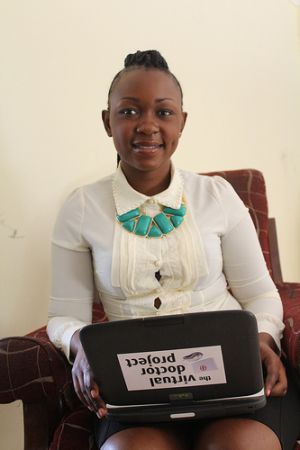
The VDP, now running live in six Zambian sites, use eHealth Opinion software to submit patient files electronically. Clinical officers, trained to screen patients before they see a doctor, access this using Fizzbook laptops. The dust-proof, splash-proof, robust laptops can be easily transported and a battery backup means they can withstand Zambia's power cuts.
The software allows the clinical officers to build a patient file which is compressed and sent to one of the VDP's medical experts in Zambia, the UK, U.S., India, Pakistan, China, Nigeria, New Zealand or Malaysia. The file includes the patient's basic details, medical history, prescription and the specific questions the Zambian clinical officers need answered.
All clinical officers are given a basic Samsung HD camera with which they can take photos of X-rays. These can be uploaded to the computer and included in the patient file along with lab reports. The "virtual doctor" then reviews the information they've received and offers diagnostic and treatment advice with another click of a button.
Operational in Zambia for six months, the VDP, set up by an eponymous charity, are due to go live at three more sites this month. They hope to have at least 12 sites live by the end of the year. They're also looking at expanding into Tanzania in the near future, along with other African countries.
Just before Christmas four new clinical officers were trained in Zambia's new Chilanga District.
"Effectively it's a platform for you to be able to talk to somebody else about a patient that maybe you're not too sure on. The idea is not to take any responsibility for ownership away from you," project co-ordinator Heather Ashcroft told the trainees.
"You still are and you remain the first port of call, you have the final say on how you diagnose or treat a patient. The idea behind the system is that you get a bit of a sounding board."
Mercy Nalwamba, 22, was one of two female clinical officers who attended the Dec. 23 training session. A recent graduate of Chianama College of health sciences, she is now the clinical officer general of Makeni clinic in Chilanga District and sees about 50 patients daily, the majority of them suffering from respiratory tract infection, diarrhoea and malaria.
Nalwamba said having access to the VDP experts at Makeni would mean the clinic would have to make less referrals to other centres further away for nonemergency cases, the project's main aim. But she told IPS, "I can't wait to hear their opinions and new ideas. It will enhance my work, I'll gain more experience and knowledge.
"I think there will be less work and we'll be getting more information on how to go about (treating) chronically ill patients, how to manage them and when we're referring them we can at least make the patients a little bit stable."
Ashcroft says the Memorandum of Understanding (MOU) signed with Zambia's Ministry of Health (MoH) states that VDP will provide the equipment, training and software for free for the first 12 months, giving the system time to "bed in and have a positive impact on the clinic's referral rates". The government is supporting them in motivating and encouraging health staff to use it.
"Following this, we will continue to support the clinical officers, however, a small surcharge will be made to ensure that the system can be upgraded and maintained in the health centres," Ashcroft told IPS. "All equipment, and licenses for donations is provided by charitable donations, so our aim is to equip the clinics with everything they need for the service to become a self-sustaining, yet integral part of the day-to-day running of the health centres." The charity is one of the increasing number of NGOs accepting Bitcoin donations.
Andrew Phiri from the MoH is confident the government will be able to support VDP after its first year, stressing it's a much-needed project.
"We've got a lot of people living in rural areas, they have to walk long distances (to clinics). We don't have a lot of ambulances. You find that our health facilities are not closely linked, they are huge distances apart," Phiri told IPS.
"Through consultation you are going to give the best quality of care that the patient requires. It will be a very good outcome because, really, in medicine you need to consult, you cannot work alone."
© Inter Press Service (2014) — All Rights Reserved. Original source: Inter Press Service
Where next?
Browse related news topics:
Read the latest news stories:
- Africa Has the Technology to Achieve Food Security—Now It Needs Coordinated Deployment Tuesday, September 22, 2026
- Family Law Reforms Are Needed to Advance Gender Equality Tuesday, September 22, 2026
- United Nations Least Developed Country Category – Curse or Boon? Monday, September 21, 2026
- UN condemns attempted Houthi strike on Riyadh as Yemen displacement surges past 130,000 Monday, September 21, 2026
- ‘Nowhere is safe’: UN experts detail Ukraine war’s toll and Russia’s reach beyond its borders Monday, September 21, 2026
- ‘We are not powerless’: UN chief urges world leaders to invest in peace Monday, September 21, 2026
- Why climate action now comes down to speed, finance and cooperation Monday, September 21, 2026
- Ebola vaccine trial begins in DR Congo Monday, September 21, 2026
- UN panel calls for stronger safeguards as AI agents advance Monday, September 21, 2026
- Sudan: Blood on Foreign Powers’ Hands Monday, September 21, 2026
Share this
Bookmark or share this with others using some popular social bookmarking web sites:
 Bluesky