 Global Issues
COP19—Warsaw Climate Conference
Author and Page information
- This page: https://www.globalissues.org/article/803/cop19-warsaw-climate-conference.
- To print all information (e.g. expanded side notes, shows alternative links), use the print version:
On this page:
Introduction
November 11 – 23, 2013, Warsaw, Poland was the venue for the 19th annual United Nations Climate Change Conference, also known as the 19th Conference of the Parties — or COP 19.
The purpose of this conference was to create a loss and damage pillar of a new climate treaty to be finalized in 2015. The other two pillars discussed in previous meetings are mitigation (emission reductions) and adaptation pillars.
Meeting outcome
The main outcome of the meeting was the establishment of an international mechanism for a loss and damage associated with climate change impacts .
Predictably, the loss and damage aspect of climate negotiations brought out the worst in some countries. Some developing countries were going to resist the idea of financing adaptation to climate change, while others appeared to hate the idea of climate reparations for poor countries. A few years earlier, industrialized nations had made a legal commitment to a global climate fund. Unsurprisingly, not much came of it, as Inter Press Service summarized,
In 2009 at the semi-infamous Copenhagen talks, the rich countries made a deal with developing countries, saying in effect:
We’ll give you billions of dollars for adaptation, ramping up to 100 billion dollars a year by 2020, in exchange for our mitigation amounting to small CO2 cuts instead of making the big cuts that we should do.The money to help poor countries adapt flowed for the first three years but has largely dried up. Warsaw was supposed to be the
Finance COPto bring the promised money. That didn't happen.Countries like Germany, Switzerland and others in Europe only managed to scrape together promises of 110 million dollars into the Green Climate Fund. Developing countries wanted a guarantee of 70 billion a year by 2016 but were blocked by the U.S., Canada, Australia, Japan and others.
It got to the point that hundreds of representatives from various NGOs walked out of the negotiating rooms to protest against developed countries’ reluctance to commit to a loss and damage mechanism. And this was a day after the G77+China group of 133 developing countries walked out of negotiations over the same thing.
Looking through the briefing reports from the respected NGO, the Third World Network, It seems that on the surface, while an outcome was eventually thrashed out, there are many areas of weakness of sufficient vagueness to satisfy everyone that contentious issues that are seemingly resolved can still be challenged and changed in the future.
In context: common but differentiated responsibilities
Many years ago all nations agreed that climate change was largely the result of actions from today’s industrialized nations, as carbon dioxide — the main greenhouse gas — stays in the atmosphere for decades. Yet, the poorest would end up suffering the most for a problem they largely did not cause. The approaches to mitigation (emissions reduction) would therefore be different for those groups of countries — the common but differentiated responsibilities principle.
It is in this context that the discussion for loss and damage has come about. And it is something that rich countries are keen to get rid of .
The years of resistance on this issue (and many others) means each time it is discussed again the reactions seem to get even more hostile. Combined with the lack of detailed context in the mainstream media coverage of this aspect, it then becomes easier each time to see culprits as China and India given their enormous greenhouse emissions in recent years, compared to the far greater amount by the industrialized nations over the longer period. See this site’s section on climate justice for more detailed background.
In context: Typhoon Haiyan
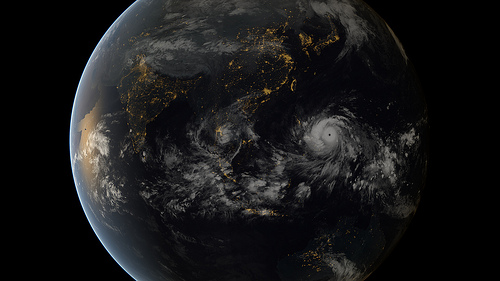
The meeting came at the time when the devastating Typhoon Haiyan had just killed thousands in the Philippines and affected millions more. It was an ominous warning of what could be more frequent as climate change continues to take hold.
It was also an example of how poorer nations could be affected by a problem they have largely not been responsible for and that while all the international outpouring of aid and assistance was incredibly welcome, that support for preventing and adapting to such events is paramount and efforts are urgently needed to curb emission increases.
In an emotional speech the Philippines lead negotiator for the conference, Naderev Saño, received a standing ovation for announcing that he will go on a hunger strike until a meaningful outcome is in sight.
Lack of urgency
Inter Press Service (IPS) noted the seeming lack of urgency given the years and years of delay and watering down of meaningful action:
To have a good chance at staying under two degrees C, industrialised countries need to crash their CO2 emissions 10 percent per year starting in 2014, said Kevin Anderson of the Tyndall Centre for Climate Change Research at the University of Manchester.
We can still do two C but not the way we're going,Anderson said on the sidelines of COP 19 in Warsaw. He wondered why negotiators on the inside are not reacting to the reality that it is too late for incremental changes.
I’m really stunned there is no sense of urgency here,he told IPS.
More information
As the conference is still underway as this page is written, more information will be added here after the event is over.
For more about the issues from other organizations, here are some starting points:
News stories from IPS
Below is a list of stories from Inter Press Service related to the Warsaw climate conference and its aftermath.
When Frontline Communities Lead: Lessons From Five Years of Just Climate Action
- Inter Press Service

Efforts to combat climate change too often sideline the very communities hit hardest by the crisis and who have contributed the least to it. This injustice was the core idea of the Voices for Just Climate Action (VCA) program. Now that VCA has concluded after five years, Job Muriithi and Winny Nyanwira from Hivos reflect on its achievements and share recommendations for governments and donors to ensure fair and equitable climate action.
Venezuela Needs More Local Data To Understand the Impacts of Climate Change
- Inter Press Service

CARACAS, December 15 (IPS) - A group of 55 researchers gathered and analyzed 1,260 bibliographic references to compile the Second Academic Report on Climate Change in Venezuela. Their final conclusion is that more local studies are still needed to record the direct impacts across different Venezuelan regions and, in particular, to provide data to design the adaptation plans necessary to address climate change.
Five climate trailblazers: UNEP’S 2025 Champions of the Earth
- UN News

Global temperatures rises are projected to surpass 1.5°C (2.7°F) within the next decade, underscoring the urgency of the climate crisis.
Fresh Lens For Nuanced Multifaceted Climate Solutions Needed
- Inter Press Service

SRINAGAR, December 4 (IPS) - “I see more philanthropic support aligning with systems thinking, linking climate stability, biodiversity protection, Indigenous leadership, and community resilience,” says Michael Northrop, Program Director at the Rockefeller Brothers Fund.
COP30 Was Diplomacy in Action as Cooperation Deepens—Says Climate Talks Observer
- Inter Press Service

BELÉM, Brazil, November 24 (IPS) - As observers at the Conference of Parties closely monitored proceedings in Belém, many, such as Yamide Dagnet, approached the UN Climate Summit as an implementation COP. They are advocating for tangible signals to ignite crucial climate action before the climate crisis reaches irreversible levels.
Belém COP30 delivers climate finance boost and a pledge to plan fossil fuel transition
- UN News
In a pivotal outcome at COP30 in Belém, Brazil, countries agreed on a sweeping package to scale up climate finance and accelerate implementation of the Paris Agreement – but without a clear commitment to move away from fossil fuels.
Can industrial growth and climate action go hand in hand?
- UN News

Do higher living standards in developing countries have to mean more polluting, fossil-fuel dependent industries? Or is a low-carbon alternative possible? As the world grapples with climate change, economic inequality, and rapid technological shifts, next week’s Global Industry Summit will tackle these questions, bringing together governments, business leaders, and innovators to shape solutions that balance prosperity with sustainability.
From COP28 to Belém – Climate Security is Health Security
- Inter Press Service

BELÉM, Brazil, November 20 (IPS) - Around the world, the climate crisis is fast becoming the biggest public-health threat of the century. Extreme heat now kills more Europeans than any other natural disaster. Floods in Asia displace millions and contaminate water supplies. Mosquito-borne diseases once confined to the tropics are appearing in southern Europe and the United States.
In the Amazon, a school becomes a beacon of climate resilience
- UN News

The boat ride from Belém to Barcarena is a journey through shimmering waterways and emerald forest, where the Amazon meets the Atlantic in a sweep of beauty. But beneath the postcard-perfect scene, climate change is quietly rewriting the rules of life.
Why Climate Finance Is Vital for the Implementation of NDCs in Africa
- Inter Press Service

BELÉM, Brazil, November 18 (IPS) - Funding cuts from the United States, the United Kingdom and Europe have left a funding gap in climate change programmes across Africa.
Pan-African Activist Advocates for Climate-Resilient Food, Education Systems at Belém Talks
- Inter Press Service

BELÉM, Brazil, November 18 (IPS) - “I am the founder of the ‘I Lead Climate Action Initiative,’ which is a Pan-African movement that carries out grassroots-based climate action to address the climate crisis in Africa. We advocate for the restoration of Lake Chad, the world’s largest environmental crisis through research and engagement,” says Adenike Titilope Oladosu.
‘No Land Rights, No Climate Justice,’ Say Activists at Peoples’ Summit
- Inter Press Service

BELÉM, Brazil, November 17 (IPS) - Brazilian Indigenous leader and environmentalist Cacique Raoni Metuktire appealed for support for Indigenous peoples and their land. From the podium of the Peoples’ Summit, Cacique Raoni warned negotiators at the UN climate conference in Belém that without recognizing Indigenous peoples’ land rights, there will be no climate justice.
Innovative Approaches to Climate, Peace and Security: Opportunities for India–Germany–Australia Collaboration
- Inter Press Service

Emerging research on the nexus between climate, peace and security (CPS) supports the integration of climate adaptation and mitigation methods to advance sustainable peace. While climate change itself may not be the direct cause of conflict, its cascading effects such as resource scarcity, displacement, and economic stress could become focal points of tension.
Shepherded by Anxious Security in Humidity-fueled Heat, Activists Plead for Climate Justice
- Inter Press Service

BELÉM, Brazil, November 14 (IPS) - Farmer and climate activist from Nigeria, Melody Areola, is beating the heat in Belém and voicing farmers’ rights in climate discussions. As the UN Climate Conference, COP30, in Brazil approaches the end of its first week, activists like Melody are making their voices louder.
‘Just Transition Must Make Climate Work for People Living its Consequences’
- Inter Press Service

BELÉM, Brazil, November 14 (IPS) - An open letter by more than 1,000 organizations from 106 countries, including trade unions, Indigenous leaders, feminist and youth movements, Afro-descendants, peasant groups, environmental advocates, disability networks and community organizations, to all States Parties to the United Nations Framework Convention on Climate Change is calling for a people-centered Just Transition.
Belém’s Hunger, Poverty Declaration Places World’s Most Vulnerable Populations at Centre of Global Climate Policy
- Inter Press Service

BELÉM, Brazil, November 14 (IPS) - A young woman at COP30 speaks about retracing her father’s footsteps. At only 16, her father and her grandfather were among the first families displaced by an unfolding climatic crisis of erratic weather and worsening climate conditions that goes on to date from their ancestral village in Sundarbans. Nearly 60 years later, she is on a mission to reclaim her ancestral lands.
Latin America: a Test Case for Aligning Climate Action, Food Security and Social Sustainability
- Inter Press Service

STOCKHOLM, Sweden, November 14 (IPS) - The urgency of linking climate action with social and wider environmental priorities is clear. Climate change, environmental degradation and violent conflict are often deeply connected and even mutually reinforcing. At the same time, climate action can either support or undermine efforts to improve social justice and halt environmental degradation.
COP30: Climate crisis is a health crisis, WHO warns as philanthropies pledge $300m for solutions
- UN News
Climate change is already fueling a global health emergency, killing more than half a million people each year through extreme heat and threatening hospitals worldwide, according to a major report released on Friday at COP30 in Belém, Brazil.
Brazil is Breathing Life into Climate Commitments—Human Rights Lawyer
- Inter Press Service

BELÉM, Brazil, November 13 (IPS) - Binaifer Nowrojee, a human rights lawyer and the president of the Open Society Foundations (OSF), has lauded the Brazilian government “for significant steps taken to breathe life into the climate commitments.”
Without Truth, There Can Be No Climate Justice—Experts
- Inter Press Service

BELÉM, Brazil, November 12 (IPS) - Concerned scientists at the UN climate conference in Belém are appealing for collective action to combat climate change-related misinformation and disinformation.
A Tale of Two Cities – Belém, Nairobi and Why Global Tax Justice Must be at Center of Climate Crisis Response
- Inter Press Service

WASHINGTON DC, November 12 (IPS) - The climate crisis is getting worse and requires fundamental changes to societies, economies, and our global financial architecture in response. While extreme economic inequality is on the rise – the world’s billionaires now hold more wealth in the world than every country except the U.S. and China – the impacts of climate change are also unequally felt, with the poor in the Global South and North most at risk.
‘A wave of truth’: COP30 targets disinformation threat to climate action
- UN News

Negotiators in Belém, Brazil, opened COP30 with a stark warning: the race to avert catastrophic global heating is being sabotaged by a surge of climate disinformation. The falsehoods, spreading faster than ever online, threaten to derail fragile progress on climate action.
The Top Climate Leaders Are Now in The Global South
- Inter Press Service

OSLO, Norway, November 11 (IPS) - When world leaders now gather in Belém, Brazil for the UN climate conference, expectations will be modest. Few believe the meeting will produce any breakthroughs. The United States is retreating from climate engagement. Europe is distracted. The UN is struggling to keep relevant in the 21st century.
COP30: The Age of Irrationality in Climate Policy
- Inter Press Service

LISBON, Portugal, November 11 (IPS) - I have been working on climate policy since the late 1990s. I was in the room when Europe’s early carbon market discussions were shaping the architecture that would eventually underpin the Kyoto Protocol.
From pledges to action: Leaders push for faster climate progress at COP30
- UN News

COP30 opened in Belém on Monday with a clear message: the era of half-measures is over. Climate change is here, devastating communities and driving up costs, but solutions are within reach. Clean energy is surging, resilience saves lives, and cooperation can still bend the curve further.
Safeguarding clean water access as climate threats rise
- UN News

As health emergencies multiply linked to the climate crisis, governments are joining forces with the UN to protect access to clean water, while data indicates that 118 million people in Europe alone live near healthcare facilities lacking basic sanitation.
COP30 kicks off with urgent call to deliver on climate promises and scale up finance
- UN News

Thousands of diplomats and climate experts are heading to Belém, in Brazil’s Amazon, for COP30 – the latest round of UN climate talks. Their task couldn’t be clearer: turn promises into action and agree on tougher plans to cut greenhouse gas emissions.
US Skips High-Level Presence at COP30 Climate Summit
- Inter Press Service

UNITED NATIONS, November 7 (IPS) - “Has the world given up fighting climate change?” was a rhetorical question posed recently by the New York Times, perhaps with a degree of sarcasm. It might look that way, says Christiana Figueres, a founding partner of the nongovernmental organization Global Optimism, “as US president Donald Trump blusters about fossil fuel, Bill Gates prioritizes children’s health over climate protection, and oil and gas companies plan decades of higher production.”
New Brazil-led fund aims to put forest protection at the heart of climate action
- UN News
Tropical forests, vital allies in the fight against climate breakdown, are vanishing at an alarming rate. On Thursday, in a bid to help reverse this trend, Brazil launched a new initiative at a summit of world leaders in Belém, the gateway to the Amazon.
COP30: New Faces, Old Issues: What Must Change if Global Climate Talks Are to Deliver Justice for Africa
- Inter Press Service

ADDIS ABABA, Ethiopia / ABUJA, Nigeria , November 5 (IPS) - Three decades after the first Climate COP, the multilateral climate process – which was intended to serve as an instrument of justice and a guardian of the planet’s atmosphere – has fallen far short of its goals.
Author and Page Information
- Created: