

Disparities in Birth and Death
PORTLAND, USA, November 17 (IPS) - “Thou know’st ’tis common; all that lives must die, passing through nature to eternity.”(Hamlet)Although birth and death are universal human experiences, their timing and circumstances vary considerably within and across countries, contributing to significant differences in population growth rates. These differences also reflect profound disparities between privileged and marginalized populations.
In 2026, an estimated 133 million people worldwide are expected to be born, while approximately 64 million are expected to die. These births and deaths, however, are distributed unevenly across countries and populations.
Approximately 63% of births are expected to occur in the less developed countries, excluding the least developed; 28% in the least developed countries; and 9% in the more developed countries.
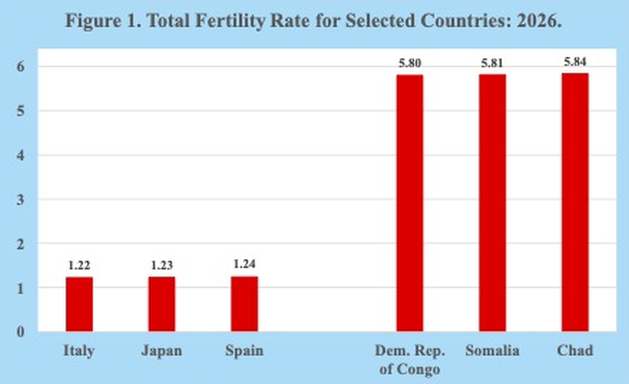
Approximately 110 countries have fertility rates below the replacement level of 2.1 births per woman. These countries include Italy, Japan, and Spain, where fertility rates are about 1.2 births per woman. In contrast, some of the world’s highest fertility rates are found in less developed countries, including Chad, the Democratic Republic of the Congo, and Somalia, where rates approach 6 births per woman (Figure 1).
Like births, deaths are distributed unequally across countries. Premature deaths are concentrated in low-income regions, largely because of poverty, limited access to healthcare, and civil conflict. Consequently, some people in the world die at relatively young ages, while others live considerably longer.
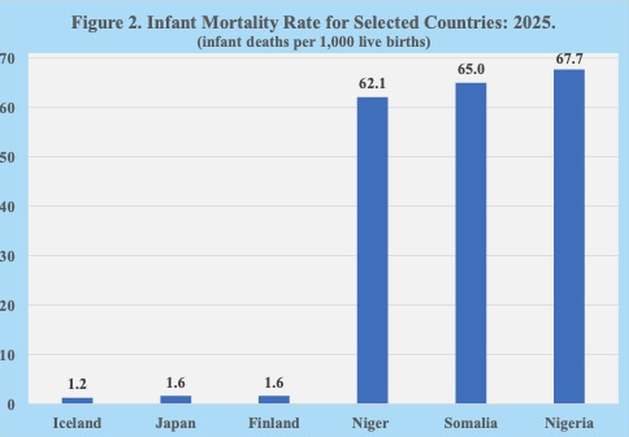
Differences in mortality risks are evident from the first year of life. Finland, Iceland, and Japan, for example, have some of the world’s lowest infant mortality rates, with fewer than 2 deaths per 1,000 live births. In contrast, Niger, Nigeria, and Somalia have some of the highest rates, exceeding 62 infant deaths per 1,000 live births. Infants in these countries therefore face mortality risks more than 30 times higher than those in countries with the lowest mortality rates (Figure 2).
These disparities in infant mortality are also reflected in maternal mortality. In 2023, some of the highest maternal mortality rates were recorded in African countries, including Chad, Nigeria, and South Sudan, where rates exceeded 1,000 maternal deaths per 100,000 live births. By contrast, countries such as Iceland, Norway, and Poland recorded fewer than 3 maternal deaths per 100,000 live births.
Life expectancy at birth likewise reveals substantial disparities in mortality across countries. In 2025, some of the lowest life expectancies at birth, at approximately 55 years, were reported in African countries, including Chad, Nigeria, and South Sudan. By contrast, Japan, the Republic of Korea, and Switzerland had life expectancies at birth of approximately 85 years, about 30 years longer than those in countries with the lowest life expectancies.
Mortality disparities persist into older ages, as reflected in life expectancy at age 65. In 2025, for example, people aged 65 in Chad, Nigeria, and Togo could expect to live about 12 more years, compared with approximately 23 additional years in Australia, France, and Japan.
Life expectancy also varies considerably by income and education. Working-class individuals and those with less education generally have shorter life expectancies than their wealthier and more highly educated counterparts. Higher educational attainment is also associated with higher incomes, healthier lifestyles, better access to health care, and longer life spans.
Beyond deaths resulting from illness, disease, accidents, violence, and armed conflicts, voluntary medically assisted death is becoming an increasingly prominent global issue.
Medically assisted death, also known as death with dignity, voluntary assisted dying, or medical aid in dying (MAID), is the subject of growing debate in many countries. It can take two main forms: assisted suicide, in which individuals take prescribed life-ending medication themselves, and voluntary euthanasia, in which a medical professional administers the medication.
An important demographic consequence of disparities in birth and death across countries is the substantial variation in the levels of natural population change, defined as the difference between births minus deaths.
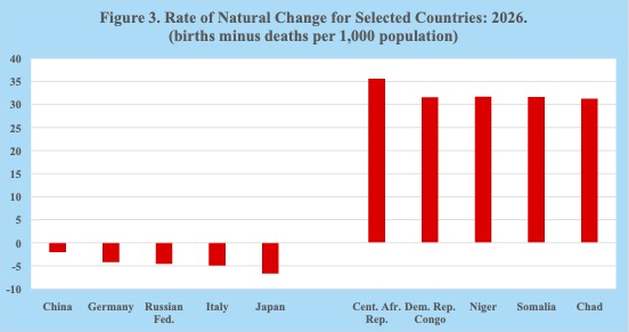
Many African countries, for example, have relatively high rates of natural increase. Rates exceed 30 per 1,000 population in the Central African Republic, Chad, the Democratic Republic of the Congo, Niger, and Somalia. In contrast, rates of natural change are negative in many countries, including China, Germany, the Russian Federation, Italy, and Japan (Figure 3).
In sum, although birth and death are universal human experiences, their patterns reflect significant disparities within and across countries and between privileged and marginalized groups.
High fertility and premature mortality are concentrated largely in less developed countries, particularly the least developed, while longer life expectancy and low fertility are more common in more developed countries. Similarly, high rates of population growth prevail in many less developed countries, especially in Africa, while low or negative rates of population growth are occurring in a growing number of countries.
These demographic disparities in birth, death, and population growth are having significant economic, social, and political consequences worldwide.
Joseph Chamie is a consulting demographer, a former director of the United Nations Population Division, and author of many publications on population issues.
© Inter Press Service (20261117115707) — All Rights Reserved. Original source: Inter Press Service