 Global Issues
Trade, Economy, & Related Issues
Author and Page information
- This page: https://www.globalissues.org/issue/1/trade-economy-related-issues.
- To print all information (e.g. expanded side notes, shows alternative links), use the print version:
One cannot separate economics, political science, and history. Politics is the control of the economy. History, when accurately and fully recorded, is that story. In most textbooks and classrooms, not only are these three fields of study separated, but they are further compartmentalized into separate subfields, obscuring the close interconnections between them.
This section attempts to highlight some of the misconceptions and unfairness in the current model for global trading, economics and the current form of overly corporate-led globalization. It attempts to provide a look at how this all has an impact on people around the world, especially the developing nations.
67 articles on “Trade, Economy, & Related Issues” and 10 related issues:
Global Financial Crisis
 Following a period of economic boom, a financial bubble — global in scope — burst, even causing some of the world’s largest financial institutions have collapsed. With the resulting recession, many governments of the wealthiest nations in the world have resorted to extensive bail-out and rescue packages for the remaining large banks and financial institutions while imposing harsh austerity measures on themselves.
Some of the bail-outs have also led to charges of hypocrisy due to the apparent socializing of the costs while privatizing the profits.
Furthermore, the institutions being rescued are typically the ones got the world into this trouble in the first place. For smaller businesses and poorer people, such options for bail out and rescue are rarely available when they find themselves in crisis.
Plummeting stock markets at one point wiped out 33% of the value of companies, $14.5 trillion. Taxpayers bailed out their banks and financial institutions with large amounts of money. US taxpayers alone have spent some $9.7 trillion in bailout packages and plans. The UK and other European countries have also spent some $2 trillion on rescues and bailout packages. More is expected. Much more.
Such numbers, made quickly available, are enough to wipe many individual’s mortgages, or clear out third world debt many times over. Even the high military spending figures are dwarfed by the bailout plans to date.
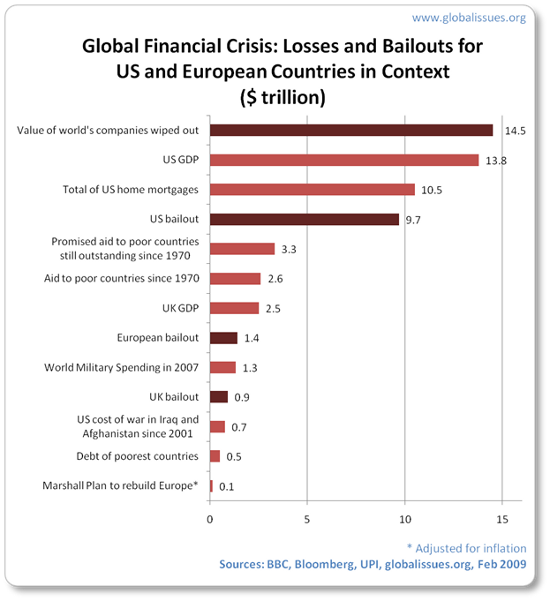
This problem could have been averted (in theory) as people had been pointing to these issues for decades. However, during boom, very few want to hear such pessimism. Does this crisis spell an end to the careless forms of banking and finance and will it herald a better economic age, or are we just doomed to keep forgetting history and repeat these mistakes in the future? Signs are not encouraging as rich nations are resisting meaningful reform…
Read “Global Financial Crisis” to learn more.
Causes of Poverty
Poverty is the state for the majority of the world’s people and nations. Why is this? Is it enough to blame poor people for their own predicament? Have they been lazy, made poor decisions, and been solely responsible for their plight? What about their governments? Have they pursued policies that actually harm successful development? Such causes of poverty and inequality are no doubt real. But deeper and more global causes of poverty are often less discussed.
Read “Causes of Poverty” to learn more.
Poverty Facts and Stats
Most of humanity lives on just a few dollars a day. Whether you live in the wealthiest nations in the world or the poorest, you will see high levels of inequality.
The poorest people will also have less access to health, education and other services. Problems of hunger, malnutrition and disease afflict the poorest in society. The poorest are also typically marginalized from society and have little representation or voice in public and political debates, making it even harder to escape poverty.
By contrast, the wealthier you are, the more likely you are to benefit from economic or political policies. The amount the world spends on military, financial bailouts and other areas that benefit the wealthy, compared to the amount spent to address the daily crisis of poverty and related problems are often staggering.
Some facts and figures on poverty presented in this page are eye-openers, to say the least.
Read “Poverty Facts and Stats” to learn more.
Structural Adjustment—a Major Cause of Poverty
Cutbacks in health, education and other vital social services around the world have resulted from structural adjustment policies prescribed by the International Monetary Fund (IMF) and the World Bank as conditions for loans and repayment. In addition, developing nation governments are required to open their economies to compete with each other and with more powerful and established industrialized nations. To attract investment, poor countries enter a spiraling race to the bottom to see who can provide lower standards, reduced wages and cheaper resources. This has increased poverty and inequality for most people. It also forms a backbone to what we today call globalization. As a result, it maintains the historic unequal rules of trade.
Read “Structural Adjustment—a Major Cause of Poverty” to learn more.
Poverty Around The World
 Around the world, in rich or poor nations, poverty has always been present.
In most nations today, inequality—the gap between the rich and the poor—is quite high and often widening.
The causes are numerous, including a lack of individual responsibility, bad government policy, exploitation by people and businesses with power and influence, or some combination of these and other factors.
Many feel that high levels of inequality will affect social cohesion and lead to problems such as increasing crime and violence.
Inequality is often a measure of relative poverty. Absolute poverty, however, is also a concern. World Bank figures for world poverty reveals a higher number of people live in poverty than previously thought.
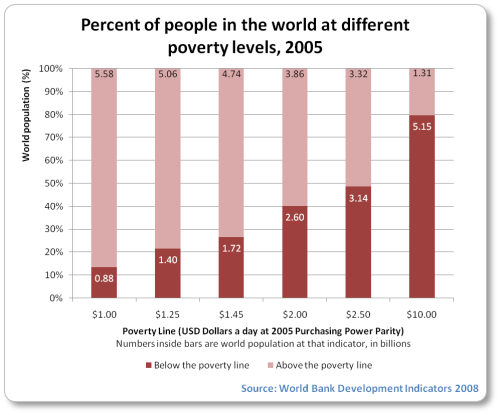
For example, the new poverty line is defined as living on the equivalent of $1.25 a day. With that measure based on latest data available (2005), 1.4 billion people live on or below that line.
Furthermore, almost half the world—over three billion people—live on less than $2.50 a day and at least 80% of humanity lives on less than $10 a day:
Read “Poverty Around The World” to learn more.
Today, around 21,000 children died around the world
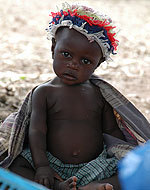

Around 21,000 children die every day around the world.
That is equivalent to:
- 1 child dying every 4 seconds
- 14 children dying every minute
- A 2011 Libya conflict-scale death toll every day
- A 2010 Haiti earthquake occurring every 10 days
- A 2004 Asian Tsunami occurring every 11 days
- An Iraq-scale death toll every 19–46 days
- Just under 7.6 million children dying every year
- Some 92 million children dying between 2000 and 2010
The silent killers are poverty, easily preventable diseases and illnesses, and other related causes. Despite the scale of this daily/ongoing catastrophe, it rarely manages to achieve, much less sustain, prime-time, headline coverage.
Read “Today, around 21,000 children died around the world” to learn more.
World Hunger and Poverty
Meaningful long-term alleviation of hunger is rooted in the alleviation of poverty, as poverty leads to hunger. World hunger is a terrible symptom of world poverty. If efforts are only directed at providing food, or improving food production or distribution, then the structural root causes that create hunger, poverty and dependency would still remain. While resources and energies are deployed to relieve hunger through technical measures such as improving agriculture, and as important as these are, inter-related issues such as poverty means that political solutions are likely required as well for meaningful and long term hunger alleviation.
Read “World Hunger and Poverty” to learn more.
Causes of Hunger are related to Poverty
There are many inter-related issues causing hunger, which are related to economics and other factors that cause poverty. They include land rights and ownership, diversion of land use to non-productive use, increasing emphasis on export-oriented agriculture, inefficient agricultural practices, war, famine, drought, over-fishing, poor crop yields, etc. This section introduces some of these issues.
Read “Causes of Hunger are related to Poverty” to learn more.
Solving World Hunger Means Solving World Poverty
Solving world hunger in the conventional sense (of providing/growing more food etc) will not tackle poverty that leads to hunger in the first place. Further, there is a risk of continuing the poverty and dependency without realizing it, because the act of attempting to provide more food etc can appear so altruistic in motive. To solve world hunger in the long run, poverty alleviation is required.
Read “Solving World Hunger Means Solving World Poverty” to learn more.
Food Dumping [Aid] Maintains Poverty
Food aid (when not for emergency relief) can actually be very destructive on the economy of the recipient nation and contribute to more hunger and poverty in the long term. Free, subsidized, or cheap food, below market prices undercuts local farmers, who cannot compete and are driven out of jobs and into poverty, further slanting the market share of the larger producers such as those from the US and Europe. Many poor nations are dependent on farming, and so such food aid
amounts to food dumping. In the past few decades, more powerful nations have used this as a foreign policy tool for dominance rather than for real aid.
Read “Food Dumping [Aid] Maintains Poverty” to learn more.
Food Aid as Dumping
The way the food aid programs of various rich countries is structured may be of concern. In fact, food aid
(when not for emergency relief) can actually be very destructive on the economy of the recipient nation. Dumping food on to poorer nations (i.e. free, subsidized, or cheap food, below market prices) undercuts local farmers, who cannot compete and are driven out of jobs and into poverty, further slanting the market share of the larger producers such as those from the US and Europe.
Read “Food Aid as Dumping” to learn more.
Myth: More US aid will help the hungry
With kind permission from Peter Rosset of the Institute for Food and Development Policy (or FoodFirst.org as it is also known), chapter 10 of World Hunger: 12 Myths, 2nd Edition, by Frances Moore Lappé, Joseph Collins and Peter Rosset, with Luis Esparza (fully revised and updated, Grove/Atlantic and Food First Books, Oct. 1998) has been posted here. It describes in detail the issue of food aid and the United States of America’s aid policies, the problems it causes and who it really benefits.
Read “Myth: More US aid will help the hungry” to learn more.
Corruption
 We often hear leaders from rich countries telling poor countries that aid and loans will only be given when they show they are stamping out corruption.
While that definitely needs to happen, the rich countries themselves are often active in the largest forms of corruption in those poor countries, and many economic policies they prescribe have exacerbated the problem.
Corruption in developing countries definitely must be high on the priority lists (and is increasingly becoming so in the wake of the global financial crisis), but so too must it be on the priority lists of rich countries.
Read “Corruption” to learn more.
United Nations World Summit 2005
The UN World Summit for September 2005 is supposed to review progress since the Millennium Declaration, adopted by all Member States in 2000. However, the US has proposed enormous changes to an outcome document that is to be signed by all members. There are changes on almost all accounts, including striking any mention of the Millennium Development Goals, that aim for example, to halve poverty and world hunger by 2015. This has led to concerns that the outcome document will be weakened. Developing countries are also worried about stronger text on human rights and about giving the UN Security Council more powers.
Read “United Nations World Summit 2005” to learn more.
IMF & World Bank Protests, Washington D.C.
To complement the public protests in Seattle, the week leading up to April 16th/17th 2000 saw the other two global institutions, the International Monetary Fund (IMF) and World Bank, as the focus of renewed protests and criticisms in Washington, D.C. The purpose of the mass demonstrations was to protest against the current form of globalization, which is seen as unaccountable, corporate-led, and non-democratic, and to show the link between poverty and the various policies of the IMF and the World Bank.
Read “IMF & World Bank Protests, Washington D.C.” to learn more.
Economic Democracy
This next page is a reposting of a flyer about a new book from J.W. Smith and the Institute for Economic Democracy, whom I thank for their kind permission. The book is called Economic Democracy: The Political Struggle Of The 21st Century. Typically on this site, I do not advertise books etc, (although I will cite from and link to some, where relevant). However, in this case, I found that the text in the flyer provides an excellent summary of poverty's historic roots, as well as of the multitude of issues that cause poverty. (Please also note that I do not make any proceeds from the sale of this book in any way.)
Read “Economic Democracy” to learn more.
Poverty Links for More Information
Links to other sites discussion issues on trade, the global economy, poverty and other related issues.
Read “Poverty Links for More Information” to learn more.
World hunger related links for more information
Links to web sites and articles that discuss world hunger, the relationship between populations and hunger, of poverty and hunger, agricultural issues, land rights and so on.
Read “World hunger related links for more information” to learn more.
Third World Debt Undermines Development
Read “Third World Debt Undermines Development” to learn more.
Causes of the Debt Crisis
The causes of debt are a result of many factors, including:
- The legacy of colonialism — for example, the developing countries’ debt is partly the result of the unjust transfer to them of the debts of the colonizing states, in billions of dollars, at very high interest rates.
- Odious debt, whereby unjust debt is incurred as rich countries loaned dictators or other corrupt leaders when it was known that the money would be wasted. South Africa, for example shortly after freedom from Apartheid had to pay debts incurred by the apartheid regime. In effect, South Africans are paying for their own oppression.
- Mismanaged spending and lending by the West in the 1960s and 70s
In effect, due to enormous debt repayments, the poor are subsidizing the rich.
Read “Causes of the Debt Crisis” to learn more.
The Scale of the Debt Crisis
Total debt continues to rise, despite ever-increasing payments, while aid is falling. For example:
- The developing world now spends $13 on debt repayment for every $1 it receives in grants.
- For the poorest countries (approximately 60), $550 billion has been paid in both principal and interest over the last three decades, on $540bn of loans, and yet there is still a $523 billion dollar debt burden.
Debt kills. Some 11 million children die each year around the world, due to conditions of poverty and debt.
Read “The Scale of the Debt Crisis” to learn more.
The Heavily In-debt Poor Countries Initiative is Not Working
The Heavily In-debt Poor Countries (HIPC) initiative set up in 1996 by the rich nations through the IMF and World Bank calls for the reduction of external debt for the poorest countries through write-offs by official donors.
The IMF and World Bank have actually admitted that the HIPC initiative is backfiring in some cases and are confirming warnings that debt-relief advocates were making even before the scheme was launched. Difficult, and sometimes unfair conditions, are often associated with the initiative.
Read “The Heavily In-debt Poor Countries Initiative is Not Working” to learn more.
Debt Cancellation and Public Pressure
As well as the admissions by some heads of international financial institutions such as the IMF that their various schemes are not working (as mentioned above), there have been some additional positive actions and decisions. The Jubilee 2000 initiative, for example, has been very beneficial here to raise awareness.
Various G8 Summits have seen promises of billions in debt-write off, but almost hardly are carried out, or contain a lot of spin. For example, a lot of debt relief promised may include moneys previously announced for such purposes, thus creating an impression of enormous write-offs. Bilateral debt relief also does not typically release actual money to be used for other purposes. Multilateral debt relief, however, could.
Read “Debt Cancellation and Public Pressure” to learn more.
Debt and the Global Economic Crisis of 1997/98/99
The structural adjustment measures, global, unregulated free markets and lack of protection for emerging economies all contributed to the global economic and financial crisis in the late 1990s.
The Progress of Nations, 1999 report by UNICEF, suggests that debt is killing children. It is pointed out that as countries are diverting resources away from social provisions to repay debt, those most affected are the poor, especially women and children. UNICEF’s 2000 report says 30,000 children die each day due to poverty. That is just under 11 million children each year.
Read “Debt and the Global Economic Crisis of 1997/98/99” to learn more.
Debt and the Effect on Children
Read “Debt and the Effect on Children” to learn more.
Debt and the Environment
At first glance, it may seem like separate issues, but environment issues and poverty/debt are very much related. Basically, the more the developing countries stay in debt, the more they will feel that they need to milk the earth’s resources for the hard cash they can bring in, and also cut back on social, health, environmental conservation, employment and other important programs.
Responding to environmental disasters is also made more difficult when the affected countries are in severe debt. Examples include Honduras and Nicaragua, where Hurricane Mitch devastated large parts of those countries, as well as Mozambique and Madagascar where floods have made hundreds of thousands of people homeless.
Tackling debt-related issues would also therefore indirectly help address environmental and other issues as well.
Read “Debt and the Environment” to learn more.
Free Trade and Globalization
Read “Free Trade and Globalization” to learn more.
A Primer on Neoliberalism
Global trading that allows all nations to prosper and develop fairly and equitably is probably what most people would like to see. Neoliberalism is touted as the mechanism for this. Margaret Thatcher's TINA acronym suggested that There Is No Alternative. But what is neoliberalism, anyway?
Read “A Primer on Neoliberalism” to learn more.
Criticisms of Current Forms of Free Trade
While internationalism and equitable global trading allowing fair development is probably what most people would like to see, the current model of corporate-led free trade and its version of globalization that has resulted, has come under criticism by many, many NGOs, developing nation governments and ordinary citizens.
Read “Criticisms of Current Forms of Free Trade” to learn more.
The WTO and Free Trade
The World Trade Organization, (WTO), is the primary international body to help promote free trade, by drawing up the rules of international trade. However, it has been mired in controversy and seen to be hijacked by rich country interests, thus worsening the lot of the poor, and inviting protest and intense criticism.
Read “The WTO and Free Trade” to learn more.
WTO Doha “Development” Trade Round Collapse, 2006
Supposed to be a Development
round of trade talks, the almost five year-long Doha round collapsed at the end of July, 2006. The US found itself on the defensive as around the world blame was directed at the US, in particular by the EU. However, the EU has also been part of the reason for failure throughout the five years. This article looks at what happened at the end of 2006, and also introduces a collection of articles that were written at the time of each previous major WTO meetings from the initial Doha round in 2001 and since.
Read “WTO Doha “Development” Trade Round Collapse, 2006” to learn more.
Deregulation or Protectionism?
Protectionism is often referred to as being a barrier to free trade. The word seems to conjure up negative images of isolationism and subsidizing industries that could otherwise not compete fairly against others. (This can help indicate why some industries would strongly support protectionism for themselves.) Complete deregulation allows corporations to benefit but at the possible expense of people in that nation or region if that deregulation means relaxation of environmental rules, health and educational services including control of natural resources and energy. (This hints at the powerful lure that the "freeing" of trade and liberalization of access to resources from regulation has to some proponents.) Neither seems to answer the notion of fairness, though. Often those nations that promote free trade for all, want protectionism for themselves.
Read “Deregulation or Protectionism?” to learn more.
Some Regional Free Trade Agreements
There have been numerous regional free trade agreements. Some have been controversial, while others may be beneficial. Examples include the North American Free Trade Agreement (NAFTA), the Free Trade Area of the Americas (FTAA), US attempts at free trade agreements with African nations and so on. Critics argue that when these agreements include partners that have different levels of development, this will lead to unequal trade and favor the wealthier partners to the detriment of the poorer ones.
Read “Some Regional Free Trade Agreements” to learn more.
The Mainstream Media and Free Trade
The mainstream media has been flooded by free trade proponents and heavily backed by those that will profit from it the most. This makes public debate more difficult.
Read “The Mainstream Media and Free Trade” to learn more.
Public Protests Around The World
 The global financial crisis has spawned a global protest movement campaigning against things like inequality, corporate greed, lack of jobs, etc.
Although these protests have occurred for decades, they have typically been in the developing countries, or about the situation in developing countries.
As such, many Western nations, who have strongly influenced the conditions in developing countries, have typically not paid much attention to such protests, no matter how large (even the famous Battle for Seattle
was more about violence than the underlying issues, for example). However, this time, the global financial crisis has hit the ordinary citizens of Western nations quite hard, and inspired by the Arab Spring and protests in Spain, a global movement seems to have sprung up.
Read “Public Protests Around The World” to learn more.
WTO Protests in Seattle, 1999
At the end of November 1999, Seattle saw major governments meet at a WTO ministerial meeting to discuss various trading rules. Seattle also saw free speech cracked down on in the name of free trade. Enormous public protests ensued. There were many differences in the perspectives of developing and industrialized nations on the current reality of free trade and how it affected them. It resulted in a WTO failure to agree on many issues, without adopting any resolutions. Developing countries were sidelined and one delegate even physically barred from a meeting.
Read “WTO Protests in Seattle, 1999” to learn more.
General Agreement on Trade in Services
A similar agreement to the derailed Multilateral Agreement on Investment (MAI), the General Agreement on Trade in Services (GATS) at the WTO has a potentially wide ramification for the poor and developing countries.
Read “General Agreement on Trade in Services” to learn more.
Multilateral Agreement on Investment
We had a potential nightmare in the form of the Multilateral Agreement on Investment (MAI). An almost secret agreement about investment rights and opening up nations for freer trade. However many, many people feared that this would be accompanied by grave social and environmental consequences, due to the wording of the MAI text.
Read “Multilateral Agreement on Investment” to learn more.
Corporations
Read “Corporations” to learn more.
The Rise of Corporations
Today we know that corporations, for good or bad, are major influences on our lives. For example, of the 100 largest economies in the world, 51 are corporations while only 49 are countries. In this era of globalization
, marginalized people are becoming especially angry at the motives of multinational corporations, and corporate-led globalization is being met with increasing protest and resistance. How did corporations ever get such power in the first place? What was the impact of giving corporations the same right as individuals in 1886 in the United States?
Read “The Rise of Corporations” to learn more.
Corporations and Human Rights
Large, transnational corporations are becoming increasingly powerful. As profits are naturally the most important goal, damaging results can arise, such as violation of human rights, lobbying for and participating in manipulated international agreements, environmental damage, child labor, driving towards cheaper and cheaper labor, and so on. Multinational corporations claim that their involvement in foreign countries is actually a constructive engagement as it can promote human rights in non-democratic nations. However, it seems that that is more of a convenient excuse to continue exploitative practices.
Read “Corporations and Human Rights” to learn more.
Pharmaceutical Corporations and Medical Research
 For a while now, pharmaceutical companies have been criticized about their priorties. It seems the profit motive has led to emphasis on research that is aimed more at things like baldness and impotence, rather than various tropical diseases that affect millions of people in developing countries.
Unfortunately, while a large market therefore exists, most of these people are poor and unable to afford treatments, so the pharmaceutical companies develop products that can sell and hence target wealthier consumers.
In addition, there is concern at how some pharmaceutical companies have been operating: from poor research and trial practice to distorting results, and politically lobbying and pressuring developing countries who try to produce generics or try to get cheaper medicines for their citizens.
Read “Pharmaceutical Corporations and Medical Research” to learn more.
Pharmaceutical Corporations and AIDS
The AIDS crisis is one example that highlights the motives of some of the larger pharmaceutical corporations. When South Africa wanted to try and produce cheaper drugs to help its own people, by producing more generic and cheaper drugs, these companies actually lobbied the US government to impose sanctions on them!
Read “Pharmaceutical Corporations and AIDS” to learn more.
Tax Avoidance and Tax Havens; Undermining Democracy
 Through tax havens, transfer pricing and many other policies — both legal and illegal — billions of dollars of tax are avoided. The much-needed money would helped developing (and developed) countries provide important social services for their populations.
Some tax avoidance, regardless of how morally objectionable it may be to some people, is perfectly legal, and the global super elite are able to hide away trillions of dollars, resulting in massive losses of tax revenues for cash-strapped governments who then burden ordinary citizens further with austerity measures during economic crisis, for example. Yet these super elite are often very influential in politics and business. In effect, they are able to undermine democracy and capitalism at the same time.
As the global financial crisis has affected many countries, tackling tax avoidance would help target those more likely to have contributed to the problem while avoid many unnecessary austerity measures that hit the poorest so hard. But despite rhetoric stating otherwise, it does not seem to high on the agenda of many governments as you might think.
Read “Tax Avoidance and Tax Havens; Undermining Democracy” to learn more.
Corporations and the Environment
Many industries such as the energy and fossil fuels industry leave many environmental problems in their wake. Because international lending schemes are tied with reforms
that include cutting back on regulatory and safety measures such as health, education and the environment, problems can arise without many resources available to deal with them. While large corporations are able to profit, the costs from environmental and other damage has to be borne by the local population.
Read “Corporations and the Environment” to learn more.
Corporate Social Responsibility
Corporate Social Responsibility is a bit of a buzz word and some feel that it has been diluted from its original aims, while others are trying to find innovative ways to engage with businesses to be more responsible in their practices.
Read “Corporate Social Responsibility” to learn more.
Corporate Influence on Children
When companies see children as an enormous market with incredible purchasing power, it leads to a lot of advertising and marketing targeted directly at them. Some are concerned at the effect it has as children, teaching them to be consumers and overly conscious about materialistic things, perhaps even at the expense of human qualities from an early age.
Read “Corporate Influence on Children” to learn more.
Corporations and Worker’s Rights
For many companies, the largest cost is often the work force. Hence, where profits are the bottom line, it is only natural for companies to seek out the cheapest labor possible. However, when international agreements are often designed to foster an environment where cheaper and cheaper labor is promoted, the workers themselves are often not paid enough to live on. When a nation tries to provide regulatory steps to improve workers conditions (which does mean more costs to the companies), multinational corporations naturally pick up and go to other places where there are less measures in place. In this way, improving working conditions will always be difficult, as it is not in the interest of the large companies.
Read “Corporations and Worker’s Rights” to learn more.
Influence at the World Trade Organization
Transnational corporations are able to exert enormous influence in no less a powerful body as the World Trade Organization (WTO). These corporations are closely linked to the WTO decision-makers themselves.
Read “Influence at the World Trade Organization” to learn more.
Corporate Power Facts and Stats
As transnational corporations grow in size and power, their influence and impacts affect more and more people. These stats provide an insight into the growing size and influence of corporations.
Read “Corporate Power Facts and Stats” to learn more.
Consumption and Consumerism
Read “Consumption and Consumerism” to learn more.
Creating the Consumer
This section looks at the rise of the consumer and the development of the mass consumer society. While consumption has of course been a part of our history, in the last 100 years or so, the level of mass consumption beyond basics has been exponential and is now a fundamental part of many economies. Luxuries that had to be turned into necessities and how entire cultural habits had to be transformed for this consumption is introduced here.
Read “Creating the Consumer” to learn more.
Children as Consumers
 The market for children’s products and food is enormous. Parents on the one hand have a hard time raising children the way they want to, while on the other hand, kids are being increasingly influenced by commercialism that often goes against what parents are trying to do.
Read “Children as Consumers” to learn more.
Effects of Consumerism
Because consumption is so central to many economies, and even to the current forms of globalization, its effects are also seen around the world. How we consume, and for what purposes drives how we extract resources, create products and produce pollution and waste. Issues relating to consumption hence also affect environmental degradation, poverty, hunger, and even the rise in obesity that is nearing levels similar to the official
global poverty levels. Political and economic systems that are currently promoted and pushed around the world in part to increase consumption also lead to immense poverty and exploitation. Much of the world cannot and do not consume at the levels that the wealthier in the world do. Indeed, the above U.N. statistics highlight that very sharply. In fact, the inequality structured within the system is such that as Richard Robbins says, some one has to pay
for the way the wealthier in the world consume.
Read “Effects of Consumerism” to learn more.
Tobacco
 It is well known that tobacco smoking kills millions. But it also exacerbates poverty, contributes to world hunger by diverting prime land away from food production, damages the environment and reduces economic productivity. Second hand smoking also affects other people’s lives.
Despite many attempts to prevent it, a global tobacco control treaty became international law in 2005.
However, challenges still remain as tobacco companies try to hit back, for example, by targeting developing nations, increasing advertising at children and women, attempting to undermine global treaties and influence trade talks, etc.
Read “Tobacco” to learn more.
Wasted Wealth, Capital, Labor and Resources
We are beginning to get just a hint of how wasteful our societies are. Sugar, beef, and bananas are just the tip of the iceberg in terms of examples of wasted industry and waste structured within the current system. Not only are certain wasteful job functions unnecessary as a result, but the capital that employs this labor is therefore a wasteful use of capital. As a result, we see waste and misuse of the environment, as well as social and environmental degradation increasing. Our industries may be efficient for accumulating capital and making profits, but that does not automatically mean that it is efficient for society. However, with such wasted labor
what do we do? We can’t have such an enormous idle labor force, right? Well, as J.W. Smith points out, we should share the remaining jobs. This would also reduce our workweek. Something technocrats have kept promising us in rhetoric only!
Read “Wasted Wealth, Capital, Labor and Resources” to learn more.
Mathematics of Wasted Labor—an Example
With kind permission from J.W. Smith, a part of the conclusion to Part I of World’s Wasted Wealth II (Institute for Economic Democracy, 1994) has been reproduced on this page. That part is titled The Mathematics of Wasted Labor. It is a vivid example of wasted and unnecessary labor using the United States as the case study. While the book was written back in 1994 and the numbers, facts and estimates are hence based on data from the early 1990s, the pattern and examples shown here are still very valid. His calculations suggest that with the elimination of wasted labor in the U.S. and sharing the remaining productive jobs between all those who can work, workers would need to work just 2.4 days per week!
Read “Mathematics of Wasted Labor—an Example” to learn more.
Consumption and Consumerism Links and Resources
Because this topic is vast, I cannot expect to write everything here! In addition, due to the overlapping and inter-related nature of so many issues, throughout this web site topics are presented which can also be looked at from this waste perspective. Such links as well as links to other web site, books and so on are presented here.
Read “Consumption and Consumerism Links and Resources” to learn more.
Sustainable Development
Read “Sustainable Development” to learn more.
Sustainable Development Introduction
 The idea of sustainable development grew from numerous environmental movements in earlier decades. Summits such as the Earth Summit in Rio, Brazil, 1992, were major international meetings to bring sustainable development to the mainstream.
However, the record on moving towards sustainability so far appears to have been quite poor. The concept of sustainability means many different things to different people, and a large part of humanity around the world still live without access to basic necessities.
Read “Sustainable Development Introduction” to learn more.
Poverty and the Environment
The causes of poverty and of environmental degradation are inter-related suggesting that approaching sustainable development requires understanding the issues from many angles, not just say an environmentalist or economics perspective alone.
Read “Poverty and the Environment” to learn more.
Non-governmental Organizations on Development Issues
What does an ever-increasing number of non-governmental organizations (NGOs) mean? NGOs are non-profit organizations filling the gap where governments will not, or cannot function. In the past however, some NGOs from the wealthy nations have received a bad reputation in some developing nations because of things like arrogance, imposition of their views, being a foreign policy arm or tool of the original country and so on. Even in recent years some of these criticisms still hold. However, recently some new and old NGOs alike, have started to become more participatory and grassroots-oriented to help empower the people they are trying to help, to help themselves. This is in general a positive turn. Yet, the fact that there are so many NGOs popping up everywhere perhaps points to failures of international systems of politics, economics, markets, and basic rights.
Read “Non-governmental Organizations on Development Issues” to learn more.
Foreign Aid for Development Assistance
In 1970, the world’s rich countries agreed to give 0.7% of their gross national income as official international development aid, annually.
Since that time, billions have certainly been given each year, but rarely have the rich nations actually met their promised target.
For example, the US is often the largest donor in dollar terms, but ranks amongst the lowest in terms of meeting the stated 0.7% target.
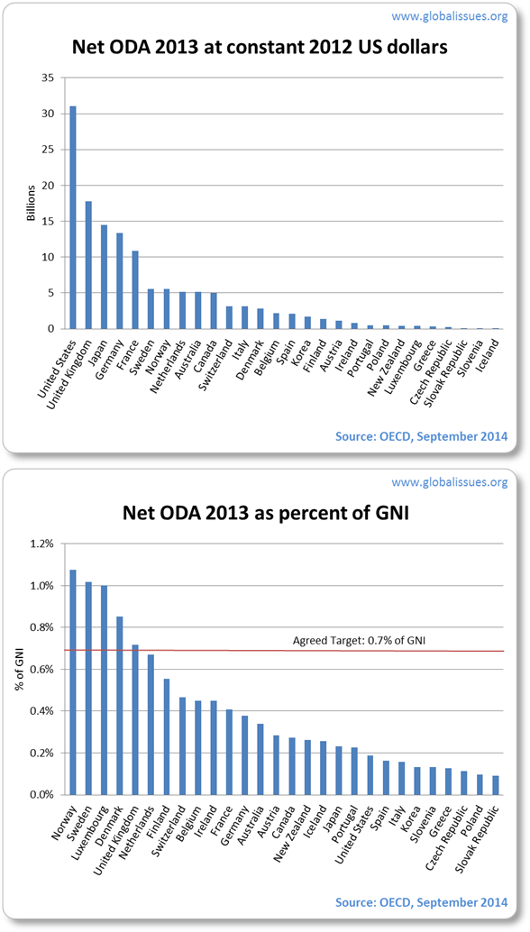
Furthermore, aid has often come with a price of its own for the developing nations. Common criticisms, for many years, of foreign aid, have included the following:
- Aid is often wasted on conditions that the recipient must use overpriced goods and services from donor countries
- Most aid does not actually go to the poorest who would need it the most
- Aid amounts are dwarfed by rich country protectionism that denies market access for poor country products while rich nations use aid as a lever to open poor country markets to their products
- Large projects or massive grand strategies often fail to help the vulnerable; money can often be embezzled away.
This article explores who has benefited most from this aid, the recipients or the donors.
Read “Foreign Aid for Development Assistance” to learn more.
G8: Too Much Power?
Read “G8: Too Much Power?” to learn more.
G8 Summits: Empty promises each year
The G8, is made up of the seven most powerful economies of the world, (United States, Japan, Germany, France, UK, Canada, Italy) and Russia. Together they form a very powerful and influential (though informal) group of nations. For example, they accounting for almost 50% of the votes at the IMF and World Bank. At their annual summits they attract a lot of criticism, increasingly now in the mainstream, for failing the world’s poor. This section introduces the G8 with an overview of recent summits and their outcomes.
Read “G8 Summits: Empty promises each year” to learn more.
G8 Summit 2007
The 2007 Summit has gained some media attention in its buildup, but issues around climate change, similar to the efforts seen in 2005 to water down draft texts, have surfaced again. Protesters are gathering, and while mostly peaceful a handful have clashed with police. Issues such as the excessive farm subsidies of the rich nations seem less likely to get discussed, even though it is crucial for many poor countries.
Read “G8 Summit 2007” to learn more.
G8 Summit 2005—One Year On
One year on from the G8 Summit of 2005 that seemed to promise so much, what has been the status? It seems that some progress was certainly made. For example, significant debt cancellation has allowed some countries to offer enhanced or even free health services to all. Yet, there are still many concerns. The fancy accounting and spin used by some countries to paint a positive picture or give the impression that more assistance has been delivered than what actually has risks discrediting the process, impacting the poor once more. This short article explores some of these concerns.
Read “G8 Summit 2005—One Year On” to learn more.
G8 Summit 2005
The G8 Summit in July 2005 looked to be historic because of promised debt relief for some poor countries in Africa as well as action on climate change. But behind the media and government spin, was this really the case? Climate change was also under discussion, but leaked drafts revealed an extremely watered down text suggesting limited or no responsibility on rich countries to take leadership, and even questions around the science of climate change.
Read “G8 Summit 2005” to learn more.
Water and Development
Issues such as water privatization are important in the developing world especially as it goes right to the heart of water rights, profits over people, and so on. This article looks into these issues and the impacts it has on people around the world.
Read “Water and Development” to learn more.
Brain Drain of Workers from Poor to Rich Countries
Brain drain is a problem for many poor countries losing skilled workers to richer countries. In healthcare, the effects can often be seen vividly. For example, in many rich countries, up to one third of doctors may be from abroad, many from Sub-Sahara Africa, while many African countries have as little as 500 doctors serving their entire population. Reasons for this brain drain vary, ranging from poor conditions domestically to attractive opportunities and active enticement from abroad.
Read “Brain Drain of Workers from Poor to Rich Countries” to learn more.
World Summit on Sustainable Development
This section introduces some of the issues on the international summit (August 26 - September 4, 2002) where thousands of delegates met to discuss various issues comprising sustainable development. Of course, there was a lot of controversy including differences between the global North and South on all sorts of issues such as corporate-led globalization, privatization of energy, water, health, etc. In addition there was also concern about motives and influences of large corporations on the outcomes of the Summit.
Read “World Summit on Sustainable Development” to learn more.
United Nations on Development Issues
The United Nations is the largest international body involved in development issues around the world. However, it has many political issues and problems to contend with. But, despite this, it is also performing some much needed tasks around the world, through its many satellite organizations and entities, providing a means to realize the Declaration of Human Rights. Unfortunately though, it is not perfect and is negatively affected by politics of powerful nations that wish to further their own interests.
Read “United Nations on Development Issues” to learn more.
Fair Trade
Read “Fair Trade” to learn more.
Child Labor
Read “Child Labor” to learn more.
The Banana Trade War
 Bananas are widely consumed. Yet, they represent a wide variety of inter-related issues, from environmental, economic, social, and political. Nations and regions, such as the US and EU have in the past battled in a trade war over how bananas are exported and imported, affected the poorest in the producing countries the most.
Read “The Banana Trade War” to learn more.
Trade, Economic Links For More Information
Read “Trade, Economic Links For More Information” to learn more.
Author and Page Information
- Created:
- Last updated: