 Global Issues
Arms Control
Author and Page information
- This page: https://www.globalissues.org/issue/66/arms-control.
- To print all information (e.g. expanded side notes, shows alternative links), use the print version:
I have seen how easy it is for nuclear contamination to occur, and how hard it is to clean it up…. Do nations possess nuclear, chemical and biological weapons because of fear of attack from some other nation, or is it mainly because without them the stronger cannot otherwise exploit the weaker?
Stockpile Stewardshipprogram on nuclear weapons and worked at Los Alamos National Laboratory. He was critical of US Nuclear policy.)
As the more powerful countries show less commitment to reducing their own arms substantially and continue to
pursue their own national interests
, they affect many others around the world.
- This has led to an increase in resentment against them.
- One option for nations that feel threatened has been to improve their defensive capabilities and increase arms purchases and spending.
- Neighboring countries will often feel the pressure to keep up,
just in case.
- The military industrial complexes of the wealthier (and more powerful) nations will highlight how so many other countries have increasingly sophisticated weapons (often sold by the wealthier and more powerful nations!) and how that means that they should consider urgently increasing their own military spending and proliferation.
- An increase in arms leads to an arms race and an increase in insecurity.
Many nations around the world today possess, or have the means to procure, weapons of mass destruction. They may be nuclear, chemical, biological or other types of weapons, which can be delivered through a variety of means. It is mainly the more powerful wealthy countries that have such weapons although some poorer nations are also acquiring them.
In recent years, there have been movements and treaties to help control the flow and deployment of arms, be they landmines, small arms, or weapons of mass destruction such as nuclear weapons.
This part of the global issues web site starts by looking in to some of those arms control measures in the nuclear weapons arena and at some of the controversial decisions that have been made.
7 articles on “Arms Control” and 2 related issues:
Nuclear Weapons
Read “Nuclear Weapons” to learn more.
Arms Trade—a major cause of suffering
The arms trade is a major cause of human rights abuses. Some governments spend more on military expenditure than on social development, communications infrastructure and health combined. While every nation has the right and the need to ensure its security, in these changing times, arms requirements and procurement processes may need to change too.
Read “Arms Trade—a major cause of suffering” to learn more.
Militarization and Weaponization of Outer Space
The US is planning to develop weapons for and ensure military dominance in space. This goes counter to the United Nations Outer Space Treaty that provides the legal framework for the use of space for peaceful purposes. A risk of an arms race increases when combined with the missile defense plans.
Read “Militarization and Weaponization of Outer Space” to learn more.
Star Wars; Phantom Menace or New Hope?
The US is also risking abrogation of the Anti Ballistic Missile Treaty by continuing with its Star Wars, or national missile defense system. However, critics point out that the program is very expensive (largely paid for by the public), that the technologies are risky, that the threat rationale isn't very strong and that this will affect international relations, and could lead to an arms race.
Read “Star Wars; Phantom Menace or New Hope?” to learn more.
World Military Spending
World military spending had reduced since the Cold War ended, but a few nations such as the US retain high level spending.
In recent years, global military expenditure has increased again and is now comparable to Cold War levels. Recent data shows global spending at over $1.7 trillion. 2012 saw the first dip in spending — only slightly —since 1998, in an otherwise rising trend.

The highest military spender is the US accounting for almost two-fifths of the world’s spending, more than the rest of the G7 (most economically advanced countries) combined, and more than all its potential enemies, combined.
Read “World Military Spending” to learn more.
A Code of Conduct for Arms Sales
The arms trade is one of the most corrupt trades in the world, fueling conflict and poverty. Since the early 1990s there has been efforts to review and develop arms-transfer principles and codes of conduct to ensure that arms are not sold to human rights violators. The US, EU and others have developed some codes, but they are fraught with problems, loopholes, lack of transparency and are open to corruption. There is a proposed international arms trade treaty to overcome these limitations. However, for various political and profit reasons, some nations seem unwilling to agree to a code of conduct. Proposals are growing stronger for an arms trade treaty. Will that suffer the same problem?
Read “A Code of Conduct for Arms Sales” to learn more.
Arms Control Links for More Information
Read “Arms Control Links for More Information” to learn more.
Landmines
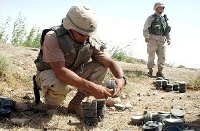 Throughout the 1990s, a coalition of numerous non-governmental organizations, the International Campaign to Ban Landmines (ICBL), campaigned successfully to prohibit the use of landmines.
This helped to create the 1997 Convention on the Prohibition of the Use, Stockpiling, Production and Transfer of Anti-Personnel Mines and on their Destruction, also known as the Ottawa Treaty.
(It also won the ICBL the 1997 Nobel Peace Prize for their efforts.) This treaty came into force in 1999.
Although landmine use in the past decade has been significantly reduced, problems such as clearance and rehabilitation remain. Furthermore, some key countries continue to use landmines, or support the need for them, despite the problems they often cause for civilians long after conflicts have ended.
Read “Landmines” to learn more.
Military Aid
 Military aid can be controversial. Its stated aim is usually to help allies or poor countries fight terrorism, counter-insurgencies or to help suppress drug production.
Military aid may even be given to opposition groups to fight nations, which was commonplace during the Cold War where even dictatorships were tolerated or supported in order to achieve geopolitical aims.
The aid may be in the form of training, or even giving credits for foreign militaries to purchase weapons and equipment from the donor country.
It is argued that strengthening military relationships can strengthen relationships between nations and military aid may be a way to achieve that. But it seems some aid goes to oppressive regimes which may help with geopolitical aims but may not necessarily help people of the recipient nation.
Read “Military Aid” to learn more.
Author and Page Information
- Created:
- Last updated: