

Arms Trade—a major cause of suffering
Author and Page information
- This page: https://www.globalissues.org/issue/73/arms-trade-a-major-cause-of-suffering.
- To print all information (e.g. expanded side notes, shows alternative links), use the print version:
Every gun that is made, every warship launched, every rocket fired signifies, in the final sense, a theft from those who hunger and are not fed, those who are cold and are not clothed. The world in arms is not spending money alone. It is spending the sweat of its laborers, the genius of its scientists, the hopes of its children… This is not a way of life at all, in any true sense. Under the cloud of threatening war, it is humanity hanging from a cross of iron.
The arms trade is a major cause of human rights abuses. Some governments spend more on military expenditure than on social development, communications infrastructure and health combined. While every nation has the right and the need to ensure its security, in these changing times, arms requirements and procurements may need to change too.
10 articles on “Arms Trade—a major cause of suffering” and 1 related issue:
The Arms Trade is Big Business
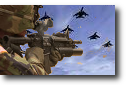 Each year, around $45-60 billion worth of arms sales are agreed. Most of these sales (something like 75%) are to developing countries.
The 5 permanent members of the UN Security Council (US, Russia, France, United Kingdom and China), together with Germany and Italy account for around 85% of the arms sold between 2004 and 2011.
Some of the arms sold go to regimes where human rights violations will occur. Corruption often accompanies arms sales due to the large sums of money involved.
Read “The Arms Trade is Big Business” to learn more.
World Military Spending
World military spending had reduced since the Cold War ended, but a few nations such as the US retain high level spending.
In recent years, global military expenditure has increased again and is now comparable to Cold War levels. Recent data shows global spending at over $1.7 trillion. 2012 saw the first dip in spending — only slightly —since 1998, in an otherwise rising trend.

The highest military spender is the US accounting for almost two-fifths of the world’s spending, more than the rest of the G7 (most economically advanced countries) combined, and more than all its potential enemies, combined.
Read “World Military Spending” to learn more.
Training Human Rights Violators
- A US military training school, the School of the Americas, has trained many of the worst human rights violators and dictators in various Latin American countries.
- Some of the worst dictators and human rights abusers in the developing world have passed through the school's doors, including people like Roberto D’Aubisson from El Salvador and Manuel Noriega of Panama.
- The US Army maintain that the school was set up to preserve democracy.
Read “Training Human Rights Violators” to learn more.
Military Propaganda for Arms Sales
- Arms contractors and maintain that arms sales are essential to foster good relations and also create more jobs at home.
- Arms companies selling to one country will often demonize their neighbors. Those countries are then demonized to us so we purchase more. That does not foster good relations.
- Often, to secure a sale, the manufacture of the arms also goes to the target nation. Therefore, jobs are created, but not at home.
- Propaganda comes in various forms, often via manipulative advertising campaigns.
- Arms corporations benefit from alliances like NATO and conflicts such as Kosovo, where opportunity for sales increases.
Read “Military Propaganda for Arms Sales” to learn more.
Small Arms—they cause 90% of civilian casualties
- The growing availability of small arms has been a major factor in the increase in the number of conflicts.
- In modern conflicts over 80 percent of all casualties have been civilian. 90 percent of these are caused by small arms.
Read “Small Arms—they cause 90% of civilian casualties” to learn more.
A Code of Conduct for Arms Sales
The arms trade is one of the most corrupt trades in the world, fueling conflict and poverty. Since the early 1990s there has been efforts to review and develop arms-transfer principles and codes of conduct to ensure that arms are not sold to human rights violators. The US, EU and others have developed some codes, but they are fraught with problems, loopholes, lack of transparency and are open to corruption. There is a proposed international arms trade treaty to overcome these limitations. However, for various political and profit reasons, some nations seem unwilling to agree to a code of conduct. Proposals are growing stronger for an arms trade treaty. Will that suffer the same problem?
Read “A Code of Conduct for Arms Sales” to learn more.
Landmines
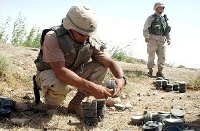 Throughout the 1990s, a coalition of numerous non-governmental organizations, the International Campaign to Ban Landmines (ICBL), campaigned successfully to prohibit the use of landmines.
This helped to create the 1997 Convention on the Prohibition of the Use, Stockpiling, Production and Transfer of Anti-Personnel Mines and on their Destruction, also known as the Ottawa Treaty.
(It also won the ICBL the 1997 Nobel Peace Prize for their efforts.) This treaty came into force in 1999.
Although landmine use in the past decade has been significantly reduced, problems such as clearance and rehabilitation remain. Furthermore, some key countries continue to use landmines, or support the need for them, despite the problems they often cause for civilians long after conflicts have ended.
Read “Landmines” to learn more.
Military Aid
 Military aid can be controversial. Its stated aim is usually to help allies or poor countries fight terrorism, counter-insurgencies or to help suppress drug production.
Military aid may even be given to opposition groups to fight nations, which was commonplace during the Cold War where even dictatorships were tolerated or supported in order to achieve geopolitical aims.
The aid may be in the form of training, or even giving credits for foreign militaries to purchase weapons and equipment from the donor country.
It is argued that strengthening military relationships can strengthen relationships between nations and military aid may be a way to achieve that. But it seems some aid goes to oppressive regimes which may help with geopolitical aims but may not necessarily help people of the recipient nation.
Read “Military Aid” to learn more.
Arms Trade Links for more information
Read “Arms Trade Links for more information” to learn more.
Corruption
 We often hear leaders from rich countries telling poor countries that aid and loans will only be given when they show they are stamping out corruption.
While that definitely needs to happen, the rich countries themselves are often active in the largest forms of corruption in those poor countries, and many economic policies they prescribe have exacerbated the problem.
Corruption in developing countries definitely must be high on the priority lists (and is increasingly becoming so in the wake of the global financial crisis), but so too must it be on the priority lists of rich countries.
Read “Corruption” to learn more.
Arms Control
Read “Arms Control” to learn more.
Author and Page Information
- Created:
- Last updated: