

Landmines
Author and Page information
- This page: https://www.globalissues.org/article/79/landmines.
- To print all information (e.g. expanded side notes, shows alternative links), use the print version:
Throughout the 1990s, a coalition of numerous non-governmental organizations, the International Campaign to Ban Landmines (ICBL), campaigned successfully to prohibit the use of landmines.
This helped to create the 1997 Convention on the Prohibition of the Use, Stockpiling, Production and Transfer of Anti-Personnel Mines and on their Destruction, also known as the Ottawa Treaty.
(It also won the ICBL the 1997 Nobel Peace Prize for their efforts.) This treaty came into force in 1999.
Although landmine use in the past decade has been significantly reduced, problems such as clearance and rehabilitation remain. Furthermore, some key countries continue to use landmines, or support the need for them, despite the problems they often cause for civilians long after conflicts have ended.
On this page:
Civilians as casualties — long after conflict has ended


In the 1990s, there was increasing awareness and activism on the controversial issue of landmines.
Horrific stories and pictures from all around the world often showed that civilians were the main landmine casualties in large numbers — and continued to be so years after the warring factions have left the battlefield (with the mines still there).
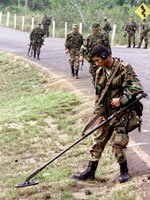
Even today, clearing decades old minefields has not always been possible. It is often risky, dangerous and time-consuming.
Other times, finding resources to help rehabilitate survivors has proven difficult.
Furthermore, in the midst of a conflict or in preparation, records are rarely kept on exact locations for any or all landmines.
This makes de-mining efforts incredibly challenging and risky.
In addition, landmines often make the land unusable until the mines are cleared. This means that people who depend on the surrounding region for their livelihoods may have to find alternatives ways of life.

Children and landmines
Many civilian casualties are also children. In many countries, child survivors have to end their education prematurely due to the period of recovery needed and the accompanying financial burden of rehabilitation on families,
the ICBL notes in a 2009 update on landmines and children.


As that report describes, suffering at an early age carries through to later life; education rates among child survivors are lower than average while school drop-outs are more frequent, diminishing employment prospects later on. This can happen because
- Psychological support for children experiencing trauma is rarely available while the psychological effects linger for many years (and sometimes for the rest of their lives).
- Accessible inclusive or special education is seldom available and further hindered by the lack of appropriate training for teachers.
- Insufficient awareness of disability issues among teachers and fellow pupils can lead to discrimination, isolation and the inability to participate in certain activities.
- This can be de-motivating for child survivors to stay in school.
Despite the challenges, Vietnam and Mozambique, for example, have attempted to address these problems with efforts for more inclusive education. Other countries such as Croatia and Lebanon, for example, have less progress, according to the ICBL update.
Landmines and non-human victims


Most discussions on landmine victims understandably refer to human suffering.
Without belittling that, there are also animals that suffer from landmines as the image shows.
Elephants in Sri Lanka (as seen in the photo) and along the Thai-Burma border, for example, are increasing victims of landmines.
Livestock and other animals can all fall victim too, which for some communities can be a major problem. However, as hard as civilian casualty data can be to obtain, it seems harder to obtain data on animal victims.
A decade of the Ottawa Treaty: progress and challenges
In the decade that the Ottawa Treaty has been in force, there has been tremendous progress, but there is still much to do.
This 2-minute presentation video from ICBL summarizes the main findings:
The ICBL identified around 73,500 casualties from landmines, ERW (explosive remnants of war) and victim-activated IEDs (improvised explosive devices) between 1999 and 2009. The ICBL stresses that full data for casualty numbers are hard to come by, implying that these numbers are likely to be very conservative. Nonetheless, they found just over 5,000 casualties in 2008, continuing a downward trend in casualties, which is positive.
However, they have found a number of countries still haven’t implemented some of their treaty obligations, while victim assistance has made the least progress of all major action
citing funding and actual action as the most prominent problems.
ICBL’s also provides a slightly more detailed table of key findings:
| 1999–2009 | 2008–2009 | |
|---|---|---|
| Landmine Monitor Report 2009 Quick Facts, International Campaign to Ban Landmines | ||
| Use | Government use of antipersonnel mines has greatly decreased over the last decade. In 1999, Landmine Monitor recorded probable use of antipersonnel mines by 15 states, compared to just two since 2007: Myanmar and Russia. | Only two states have used antipersonnel mines in 2008–2009: Myanmar and Russia. |
| Use by non-state armed groups (NSAGs) has also decreased; at least 59 NSAGs across 13 countries have committed to halt use of antipersonnel mines in the last 10 years. | NSAGs used antipersonnel mines in at least seven countries, two fewer than the previous year. | |
| Universalization | One hundred and fifty-six states—more than three-quarters of the world’s states—are party to the Mine Ban Treaty. A total of 39 countries, including China, India, Pakistan, Russia, and the United States, have still to join. Two of these are signatories: the Marshall Islands and Poland. | In December 2008, 94 states signed the Convention on Cluster Munitions, which comprehensively bans the use, production, stockpiling, and transfer of cluster munitions, and requires clearance of contaminated areas and assistance to victims and affected communities. As of 15 October 2009, 23 states had ratified the convention, which required 30 ratifications to trigger entry into force. |
| Production and trade | At least 38 former producers of antipersonnel mines have stopped, leaving only 13 states as actual or potential producers. For the past decade, global trade in antipersonnel mines has consisted solely of a low-level of illicit and unacknowledged transfers. | As few as three countries may have been producing antipersonnel mines in 2008: India, Myanmar, and Pakistan. Landmine Monitor has identified 10 other producing countries, but it is not known if they were actively manufacturing mines in the past year. |
| Stockpile destruction | The only confirmed serious violations of the treaty occurred in 2008, when three states missed stockpile destruction deadlines. | Belarus, Greece, and Turkey missed their stockpile destruction deadlines of 1 March 2008, and all three remained in serious violation of the treaty as of September 2009. |
| Eighty-six States Parties have completed the destruction of their stockpiles, and four more are in the process. Together, they have destroyed about 44 million antipersonnel mines. | Three countries completed stockpile destruction: Indonesia (November 2008), Ethiopia (April 2009), and Kuwait (declared in July 2009). | |
| Clearance of mined areas (Article 5) | Eleven states have cleared all known mined areas from their territory: Bulgaria, Costa Rica, El Salvador, France, Guatemala, Honduras, FYR Macedonia, Malawi, Suriname, Swaziland, and Tunisia.
As of August 2009, more than 70 states were believed to be mine-affected. | In May 2009, Tunisia became the eleventh State Party to formally declare completion of clearance obligations under the treaty. Mine-affected states are required to clear all antipersonnel mines from mined areas under their jurisdiction or control within 10 years of becoming party to the Mine Ban Treaty.
The first deadlines expired on 1 March 2009, but 15 States Parties with 2009 deadlines failed to meet them and were granted extensions: Bosnia and Herzegovina, Chad, Croatia, Denmark, Ecuador, Jordan, Mozambique, Nicaragua, Peru, Senegal, Thailand, the United Kingdom, Venezuela, Yemen, and Zimbabwe. All of the requests (which ranged from one to 10 years, the maximum period permitted for any extension period) were granted by the Ninth Meeting of States Parties in Geneva in November 2008. In 2009, four more States Parties (Argentina, Cambodia, Tajikistan, and Uganda) formally requested extensions for periods ranging from three to 10 years. |
| Since 1999, at least 1,100km2 of mined areas and a further 2,100km2 of battle areas, an area twice the size of London, have been cleared in more than 90 states and other areas. Operations have resulted in the destruction of more than 2.2 million emplaced antipersonnel mines, 250,000 antivehicle mines, and 17 million explosive remnants of war (ERW). | In 2008, mine action programs cleared almost 160km2 of mined areas—the size of Brussels—the highest total ever recorded by Landmine Monitor. | |
| Risk Education | Mine and ERW risk education (RE) has evolved significantly in the last decade. Many programs have shifted from a purely message-based approach to more engaged efforts to bring about broader behavior change and risk reduction. | In 2008, RE was provided in 57 states and areas, compared to 61 states and areas in 2007. RE activities increased significantly in Yemen and Somaliland, and also increased to some degree in 10 other states. In Palestine, RE decreased in 2008 but rose sharply in response to conflict in Gaza in December 2008–January 2009. In 2008 in at least 26 states and areas, RE programs were still being implemented without comprehensive needs assessments. |
| Casualties | Despite data collection challenges, Landmine Monitor has identified at least 73,576 casualties of landmines, ERW, and victim-activated improvised explosive devices in 119 states and areas in the past 10 years. Clearance, supported by RE, has resulted in a significant reduction in casualties. | There were at least 5,197 casualties caused by mines, ERW, and victim-activated IEDs in 2008, which continued a downward trend of the last few years. |
| Victim Assistance | Over the past decade, victim assistance has made the least progress of all the major sectors of mine action, with funding and action falling far short of what was needed. Most efforts remained focused on medical care and physical rehabilitation, often only when supported by international organizations and funding, rather than on promoting economic self-reliance for survivors, their families, and communities.
At the First Review Conference of the treaty, States Parties agreed that 23 States Parties with significant numbers of survivors should make special efforts to meet their needs. Throughout 2005–2009, progress among the now VA26 States Parties has been variable. Progress was most visible in coordination, rather than in implementation of actual services. Progress on activities was often unrelated to the plans the 26 countries set for themselves. | In 2008–2009, there was a continued lack of psychosocial support and economic reintegration for survivors even where there were improvements to national healthcare, physical rehabilitation, or disability laws/policies. Pakistan and Sri Lanka saw deterioration of services nationwide or in certain areas because of conflict and natural disasters. The period also saw the closure of several national NGOs/disabled people’s organizations, continued capacity problems for others, and persistent funding challenges. Other trends included the continuing handover of physical rehabilitation programs to national management and a continued increase of survivor associations and/or their capacities. |
| Support for Mine Action | Total international support for mine action for 1992–2008 was US$4.27 billion. | For 2008 Landmine Monitor identified a total of US$626 million in funding for mine action worldwide, combining international and national funding. International funding in 2008 was provided by 23 states and the European Commission and was channeled to at least 54 recipient states and other areas. The top five recipients of mine action funding in 2008 were, in descending order: Afghanistan, Sudan, Iraq, Lebanon, and Cambodia. |
The United States has not signed up to the landmine ban treaty
Due to its geopolitical position and status, the US has often been a core focus area for many landmine treaty activists. The position of the US has been interesting:
- On the one hand, the US has done a lot in the past decade to avoid use or production of landmines and assist in clearance;
- On the other hand it opposes the treaty to band landmines.
The ICBL’s annual reports include country level details. The 2009 landmine monitor report for the US includes a summary of policies over the past 10 years for the US.
US efforts to avoid landmine use
US law has prohibited all antipersonnel mine exports since October 1992 and in December 2007, the export moratorium was extended until 2014.
Furthermore, the US has not used antipersonnel mines since 1991, nor produced them since 1997.
The ICBL also reports that the United States has contributed at least $796.8 million in support of mine action between 1999 and 2008.
Yet, the US still hasn’t signed the landmine treaty
President Clinton, in 1994, was the first leader to call for an international ban on anti-personnel landmines. Yet in 1997 when they all met in Ottawa, Canada, to sign a treaty to ban the use, the USA weren’t there. The wanted the option to use landmines in some cases, such as along the demilitarized zone between North and South Korea. This, they say would help to defend South Korea.
As the introduction to a landmine documentary noted back in 1999, their refusal to sign the treaty also paradoxically allowed the US the right to lay mines anywhere, even as it supported mine removal and humanitarian relief for the victims of mine warfare.
With the Clinton administration deciding not to sign the treaty, they set the objective of joining in 2006. However, the Bush administration announced in 2004 that the US would not accede.
According to its policy announced in February 2004, the US can use any type of landmine (antipersonnel or antivehicle) that self-destructs and self-deactivates for the indefinite future and without any geographic restrictions. The policy also allows the US to use non-self-destructing antipersonnel mines in Korea until the end of 2010.
Around the time the treaty came into effect, the US were considering a new mine systems, which caused uproar in the human rights and disarmament activist circles.
Human Rights Watch, for example (also part of the ICBL coalition) has been very critical of the United States’s landmine policies. Back in 2001, for example, it criticized the US as also bearing responsibility for the landmine crisis pointing out that at the time, the United States was one of the largest producers, exporters and stockpilers of landmines.
However, in 2002, the US canceled a program to combine existing antipersonnel and antivehicle mines into a mixed
system.
For a number of years the US was looking into developing new mine systems that would have been prohibited by the mine ban treaty, but such plans were abandoned in 2008 by the Pentagon. The US can, however, still use non-self-destructing antivehicle mines without geographic restriction, but only with presidential authorization, and only until the end of 2010.
The US does stockpile a lot of landmines, however — approximately 10.4 million antipersonnel mines and 7.5 million antivehicle mines, the third largest landmine stockpile in the world after China and Russia, according to the IBCL. As of 2002, the stockpile had 1.56 million non-self-destructing landmines, including 1.16 million M14 and M16 antipersonnel mines (which are the ones for any future war in Korea) and about 403,000 Claymore mines. About half of those mines are stored in the continental US. The US military also keeps a substantial number of self-destructing, scatterable antipersonnel mines in South Korea.
With Obama’s administration, messages about landmine ban position has been mixed. At the end of November 2009, the State Department seemed to announce that it would not sign the 10-year-old anti-personnel landmines treaty. However, perhaps because of the immediate criticism that announcement generated, the next day the State Department insisted that Washington’s policy on the issue was still being reviewed.
Geopolitically, as the previous link noted, the initial State Department announcement was seen as a victory for the Pentagon, which has long opposed the treaty, and Republicans wary of all international treaties that may limit Washington’s freedom to act in the world as it wishes
.
But other key nations have also opposed the landmine treaty, which the 2009 landmine monitor report also details. (From the previous link, country-level reports on progress and other issues are available.)
Various nations continue to use landmines or oppose the treaty
As the table further above summarizes, a number of countries have still not signed the treaty, such as China, India, Pakistan, Russia, and the United States, while Russia and Myanmar continue to use landmines.


Casualties are also found around the world:

More Information
For more information about landmines, visit:
- The International Campaign To Ban Landmines Web Site
- Human Rights Watch work on landmines
- The Center for Defense Information documentary about American landmine survivors that includes a transcript of the program
- New Internationalist Magazine had a whole issue on landmines
- The Adopt-a-Minefield web site
Author and Page Information
- Created:
- Last updated: