

Food and Agriculture Issues
Author and Page information
- This page: https://www.globalissues.org/issue/749/food-and-agriculture-issues.
- To print all information (e.g. expanded side notes, shows alternative links), use the print version:
Food and agriculture is at the heart of our civilizations. Many religions and cultures celebrate various aspects of food and agriculture due to the importance in our continuity. For an issue that goes to the heart of humanity, it also has its ugly side.
26 articles on “Food and Agriculture Issues” and 4 related issues:
East Africa Food Crisis 2011
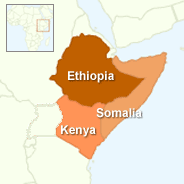 Into mid-2011, the world’s worst food crisis is being felt in East Africa, in Ethiopia, Somalia and Kenya.
Despite successive failed rains, the crisis has been criticized as avoidable and man-made. This is because the situation had been predicted many months before by an international early warning system. Both the international community and governments in the region have been accused of doing very little in the lead up to this crisis. In addition, high food prices have forced food out of the reach of many people, while local conflicts exacerbate the situation.
As the international organization Oxfam describes: 12 million people are in dire need of food, clean water, and basic sanitation. Loss of life on a massive scale is a very real risk, and the crisis is set to worsen over the coming months, particularly for pastoralist communities.
This page also presents news coverage from Inter Press Service on this crisis.
Read “East Africa Food Crisis 2011” to learn more.
Global Food Crisis 2008
 The global food crisis that has made headlines in 2008 has been simmering for a while. The rise in food prices, affecting the poorest the most, has a variety of causes, mostly man-made. It has resulted in riots, an overthrow of a Prime Minister and many deaths, around the world. It has been common to attribute causes to things like overpopulation but that seems to miss the real causes as food levels continue to outstrip demand even in a growing population. While media reports have been concentrating on some of the immediate causes, it seems that deeper issues and causes have not been discussed as much.
Read “Global Food Crisis 2008” to learn more.
Food Aid
Food aid is a crucial part of helping tackle world hunger. However, food aid comes in various forms, and is often criticized for benefiting donors and their interests more than recipients. For example, during the Cold War in particular, food dumping was common place. Today long term food aid is giving way to emergency relief. While this is important it also has its challenges. Ultimately it seems that food aid still helps the rich more than the poor. This section provides an overview of food aid.
Read “Food Aid” to learn more.
World Hunger and Poverty
Meaningful long-term alleviation of hunger is rooted in the alleviation of poverty, as poverty leads to hunger. World hunger is a terrible symptom of world poverty. If efforts are only directed at providing food, or improving food production or distribution, then the structural root causes that create hunger, poverty and dependency would still remain. While resources and energies are deployed to relieve hunger through technical measures such as improving agriculture, and as important as these are, inter-related issues such as poverty means that political solutions are likely required as well for meaningful and long term hunger alleviation.
Read “World Hunger and Poverty” to learn more.
Causes of Hunger are related to Poverty
There are many inter-related issues causing hunger, which are related to economics and other factors that cause poverty. They include land rights and ownership, diversion of land use to non-productive use, increasing emphasis on export-oriented agriculture, inefficient agricultural practices, war, famine, drought, over-fishing, poor crop yields, etc. This section introduces some of these issues.
Read “Causes of Hunger are related to Poverty” to learn more.
Solving World Hunger Means Solving World Poverty
Solving world hunger in the conventional sense (of providing/growing more food etc) will not tackle poverty that leads to hunger in the first place. Further, there is a risk of continuing the poverty and dependency without realizing it, because the act of attempting to provide more food etc can appear so altruistic in motive. To solve world hunger in the long run, poverty alleviation is required.
Read “Solving World Hunger Means Solving World Poverty” to learn more.
Food Dumping [Aid] Maintains Poverty
Food aid (when not for emergency relief) can actually be very destructive on the economy of the recipient nation and contribute to more hunger and poverty in the long term. Free, subsidized, or cheap food, below market prices undercuts local farmers, who cannot compete and are driven out of jobs and into poverty, further slanting the market share of the larger producers such as those from the US and Europe. Many poor nations are dependent on farming, and so such food aid
amounts to food dumping. In the past few decades, more powerful nations have used this as a foreign policy tool for dominance rather than for real aid.
Read “Food Dumping [Aid] Maintains Poverty” to learn more.
Food Aid as Dumping
The way the food aid programs of various rich countries is structured may be of concern. In fact, food aid
(when not for emergency relief) can actually be very destructive on the economy of the recipient nation. Dumping food on to poorer nations (i.e. free, subsidized, or cheap food, below market prices) undercuts local farmers, who cannot compete and are driven out of jobs and into poverty, further slanting the market share of the larger producers such as those from the US and Europe.
Read “Food Aid as Dumping” to learn more.
Myth: More US aid will help the hungry
With kind permission from Peter Rosset of the Institute for Food and Development Policy (or FoodFirst.org as it is also known), chapter 10 of World Hunger: 12 Myths, 2nd Edition, by Frances Moore Lappé, Joseph Collins and Peter Rosset, with Luis Esparza (fully revised and updated, Grove/Atlantic and Food First Books, Oct. 1998) has been posted here. It describes in detail the issue of food aid and the United States of America’s aid policies, the problems it causes and who it really benefits.
Read “Myth: More US aid will help the hungry” to learn more.
Population and Feeding the World
The food scarcity part of the argument in the population debate is an interesting one -- people are hungry not because the population is growing so fast that food is becoming scarce, but because people cannot afford it. Food may be scarce, but it is international trade, economic policies and the control of land that have lead to immense poverty and hunger and therefore less access to food, not food scarcity due to over population.
Read “Population and Feeding the World” to learn more.
Consumption and Consumerism
Read “Consumption and Consumerism” to learn more.
Tobacco
 It is well known that tobacco smoking kills millions. But it also exacerbates poverty, contributes to world hunger by diverting prime land away from food production, damages the environment and reduces economic productivity. Second hand smoking also affects other people’s lives.
Despite many attempts to prevent it, a global tobacco control treaty became international law in 2005.
However, challenges still remain as tobacco companies try to hit back, for example, by targeting developing nations, increasing advertising at children and women, attempting to undermine global treaties and influence trade talks, etc.
Read “Tobacco” to learn more.
Obesity
 Obesity typically results from over-eating (especially an unhealthy diet) and lack of enough exercise.
In our modern world with increasingly cheap, high calorie food (example, fast food — or junk food
), prepared foods that are high in things like salt, sugars or fat, combined with our increasingly sedentary lifestyles, increasing urbanization and changing modes of transportation, it is no wonder that obesity has rapidly increased in the last few decades, around the world.
The number of people overweight or obese is now rivaling the number of people suffering from hunger around the world. Obese people were thought to be mainly from richer countries or wealthier segments of society, but poor people can also suffer as the food industry supplies cheaper food of poorer quality.
Environmental, societal and life-style factors all have an impact on obesity and health. While individuals are responsible for their choices, other actors such as the food industry are also part of the problem, and solution. Unfortunately, the food industry appears reluctant to take too many measures that could affect their bottom line, preferring to solely blame individuals instead.
Read “Obesity” to learn more.
Sugar
In this section, we look at the example of sugar consumption; how it has arisen (as it was once a luxury, now turned into a necessity
). We look at things like how it affects the environment; the political and economic drivers in producing sugar (for example, historically, sugar plantations encouraged slavery); its health effects today; its relation to world hunger (as land used to grow sugar and related support, for export, could be used to grow food for local consumption); and so on. As we will also see, it is an example of a wasteful
industry. That is, so many resources go into this industry compared to what might be needed. This wastes labor, wastes capital and uses up many resources.
Read “Sugar” to learn more.
Beef
 Beef, like sugar, is another vivid example of using resources wastefully, degrading the environment, contributing to hunger, poor health and more.
More than one third of the world’s grain harvest is used to feed livestock. Some 70 to 80% of grain produced in the United States is fed to livestock. A lot of rainforest in the Amazon and elsewhere are cleared for raising cattle — not so much for local consumption, but for fast food restaurants elsewhere.
There are enormous related costs of what is an inefficient
process when considered as a whole. Subsidies in farming in the US and elsewhere end up encouraging unhealthy foods to be cheaper than healthy foods. Just factoring in the cost of water alone, a more realistic estimate of the real cost of common hamburger meat would be $35 a pound!
As with sugar, beef was a luxury turned into an everyday item. Like sugar, it is also an example of how people’s tastes are influenced and how demands
can be created (or very much expanded), rather than meeting some natural
demand.
Read “Beef” to learn more.
Bananas
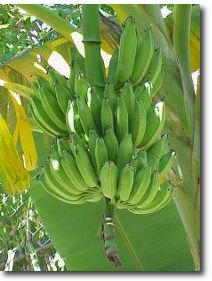 The banana industry in Latin America and the Caribbean also touches many other issues. Rainforest destruction is one effect of the banana industry.
Dependent economies is another, where bananas are grown not to feed local people and meet their demands, but to create exports for Europe and America. The recent trade disputes between those two regions have received the most attention. However, the focus of the debate is limited. It continues to leave both dependent Latin American nations, and the Caribbean nations in poverty and hunger, while Latin American nations, large multinational American banana corporations and the American government seek to destroy the Caribbean banana economy, via the World Trade Organization, in order to gain dominant access to the European markets.
So many resources are poured into the banana industry, and like the sugar and beef examples, there is a lot of unnecessary use of resources that could otherwise be freed up to help local people in a way that is also less degrading to the surrounding environment.
Read “Bananas” to learn more.
The Banana Trade War
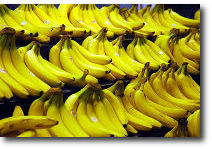 Bananas are widely consumed. Yet, they represent a wide variety of inter-related issues, from environmental, economic, social, and political. Nations and regions, such as the US and EU have in the past battled in a trade war over how bananas are exported and imported, affected the poorest in the producing countries the most.
Read “The Banana Trade War” to learn more.
Pineapples
 Pineapples are nutritious and popular. But the cheap fruit comes at a high cost. Health and environmental degradation has affected both workers and local communities. Price cuts in European supermarkets has led to wage cuts for workers already earning very little.
Read “Pineapples” to learn more.
Genetically Engineered Food
Read “Genetically Engineered Food” to learn more.
Is GE Food Safe?
Read “Is GE Food Safe?” to learn more.
"GE Technologies will solve world hunger"
Read “"GE Technologies will solve world hunger"” to learn more.
Food Patents—Stealing Indigenous Knowledge?
Read “Food Patents—Stealing Indigenous Knowledge?” to learn more.
GE Food Media Coverage
Read “GE Food Media Coverage” to learn more.
Functional Foods—the next wave of GE foods
Read “Functional Foods—the next wave of GE foods” to learn more.
Terminator Technology
Read “Terminator Technology” to learn more.
Monsanto—a major player in GE Technology
Read “Monsanto—a major player in GE Technology” to learn more.
Public Concerns and Protests on GE Food
Read “Public Concerns and Protests on GE Food” to learn more.
Genetically Engineered Food Links for more Information
Read “Genetically Engineered Food Links for more Information” to learn more.
World hunger related links for more information
Links to web sites and articles that discuss world hunger, the relationship between populations and hunger, of poverty and hunger, agricultural issues, land rights and so on.
Read “World hunger related links for more information” to learn more.
Foreign Aid for Development Assistance
In 1970, the world’s rich countries agreed to give 0.7% of their gross national income as official international development aid, annually.
Since that time, billions have certainly been given each year, but rarely have the rich nations actually met their promised target.
For example, the US is often the largest donor in dollar terms, but ranks amongst the lowest in terms of meeting the stated 0.7% target.
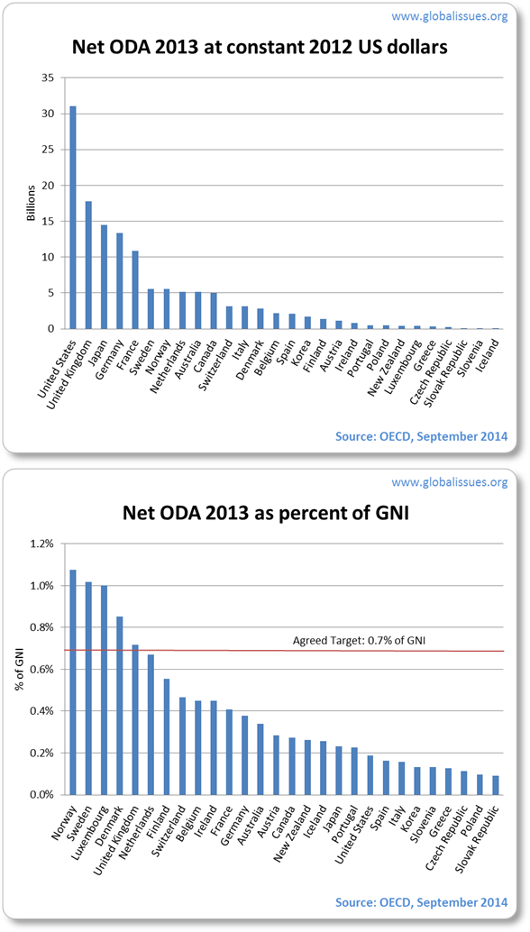
Furthermore, aid has often come with a price of its own for the developing nations. Common criticisms, for many years, of foreign aid, have included the following:
- Aid is often wasted on conditions that the recipient must use overpriced goods and services from donor countries
- Most aid does not actually go to the poorest who would need it the most
- Aid amounts are dwarfed by rich country protectionism that denies market access for poor country products while rich nations use aid as a lever to open poor country markets to their products
- Large projects or massive grand strategies often fail to help the vulnerable; money can often be embezzled away.
This article explores who has benefited most from this aid, the recipients or the donors.
Read “Foreign Aid for Development Assistance” to learn more.
Author and Page Information
- Created:
- Last updated: