Merkel Under Pressure for Refugee Policy in Germany
MUNICH, Feb 23 (IPS) - Internationally, German chancellor Angela Merkel was praised for her humanitarian decision to open the countries' border to hundreds of thousands of refugees from Syria and Iraq. But the decision has considerably reduced her support among Germans. Chances are real that Merkel could lose the chancellorship in the upcoming national elections.
Not long ago, a scene like this seemed impossible.
In spring 2015, all national polls saw Merkel's conservative party at more than 40 percent support among Germans. The Social Democrats, which came in second, reached less than 25 percent. Even after almost ten years as chancellor, Merkel was considered as indispensable by most Germans. She enjoyed an approval rating of 75 percent.
However, after the events of September 2015, her popularity quickly started to drop to levels below 50 percent. Her party fell to 32 percent in recent polls.
Angela Merkel made her famous statement "we can make it" on August 31st of 2015. The number of refugees entering the country had already risen to 100,000 a month and she wanted to assure the public that Germany could tackle the integration of those immigrants.
Within days after Merkel's comment the situation became even more dramatic.
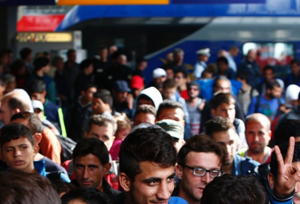
Hungarian authorities had blocked thousands of refugees, who were fleeing violence and war in the Middle East, from boarding trains to Austria or Germany where they wanted to apply for asylum. Families had to sleep in makeshift shelters outside Budapest's train station, while volunteers were struggling to provide at least a minimum of aid.
On September 4th, chancellor Merkel and her Austrian counterpart Werner Faymann therefore decided to open their countries' borders for the people stranded in Budapest. Soon afterwards, first trains arrived in Munich, and many Germans welcomed the refugees and supplied food, drinks and clothing. A total of 890.000 asylum seekers entered Germany in 2015.
"The German government's reaction was not an open-door policy, but a humanitarian reaction on the basis of international law", Petra Bendel, a professor for political science at Friedrich-Alexander University in Erlangen, told IPS.
She also pointed out that Merkel's grand coalition switched to a more restrictive refugee policy within weeks.
For example, the coalition introduced residence restrictions for asylum seekers. Instead of giving out money, some social benefits are provided in kind. And by granting only subsidiary protection instead of refugee status for Syrians, family reunions were made more difficult. On top of that, the German government started to push forward returns and expulsions.
"Timing suggests that these policy proposals must have existed in the drawers and waited for their time to come, since they were introduced in record time", Bendel, who is also a member of The Expert Council on Integration and Migration, added.
But the rapid shift to a more restrictive stance on immigration and even the steep decline in the number of refugees coming to Germany in 2016 did not lead to a recovery of Merkel's popularity.
Those parts of society that saw refugees as a threat to their wealth and security had already turned their back on her. Social networks were flooded with "Merkel must go!"-postings. After the events of Cologne and other cities, where groups of migrants sexually assaulted hundreds of women on New Year's Eve 2015, tensions within the German society intensified.
"The events clearly had a decisive effect on public opinion", said Bendel. "Survey data showed that in January 2016 for the first time a clear majority – 60 percent of survey participants instead of 46 percent in December – considered that Germany could not cope with such a large number of refugees."
In the same time, eurosceptic right-wing party AfD gained momentum with a fierce and populist anti-immigrant rhetoric. The party easily surpassed the long-established Greens, the Left Party, and the Liberals in several regional elections with double digit results. In return, Merkel's own Christian Democrats suffered one defeat after another.
In recent weeks, however, polls showed diminishing support for AfD. But it was not Merkel's conservative block that benefitted. Instead, the Social Democrats which have been the junior partner in the ruling coalition made a comeback after nominating Martin Schulz, the former president of the European Parliament, as their candidate for chancellor.
Schulz already outpolled Angela Merkel in personal popularity.
"The few moderate AfD-supporters have migrated to the Social Democrats because they believe Martin Schulz could oust Angela Merkel, whom they hate", Manfred Güllner, the head of pollster Forsa commented a survey that his institute conducted for TV network RTL and magazine Stern.
However, the resurge of the Social Democrats does not mean that refugee policy will not play a major role in the campaign for the national election due in September.
"Analyzing the party platforms, migration issues are on top of each and every party's agenda", Bendel said. "The danger exists that particularly the AfD's campaign, which has already been leaked, further builds on irrational, explosive contents and appeals to most primitive instincts."
Political observers now see a chance that after twelve years, Angela Merkel could lose the chancellorship.
© Inter Press Service (2017) — All Rights Reserved. Original source: Inter Press Service
Where next?
Browse related news topics:
Read the latest news stories:
- ‘Safeguard the postwar order,’ China tells UN General Assembly Saturday, September 26, 2026
- Countries adopt global blueprint to tackle fast-evolving crime in digital age Saturday, September 26, 2026
- The Takeaway: UN General Assembly debate Day 4 Saturday, September 26, 2026
- Nepal’s Devastating Floods Have Put Women and Girls at Greater Risk Friday, September 25, 2026
- Myanmar: Corporate Complicity in the Spotlight Friday, September 25, 2026
- Forty Years of the ‘Right to Development’: When Growth Excludes, Is It Still Development? Friday, September 25, 2026
- Haiti at ‘watershed moment’, Prime Minister tells UN, urging full backing for security force Friday, September 25, 2026
- Pakistan’s Sharif warns any diversion of Indus waters will be ‘treated as an act of war’ Friday, September 25, 2026
- UN voices grave concern as fighting spreads across northern Ethiopia Friday, September 25, 2026
- Tuvalu urges decisive global action as rising seas threaten its future Friday, September 25, 2026
Learn more about the related issues:
Share this
Bookmark or share this with others using some popular social bookmarking web sites:
 Bluesky