CORRUPTION: Post-Mubarak Egypt Probes Public Land Contracts
Egyptian authorities have opened dozens of criminal investigations into hundreds of millions of dollars worth of public land contracts that were awarded illegally to real estate developers associated with former President Hosni Mubarak without proper procedures at below market rates.
The current probes are the first steps, and perhaps the most obvious, that emerge in post-Mubarak Egypt towards the country's new economic future - - one many here say could be less susceptible to cronyism and shady deals by government officials.
'The (Mubarak) authoritarian regime supported a class of land speculators and marketed them as if they were real developers and entrepreneurs with real projects,' said Mamdouh Hamza, civil engineering professor at Suez Canal University and a frequent public speaker on land corruption issues.
'In fact the closest thing they had to business was their relations and contacts with the regime which they used to obtain land cheaply, wait on it a bit, inflate their prices and then sell at huge profits without giving the public a penny in return.'
The investigations, backed by the country's current rulers in the military, who came to office after Mubarak was ousted in the Jan. 25, are designed to placate angry Egyptians who feel they have been ripped off by the previous regime.
The official Central Auditing Organisation, a government watchdog that was marginalised under Mubarak but continued to amass reports on official corruption, estimates that the country could recoup some 75 billion Egyptian pounds (12.7 billion U.S. dollar) from land sold as cheap farmland but later vended as residential mansions and luxury units, especially around the 220- kiometer Desert Road between Cairo and the Mediterranean city of Alexandria.
At least a dozen of close associates of the ex-president, who ruled Egypt for 30 years, and his son, Gamal, are now standing trial or investigations related to corrupt land contracts.
Almost all of the officials were members of Mubarak's once-ruling National Democratic Party. Several have been ordered not to leave the country while others had their financial assets frozen by the general prosecutors pending investigation over how they cheaply obtained public land with little or no government oversight.
Although such cases are being uncovered almost on daily basis, many who had warned of wrongful practices in state land sales in the past, say this is only the tip of the iceberg.
'The end of state land corruption has just started,' said former Dean of the Faculty of Urban Planning at Cairo University Sameh El-Alaily, who had written extensively about state land abuse.
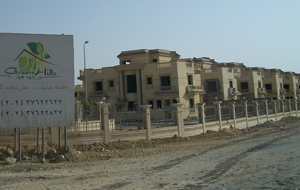
Earlier this month an Egyptian legal panel recommended that a contract to sell 230 acres of public land north east of Cairo to the country's second largest listed company, Palm Hills Developments, be annulled.
The panel found the deal was given 'by direct order' rather than through competitive bidding at drastically below market rates. As a result, the country lost millions of dollars in real value of the land.
The former Housing Minister Ahmed Al-Maghrabi now in prison, stands accused of awarding Palm Hills Developments, in which he is a shareholder, hundreds of acres of land at such rates 'using only his signature'.
The Egyptian General Prosecutor Abdel Megeed Mahmoud this week ordered freezing all assets of Al-Maghrabi and his partner, Palm Hills Developments Chairman and Chief Executive Officer Yasseen Mansour, whose family's business empire includes dealerships for General Motors, Opel, Philip Morris, McDonalds, Red Bull, and Mantrac.
Palm Hills says on its website it is a business partner with The Ritz-Carlton Hotel Company and Jumeirah Group, the Dubai-based luxury hospitality firm and member of Dubai Holding.
Palm Hills also has an agreement with India's Taj Hotels, Resorts and Palaces to manage three Palm Hills hotels, one each on the North Coast in Ain Sokhna and in Aswan.
Al-Maghrabi faces several other charges including selling land at 300 Egyptian pounds ($50) per meter when the real price was 5,000 (850 dollar) to a Saudi real estate mogul in Cairo.
The same panel also recommended cancelling another deal with Saudi billionaire Prince Waleed bin Talal to sell 100,000 acres in the southern part of the country at a rate of 50 Egyptian pounds (8.4 dollar) per acre when the government was selling similar land to Egyptian university graduates for 22,000 Egyptian pounds (3,700 dollar), the panel said.
Mubarak's regime said the plan to sell so cheaply was for Prince Bin Talal's company, Kingdom Agricultural Development Company, to reclaim and cultivate the desert land to produce food for Egypt.
The legal panel said 'the government has so far offered no evidence that the land has been cultivated despite the fact that the contract was signed 13 years ago.'
The country's largest listed developer Talaat Moustafa Group (TMG) is under similar scrutiny as it faces renewed accusations that it has been awarded an 8,000 acres in its 3 billion dollar flagship project, Madinaty (my city), at token prices without proper auction procedure.
A previous court ruling, before Mubarak's abdication, found that the now infamous Madinaty contract was fraudulent. Yet the Mubarak regime stomped all over the courts and re-issued the land late last year at the same price to the same company.
Further corruption cases involving public land are being disclosed at a dizzying pace, a development that has clearly kept corrupt officials who are still at large on their toes.
'But those who stole public land must be dying in their skin right now,' Hamza said. 'Prison is waiting for them. They deserve it.'
© Inter Press Service (2011) — All Rights Reserved. Original source: Inter Press Service
Where next?
Browse related news topics:
Read the latest news stories:
- For Brazil’s Indigenous youth, visibility is resistance Saturday, August 08, 2026
- In Taliban-Ruled Afghanistan, One Woman Refuses a Life of Dependence Friday, August 07, 2026
- Hiroshima’s Question: Will We Continue to Live Under the Nuclear Shadow? Friday, August 07, 2026
- Burkina Faso’s Cancelled Democracy Friday, August 07, 2026
- The World’s Aid Workers Must Be Protected Friday, August 07, 2026
- The Mediterranean’s own odyssey: An ecological treasure feels the strain Friday, August 07, 2026
- ‘Sudan is losing another generation’ to war, Mohammed warns Friday, August 07, 2026
- Peacock party takes pride of place in nod to decades of turbulent history Friday, August 07, 2026
- Ebola in DR Congo: Childhood deaths rise; hopes raised over new vaccine Friday, August 07, 2026
- Food prices edged up in July amid heatwaves and energy price hikes Friday, August 07, 2026
Learn more about the related issues:
Share this
Bookmark or share this with others using some popular social bookmarking web sites:
 Bluesky