

New Biodiversity Funding Brings Hope for Armenia’s Lake Sevan
YEREVAN & GEGHARKUNIK PROVINCE, Armenia, November 2 (IPS) - The midday sun shines brightly over Lake Sevan. In the still waters, a flock of cormorants drifts silently, their black feathers glistening in the autumn light.
Above them, another flock of black-and-white birds wheels effortlessly through the crisp late-October air. These are Armenian gulls; a species closely associated with the lake.
“For us, these cormorants and Armenian gulls are a matter of national pride,” says Luba Balyan, an ornithologist from the Scientific Center of Zoology and Hydro Ecology, Armenia, who is stationed at Norashen Reserve, a Ramsar-designated wetland on the lake’s shores.
According to Balyan, the gulls used the lake as an important breeding ground but abandoned their nesting sites for nearly 50 years because of hunting and pollution.
“The temperature has changed, and illegal hunting increased. But we worked very hard to restore the habitat and bring the birds back. They first returned around 2010-2011, and now their population has increased,” she tells a visiting group that includes officials from Armenia’s Ministry of Environment, the United Nations Development Programme (UNDP) and the Global Environment Facility (GEF), which has just approved funding for a major restoration project in Lake Sevan.
The funding – USD 1.4 million – was approved by the GEF at the 17th meeting of the Conference of the Parties to the Convention on Biological Diversity (CBD COP17) in Yerevan under the Global Biodiversity Framework Fund (GBFF). This initiative is one of three projects approved recently for restoring and protecting biodiversity in Armenia under various funds.
The Lake Sevan project offers a glimpse of how biodiversity finance announced at international negotiations can reach local communities. The funding will be channelled through the Asian Development Bank, Armenian government agencies, UNDP and local NGOs to support activities ranging from habitat restoration and anti-poaching patrols to ecotourism, sustainable agriculture and alternative livelihood programmes designed to reduce pressure on the lake’s biodiversity.
New Boost for an Ongoing Restoration Effort
Spanning over 450 square miles, Lake Sevan stands at an altitude of 1,900 metres above sea level, making it one of Eurasia’s largest freshwater high-altitude lakes and the largest lake in Armenia and the Caucasus region. The lake is broadly divided into two categories: small Sevan and big Sevan.
The new funding announcement comes as Armenia steps up its efforts to restore the Lake Sevan Basin through a series of conservation programmes backed by international donors and development agencies. The lake ecosystem has been under stress from overfishing, illegal fishing, contamination from dumping of garbage and uncontrolled tourism. The project aims to protect wildlife, improve the management of land and water resources, and support the communities whose lives and incomes depend on the basin.
The project covers the regions of Gegharkunik and Vayots Dzor and six communities around the lake: Martuni, Vardenis, Chambarak, Yeghegis, Vayk and Jermuk. By 2028, it is expected to directly benefit nearly 66,000 people and improve the management of grasslands, farmland and forests across the basin. It also seeks to better connect protected areas with surrounding landscapes, helping wildlife and ecosystems adapt to growing environmental pressures.
The Armenian government has already launched a range of conservation measures, including monitoring illegal fishing and hunting through a special environmental enforcement unit known as Eco Patrol. The local staff has been trained and equipped to identify and protect priority areas that are habitats for endemic species such as Sevan trout and Armenian gull.
Many of these activities are already underway through earlier conservation investments in the basin. Officials say the new GBFF funding will help expand them and bring them to additional communities.
“Lake Sevan is special to us. It’s a crown jewel for Armenia, the biggest freshwater reservoir in the region. So, when we had an opportunity, we decided to ask for funds for restoring Lake Sevan. I am very glad that it was approved for the amount,” said Armenian Environment Minister and COP17 President Hambardzum Matevosyan.
At Norashen Reserve, authorities are developing ecotourism programmes and biodiversity-friendly livelihood opportunities for local communities, according to Deputy Environment Minister Aram Meymaryan. He said these efforts, together with stronger patrolling and monitoring, are intended to generate economic benefits for local people while reducing pressure on fragile ecosystems.
Communities Become Partners in Restoration
Satik Badeyan is the president of the Center for the Territorial Development and Research NGO, which has been chosen as a partner in the restoration efforts on Lake Sevan. Under Badeyan’s leadership, the communities here have been carrying out multiple activities to control tourist flow by redirecting tourists to new attractions.
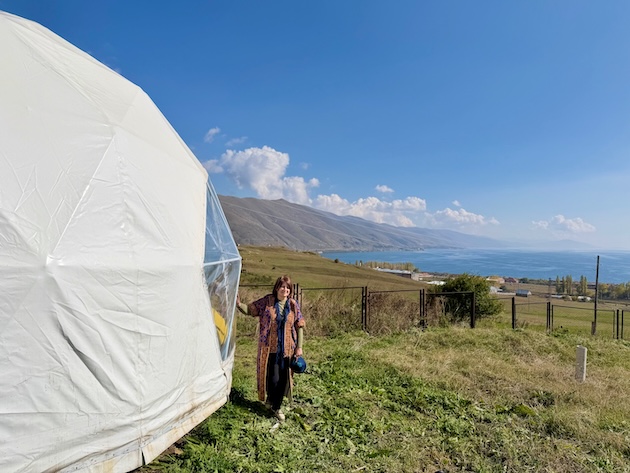
One example is a cluster of glamping tents in Tsovagyugh – a community on the northern edge of the lake. These glamping sites offer visitors a bouquet of experiences – designed by the community members themselves – including cycling and eating food cooked by locals, learning about the lake and its cultural and historical importance to local communities.
“Here, visitors can see us as a community and the value of the lake beyond its beauty or photogenic appeal; they can build a cultural bond with the community by attending different events inside the youth centre that we have built here, enjoying food cooked by local women in a sustainable way, riding a bike and buying handmade souvenirs, all of which benefit the community. These activities reduce the burden of uncontrolled tourism and lead to further restoration of the lake ecosystem.
Creating Alternatives to Illegal Fishing
According to her, a fresh lease of funding would further help the community develop and promote a culture of ecologically responsible living and environmentally sustainable economic activity, especially among their youth. It can also help address illegal fishing in Lake Sevan, which is driven by tourism demand and economic pressure on local communities.
“The illegal fishing here mostly occurs during the breeding season when fishing is banned. But if you tell someone, ‘Don’t catch fish,’ it doesn’t work because fishing has been their main occupation and only source of income for centuries, what are they supposed to do? In other words, you need to offer an alternative if you want to protect nature,” she said. “This is why we are building these glamping sites, creating alternative income opportunities for community members and slowly moving to a more sustainable lifestyle,” she says.
Karina Bruchyan of Chambarak said her family traditionally depended on fishing. Today, she earns income from beekeeping after receiving training and support through the Lake Sevan restoration programme. She now sells honey in local markets and at the eco-tourism centre in Tsovagyugh. For conservationists, such alternative livelihoods are key to reducing pressure on the lake’s fish stocks while creating new economic opportunities for local residents.
The restoration project will also support irrigation infrastructure, livestock watering points and forest nurseries to reduce land degradation and encourage more sustainable farming practices in lakeside communities.
As Armenian gulls circle once again over Lake Sevan and communities diversify their livelihoods beyond fishing, conservationists hope the latest investment will help secure the future of both the lake and the people who depend on it.
IPS UN Bureau Report



© Inter Press Service (20261102092554) — All Rights Reserved. Original source: Inter Press Service