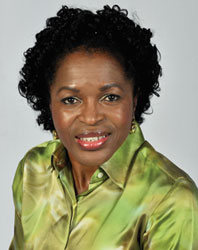
Mandela Prizewinner from Namibia Still Bringing Sight to the Blind
WINDHOEK, Aug 04 (IPS) - There was pure emotion in the face of Dr. Helena Ndume, more used to bringing sight to the blind than wiping away tears of her own.
According to friends, she was caught off guard by the rousing welcome awaiting her this past week at the Hosea Kutako International Airport after picking up the first U.N. Nelson Rolihlahla Mandela Prize in New York.
"This is not a Helena Ndume award. It belongs to Namibia," she said as more tears welled up in her eyes. "We should not leave our people and leave them to be blind. It is not their fault that they are blind. I cannot lock myself in my practice when the nation needs me."
According to the nonprofit SEE International based in Santa Barbara, California, Ndume has performed 30,000 pro bono surgeries for sufferers of eye-related illnesses in Namibia. The blind patients are filled with intra-ocular lens implants free of charge.
She was also vice chairperson of the Namibia Red Cross Society.
This summer she will collaborate with SEE on three programmes in Namibia and the Democratic Republic of the Congo. The organisation expects 700 patients to regain their eyesight during the three-week course of the tour.
Ndume left Namibia for exile at age 15. She lived in Zambia, and Gambia where she completed secondary school, and Angola, before going to Germany to study medicine.
Growing up, she wanted to be a fashion designer. On her not-pursued fashion dream, she said, "Yes, I wanted to be a fashion designer but the Swapo secretary of education in our refugee camp (former Prime Minister Nahas Angula) said 'No way! We do not need fashion designers in an independent Namibia. To come make clothes for who? We need doctors and I want you to be a doctor'," she said.
She is currently the head of the Ophthalmology department at Windhoek Central Hospital, Namibia's largest hospital, and is one of only six Namibian ophthalmologists.
During an interview she had with The Namibian last month, Ndume encouraged young girls to learn how to be independent.
"You need to be independent as a woman. Instead of depending on a man and then he uses you and you end up being treated like toilet paper, you need to work for yourself."
Edited by Kitty Stapp
© Inter Press Service (2015) — All Rights Reserved. Original source: Inter Press Service
Where next?
Browse related news topics:
Read the latest news stories:
- Breaking the silence over sexual violence against men and boys in war Saturday, August 22, 2026
- Lailuma Built Opportunities for Afghan Women – Then She Was Killed Friday, August 21, 2026
- New Emergency Care Skills Help Tanzania’s Frontline Doctors Save Lives Friday, August 21, 2026
- Cockroach Insult Unleashes Biggest Challenge yet to Modi’s Repressive Rule Friday, August 21, 2026
- UNAIDS Framework Pushes for the Protection and Integration of HIV Care Friday, August 21, 2026
- AI for Good: How the UN uses AI to advance human rights Friday, August 21, 2026
- New initiative launched to shield terrorism victims from online harm Friday, August 21, 2026
- Somalia: Humanitarian aid cuts leave millions of children vulnerable to hunger Friday, August 21, 2026
- DR Congo Ebola outbreak spreading exponentially, UN responders warn Friday, August 21, 2026
- World Humanitarian Day — Protect Aid Workers Against Drones Thursday, August 20, 2026
Learn more about the related issues:
Share this
Bookmark or share this with others using some popular social bookmarking web sites:
 Bluesky