370 Million Children Eat Healthy Food at School, Every Day
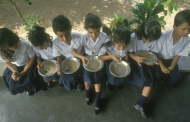
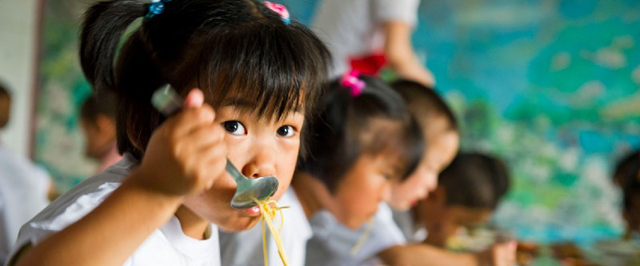
ROME, Mar 10 (IPS) - Every day some 370 million children around the world are fed at school, while learning about healthy food and nutrition through school meals programmes that also help boost attendance, the United Nations reports.
Each programme is different: beans and rice in Madagascar, spicy lentils in the Philippines, vegetable pastries and fruit in Jordan. In some countries it may be a healthy snack, or it could include take-home food such as vitamin A-enriched oil for the whole family, the UN Food and Agriculture Organization (FAO) informs.
"School meals have proved successful in providing educational and health benefits to the most vulnerable children… they boost school attendance, and a full stomach can help students concentrate on their lessons."
According to FAO, communities, particularly in rural areas, also benefit when family farmers and small and medium enterprises are the main source of healthy food for the schools.
Marking the International School Meals Day on March 9, the UN specialised agency believes that consistent global investments in school meals will lead to a generation of children who develop healthy eating habits and who benefit from a diverse diet.
This month, FAO jointly presented the Home-Grown School Feeding Resource Framework, together with partners including the World Food Programme (WFP).
The framework supports governments through the process of policy formulation, implementation and evaluation of school meals programmes.
It also brings together the technical expertise of different stakeholders in a programmatic and coherent way to be easily accessed by countries requesting technical assistance.
Purchase from Africa for Africa
In Africa, the Purchase from Africans for Africa (PAA Africa) programme is modelled on Brazil's achievements in fighting hunger and poverty, and is helping promote local agricultural production and school meals.
During the programme's second phase, around 16,000 family farmers were able to sell 2,700 tons of food for school meals for around 37,000 students, FAO reports. The school is an ideal setting for teaching basic skills in food, nutrition and health, says the UN agency. In many communities, schools may be the only place where children acquire these important life skills.
Among many tools, growing and preparing garden food at school can be instrumental. Combined with diversified school meals and nutrition education, it increases children's preferences for fruits and vegetables, it adds.
This food and nutrition education is an essential element in the prevention and control of diet-related health problems. FAO provides technical assistance for integrating food and nutrition education in the primary school curriculum.
The UN specialised body gives two examples of case studies.
Latin America and the Caribbean
In 2009, a school-feeding programme based on the National School Feeding Programme of Brazil was launched in Latin America and the Caribbean.
Through inter-sectoral policy and legal mechanisms, it developed actions for food and nutrition education, and encouraged purchases for the programmes to be made from local farming families.
In 2013, a study conducted in eight of the participating countries, surveying a territory encompassing 18 million students, showed that the programmes not only promote school attendance and bolster the learning process, but also increase the income of the community's farmers.
Cape Verde
In Cape Verde, the school meals programme was introduced by the UN in 1979, and the government took ownership in 2010.
Since then FAO has worked with the government and other UN agencies to diversify the school meals by linking local farmers to the procurement process to increase the supply of local fruit, vegetables, beans and fish to school canteens.
Around 9000 primary school students benefited from this initiative, as did local farmers and fishers who had an assured market.
© Inter Press Service (2017) — All Rights Reserved. Original source: Inter Press Service
Where next?
Browse related news topics:
Read the latest news stories:
- Hungary’s Long Road Back Friday, May 08, 2026
- Before the Flood, Jannat Carried Books. After the Flood, She Carried Dirty Dishes Friday, May 08, 2026
- Gaza’s Deepening Health Crisis Leaves Hospitals Overwhelmed Friday, May 08, 2026
- Nuclear ‘Close-Calls’ Prove Deterrence No Guarantee for Peace Friday, May 08, 2026
- Empowering Youth Is the Fastest Path to Transforming Least Developed Countries Friday, May 08, 2026
- The Mideast Conflict Spreads—Beyond the Strait of Hormuz & towards the UN Cafeteria Friday, May 08, 2026
- Lebanon war leaves families foraging for food despite ceasefire Friday, May 08, 2026
- Wider hantavirus outbreak risk is ‘absolutely low’, insists UN health agency Friday, May 08, 2026
- ‘Every Bird Counts:’ How city residents can help protect migratory birds Friday, May 08, 2026
- Cleaning Up the Fields: Across Africa and Asia GEF is Helping Farmers Rewrite Their Pesticide Story Thursday, May 07, 2026
Share this
Bookmark or share this with others using some popular social bookmarking web sites:
 Bluesky