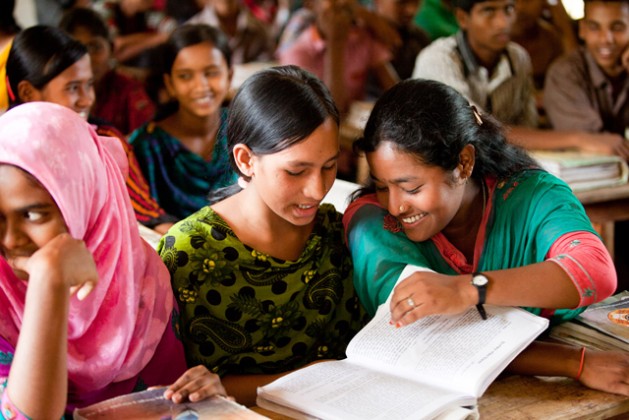
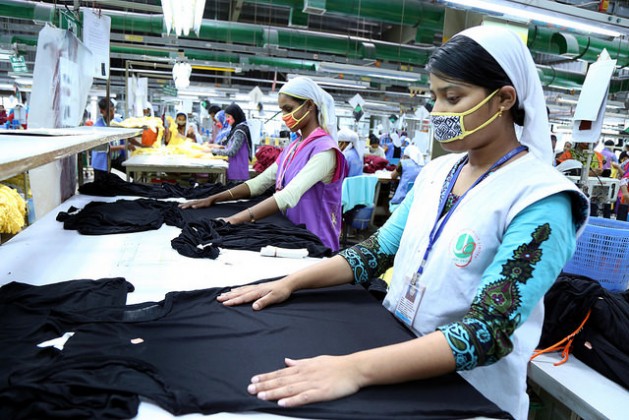
What Future for 700 Million Arab and Asian Youth?
ROME, Jun 08 (IPS) - With a combined population of around 400 million inhabitants, 22 Arab countries are home to nearly 300 million youth--that's 1 in 3 people. Meantime, there are other 400 million youth living in Asia and the Pacific. In both regions, these 700 million young people aged 15–24 years account for up to 60 per cent of world's youth population. What future for them?.
Not an easy question, especially if you consider that the Middle East and North of Africa (MENA) region faces a bulk of huge challenges: from fast growing population to increasing food insecurity; from armed conflicts (Syria, Libya, Yemen, Somalia, South Sudan, Iraq) to climate driven instability and massive displacement and migration.
Let alone the widening gender gap—in fact only 13.5 per cent of female youth are economically active, compared to around 50 per cent per cent of male youth.
All the above occurs amidst record high unemployment rates, reaching and average of 30 per cent in the whole region, with peaks of up to 55 per cent in the case of war-torn Yemen.
This challenge is aggravated by the fact that young people remain nearly four times more likely to be unemployed than their adult counterparts, and as much as over four times in the Arab states.
Asian Youth In Asia and the Pacific, youth appear not to be much better off. There, in 2015, nearly 40 million youth –12 per cent of the youth labour force– were unemployed. Although this was less than the global youth unemployment rate of 13 per cent, it varied by sub-region.
In 2015, for example, the youth unemployment rate was estimated at around 12.9 per cent in South-East Asia and the Pacific, 11.7 per cent in East Asia and 10.7 per cent in South Asia.
Here, despite relatively low youth unemployment rates, young people remain nearly four times more likely to be unemployed than their adult counterparts, and as much as 5.4 times in South-Eastern Asia (over four times in Southern Asia).
Experts from national regional and international organisations have worked hard on finding solutions. One of them, the International Labour Organization, UNESCO, UN Population Fund, World Bank, among others, emphasise the need for education, which will determine the livelihoods of 700 million people in the these two regions and drive growth and development for generations to come.
They also coincide in warning that while significant policy developments have focused on these challenges, including school-to-work transitions and skill mismatches, further coordinated efforts are needed to address obstacles to productive employment and decent work for all youth and thereby help to properly unleash their potential.
Asian and Arab Parliamentarians to Meet In addition to international experts, analysts and organisations, parliamentarians as direct, elected representatives of people, are set to meet next month in Amman under the theme "From Youth Bulge to Demographic Dividend: Toward Regional Development and Achievement of the SDGs."
Organised by the Asian Population and Development Association (APDA) and the Secretariat of the Japan Parliamentarians Federation for Population (JPFP), this Asian and Arab Parliamentarians Meeting and Study Visit on Population and Development, will on 18-20 July discuss in the Jordanian capital, the above challenges and ways how to face them.
The Jordanian capital's meeting will be followed by a two specific ones: Africa-Asia in New Delhi at mid of September, and an event on ageing, scheduled to take place in Korea end of October.
Annual Parliamentarian Meetings Since its establishment, APDA has been holding the annual Asian Parliamentarians' Meeting on Population and Development to promote understanding and increase awareness of population and development issues among Japanese, Asian, and Pacific parliamentarians.
APDA sends Japanese and Asian parliamentarians overseas to observe projects conducted by the United Nations Population Fund (UNFPA), International Planned Parenthood Federation (IPPF), Japan International Cooperation Agency (JICA) and the Japanese Government.
Similarly, parliamentarians from selected countries are invited to Japan to visit facilities in areas such as population and development, health and medical care. Through exchange between parliamentarians from Japan and other countries, the programme aims to strengthen cooperation and promote parliamentarians' engagement in the field of population and development.
© Inter Press Service (2017) — All Rights Reserved. Original source: Inter Press Service
Where next?
Browse related news topics:
Read the latest news stories:
- The grass beneath our feet: Why rangelands matter Saturday, August 15, 2026
- Former rebel fighters join campaign against Ebola in the DR Congo Saturday, August 15, 2026
- PARAGUAY: ‘Transparency Should Strengthen Democracy, Not Turn Criticism of Those in Power into a Cause for Suspicion’ Friday, August 14, 2026
- Pakistan’s Crackdown on Journalists Comes Under Heavy Fire Friday, August 14, 2026
- ‘Warned but not protected’: Four in ten adults in England ignore heat alerts Friday, August 14, 2026
- ‘Ebola is winning’: Epidemic now killing one person every 30 minutes Friday, August 14, 2026
- 900 obstacles and counting: West Bank families trapped as aid access shrinks Friday, August 14, 2026
- An attack on healthcare every six hours, and no one held to account Friday, August 14, 2026
- Meth trafficking across Middle East becoming more advanced, UNODC warns Friday, August 14, 2026
- Sudan: The harrowing reality of giving birth in a war zone Friday, August 14, 2026
Learn more about the related issues:
Share this
Bookmark or share this with others using some popular social bookmarking web sites:
 Bluesky