

‘Toxic rain’ warning from oil depot strikes amid ongoing Middle East war
Toxic “black rain” linked to strikes on oil depots, mass displacement and continuing disruption to aid supply chains are upending lives across the Middle East and beyond after 10 days of war in the region, UN humanitarians said on Tuesday.
Speaking to reporters in Geneva, UN Human Rights office spokesperson Ravina Shamdasani raised concerns about the health and environmental impacts of Israeli and U.S. strikes attacks on oil depots in Tehran as toxic pollutants spread in the air.
She said that these impacts raise “serious questions as to whether the proportionality and precaution obligations under international humanitarian law were met” in the attacks, stressing that the sites hit “do not appear to be of military exclusive usage.”
UN World Health Organization (WHO) spokesperson Christian Lindmeier warned that the “black rain” and “acidic rain” that’s been falling in Tehran after the strikes “is indeed a danger” for Iranians.
“We are in touch with the hospitals and with the authorities, and the Iranian authorities have issued an alert advising people to stay indoors, in light of the attacks on oil warehouses especially,” he said.
The UN agency is also monitoring the health risks of the “massive release” of toxic hydrocarbons, sulphur oxides and nitrogen compounds into the air.
Mr. Lindmeier said that additional reported Iranian strikes on oil infrastructures in Bahrain and in Saudi Arabia also raised concerns of “wider regional pollution exposure”, highlighting the long-term effects of pollutants, which affect respiratory health and contaminate water.
Lebanon: trauma, repeated
Turning to Lebanon, more than 100,00 people have been displaced by Israeli strikes and evacuation orders in the past 24 hours, bringing the total number of people uprooted by the conflict to almost 700,000.
The UN Refugee Agency (UNHCR) representative in the country, Karolina Lindholm Billing, spoke of a faster pace of displacement compared to the conflict with Israel in 2024.
“We see cars lined along the street with people sleeping in them,” she told reporters. “Most fled in a rush with almost nothing. They’re seeking safety in in Beirut, [the] Mount Lebanon region, in northern Lebanon and parts of the Bekaa.”
The UNHCR official described her visit on Monday to a shelter in Beirut, where she met a woman in her nineties who said that she had lost 11 members of her family back in 2024.
“She's now displaced again, staying in the same school that was turned into a shelter in 2024 and now again in 2026…Stories like hers really illustrate the fear, uncertainty and repeated trauma that these hundreds of thousands of people are facing right now.”
Afghan plight
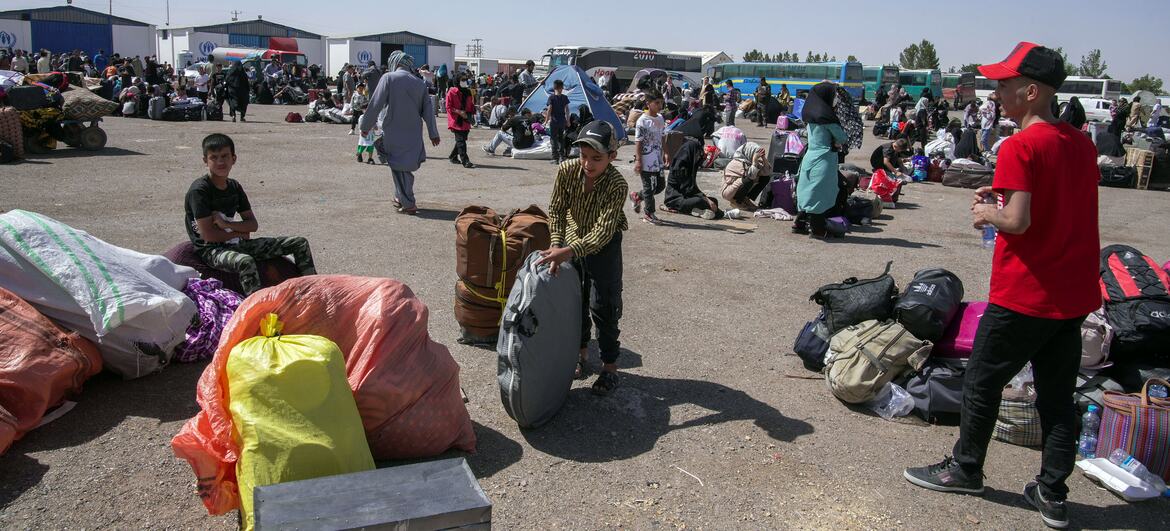
In other impacts across the region, UNHCR said that significant numbers of people have been crossing back into Afghanistan from Iran.
According to the UN refugee agency some 110,000 have returned since the beginning of the year and around 1,700 have been coming back each day since the start of the Middle East war.
While insecurity and dwindling economic prospects are pushing Afghans out of Iran, they face more precarity and uncertainty upon returning to their home country.
Speaking from the Islam Qala in Afghanistan’s Herat province on the border with Iran, the UN Children Fund (UNICEF)’s representative for Afghanistan, Tajudeen Oyewale, reported an increase in returns and warned that the total number of children who have been screened and treated for malnutrition has doubled in the last week.
Strait of Hormuz fall-out
Supply chain disruptions due to the war are already delaying essential aid, too.
“The geopolitical tension is already disrupting procurement routes,” Mr. Oyewale said. “What this means is that supplies that we need to care for children and their mothers in the midst of this emergency will arrive late… A malnourished child will get the nutritional supplement required not immediately, but with some level of delay and at a higher cost.”
Jean-Martin Bauer, director of the UN World Food Programme (WFP)’s Food and Nutrition Analysis Service, warned of the impacts of the conflict in the Strait of Hormuz and in the Bab El-Mandeb strait off the coast of the Horn of Africa.
“Two key points of the global supply chain set-up are affected by restrictions and by risk, and shipping lines are diverting their services,” he said.
Shipping premiums
Mr. Bauer explained that the need for war risk insurance for shipments means an additional cost of “$2,000 to $4,000 for each container in areas that are at risk”.
“We're also seeing that we're needing to go the long way around the Cape of Good Hope to reach some of our key geographies,” he said.
Mr. Bauer gave the example of WFP’s biggest operation in Sudan, supplied with food purchased in India, brought via Salalah in Oman and Jeddah in Saudi Arabia into Port Sudan.
Today, shipments need to take a much longer route transiting through Tangiers, adding approximately 25 days to shipping times.
“That's an additional sail of 9,000 kilometres (5592 miles)... It's like going coast to coast in the U.S. and then going back,” Mr. Bauer said.
© UN News (2026) — All Rights Reserved. Original source: UN News