

Is Gender Bias at the UN Coming to an Inglorious End?
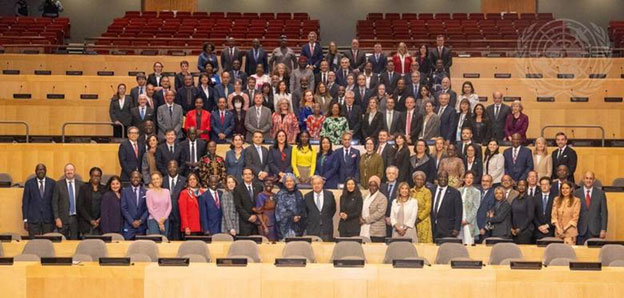
UNITED NATIONS, November 3 (IPS) - In a bygone era, gender parity was never heard of at the United Nations—UN female staffers were mostly hired as secretaries and stenographers in a male-dominated Secretariat.
Perhaps it was best illustrated in a wildly-circulated story, doing the rounds in the 1970s and 80s, about a female applicant, with strong academic credentials from a prestigious Ivy League university, being interviewed for a job in the UN Secretariat,
The high-ranking male staffer who was interviewing the candidate looked at her credentials and asked her: “But can you type?”
Perhaps one of the longstanding complaints has been the widespread gender bias and gender disparity, particularly in appointments of female staffers to some of the high-ranking jobs in the UN hierarchy– including Directors (D1-D-2), Assistant Secretaries General (ASGs) and Under-Secretaries General (USGs), ranked as the third high-level job, just behind the Secretary-General and the Deputy Secretary General (DSG).
But according to a recent UN Gender Parity Dashboard (below) there is now gender parity, with over 45 t0 56 percent of the jobs held by women, including P1-P5s, Director 1-2s, ASGs and USGs, UN system-wide and in UN entities
In 2025, the proportion of women in the Professional and higher ranks reached 50.4 per cent— described as “an historic milestone”.
The representation of women in the Professional and higher categories in the United Nations system increased from 47 per cent to 48.8 per cent from 2021-2023.
Regarding gender, Secretary-General Antonio Guterres asserted last week that the United Nations “has achieved parity across all senior leadership, and all headquarters and professional staff. We did this not by lowering standards, but increasing opportunities”, he said.
Going forward, the Secretary-General said that gender gains and expertise must be protected, and anti-racism must remain a priority and decisions on recruitment, promotion, assignments and retention, those decisions must be transparent, consistent and bias-free
As part of the commitment to transparency and accountability, the interactive Gender Parity Dashboard shows the latest gender balance data for Phase I of the Strategy. The dashboard focuses on the target population of international staff in the UN Secretariat (only), as defined in the Strategy.
Dr. Purnima Mane, a former Deputy Executive Director (Programme) and UN Assistant-Secretary-General (ASG) at the UN Population Fund (UNFPA), told Inter Press Service (IPS), recognizing that gender bias, disparity and discrimination are a reality in most countries– despite years of advocacy and programs– it is not surprising that the UN and its specialized agencies have initiated several key agreements and commitments to work towards gender equality and fight against gender bias and discrimination.
“Data from the UN Gender Parity Dashboard for UN International staff show an interesting picture. The numbers suggest that overall, women represent almost 46% of the staff and are well represented at the senior levels”.
“The data at the field level however, show that more needs to be done towards parity at least in numbers and ranks and it is perhaps here that the UN needs to focus for improvement.”
Numbers of course only tell part of the story, she said. “Working conditions, work opportunities and work-related benefits for women need to be assessed to dig deeper into gender parity at the next level of analysis.”
“Yes, there is evidence to show that there are many competent women who are assigned to take on leadership roles at all levels of the UN; and yet, a woman has never been elected to the role of SG by the members of the UN and frankly not even considered seriously till recently.”
The dashboard might serve as a tool to help Member states acknowledge that the UN practises what it preaches and serve as a reminder of the reality of women’s competency especially when there is soon going to be a vote at the UN for the leadership of the UN, said Dr Mane, who has held senior positions in the World Health Organization, UNAIDS, Global Fund to fight AIDS, TB and Malaria and the Population Council, and most recently, President and CEO of Pathfinder International.
Shihana Mohamed, President of Asia Global Forum (www.AsiaGlobalForum.org) and a US Public Voices Fellow with The OpEd Project and Equality Now, told IPS the Secretary-General has done an exemplary job in achieving gender parity in senior-level positions.
This is particularly evident in the appointment of Under-Secretaries-General (USGs) and Assistant Secretaries-General (ASGs), which falls under his sole authority. He also plays a significant role in selecting Resident Coordinators.
“However, I remain skeptical about how gender parity was achieved at the professional levels in 2026”.
Compared with the UN’s official 2025 statistics on the Composition of the Secretariat, the reported achievement reflects an annual increase of 2% or more in women’s representation at the P-5 and D-1 levels, she pointed out.
“Honestly, after more than 20 years of working on gender analysis in the UN Secretariat and ICSC, I know as a fact that such a significant increase is almost impossible to achieve organically within one year”.
“The increased representation of professional women in the UN Secretariat is mainly attributable to recent budget cuts. Massive layoffs disproportionately affected men, artificially increasing women’s share of the workforce. Recruitment, meanwhile, remained minimal. Staff reductions were even more severe in peace operations, where men have been significantly overrepresented”, she argued.
“Historically, women have been more represented at the P-2 and P-3 levels but tend to remain at these levels for longer, particularly, if they come from the Global South. The same pattern affects most men from the Global South. Thus, recent achievements in gender parity at the P-4 and P-5 levels have not necessarily benefited women in the UN who remain concentrated at the lower professional levels, said Mohamed.
Furthermore, approximately 20 countries are unrepresented and 30 are underrepresented, including countries in the Asia-Pacific region in the UN. This raises the question: Which regions do these women represent?
“One important point is that many of these hiring managers are themselves from the Global South. Yet some appear willing to do whatever it takes to please the Global North and its influential networks. Their aim seems to be to survive and advance within the UN”.
Genuine efforts to achieve gender parity must begin from the stage of recruitment and selection, she noted.
“This is where hiring managers exercise their delegated authority impartially and uphold the values and provisions of the UN Charter to recruit, select and promote women, including women from the Global South. This is the step where anti-racism efforts must also begin. However, that’s not the case within the UN.”
“The Secretary-General alone cannot achieve gender parity or address racism and racial discrimination within the UN. Real action requires a collective effort. All managers with delegated authority in human resources management must set the same tone as the Secretary-General. This is the only way to build a truly inclusive and fair UN.”
Unfortunately, that is not the reality within the UN. I hope the Secretary-General recognizes this truth as he prepares to conclude his term, said Mohamed who is also a founding member and Coordinator of the United Nations Asia Network for Diversity and Inclusion (www.UN-ANDI.org), and is a dedicated human rights activist, and a strong advocate for gender equality and the advancement of women.
Meanwhile, in an address to the UN Staff, Narda Cupidore, President of the UN Staff Union (UNSU), said addressing historically complex and deeply rooted inequality, particularly where ethnic group and gender intersects requires both institutional courage and sustained commitment.
“As we reflect on the trajectory of the Secretariat, it is important to recognize the foundations that have been established.”
In recent years, the Organization has elevated attention to systemic racial inequities, expanded spaces for workplace dialogue, made concerted efforts to advance women’s representation in senior leadership, and introduced new accountability frameworks through the Strategic Action Plan on Addressing Racism and the System-Wide Strategy on Gender Parity.
“Speaking on behalf of staff, we welcome these foundational steps”, she said.
Staff across every duty station want institutional leadership to succeed, because management’s success in eradicating discrimination strengthens the integrity and effectiveness of the entire United Nations.
At the same time, we must be candid about the road ahead: much work remains to be done. Discrimination based on color of one’s skin and gender inequality are not isolated incidents, they are systemic challenges embedded in our organizational structure that cannot be fully addressed through short-term measures, awareness campaigns, or standalone events.
Establishing policy frameworks, hosting listening sessions, and mandating e-learning modules create necessary awareness, but awareness is only the starting line. Across the Secretariat, a noticeable gap persists between administrative assessments of progress and the day-to-day lived reality of personnel on the ground.
When elected staff representatives and grassroots justice networks are engaged primarily at the conclusion of policy discussions rather than included as co-architects from the outset, our institutional response remains incomplete.
Building on the foundations already established requires moving from short-term initiatives to durable policy reforms across four operational areas.
First, efforts to advance women’s leadership and representation must extend across the entire grade pyramid. While achieving gender parity at the senior-most levels is a vital milestone, true intersectional equity requires looking beneath the executive ranks. Across the Secretariat, General Service staff and National Officers, who are predominantly women and colleagues from the Global South, perform indispensable operational and substantive work yet remain constrained by the restrictive G-to-P examination barrier.
Lasting institutional change means dismantling artificial career ceilings, introducing anonymized competency assessments, and establishing merit-based pathways into the Professional category.
Second, strengthening accountability measures must translate into verifiable outcomes.
Embedding workplace dignity clauses into Senior Manager Compacts is an important foundation, but compacts are only as strong as their enforcement. Sustainable reform requires integrating mandatory, anonymous 360-degree upward feedback into leadership evaluations and attaching clear administrative consequences when managers foster or tolerate discriminatory environments.
Third, expanded opportunities for dialogue must be backed by safe, accessible justice mechanisms. Colleagues on fixed-term and temporary appointments still hesitate to report subtle racial or gender bias due to high evidentiary thresholds in formal oversight investigations and the fear of quiet contract non-renewal.
Establishing specialized intake capacity for systemic discrimination, rebalancing the burden of proof in retaliation reviews, and guaranteeing interim contractual stability during active grievances will give personnel the security required to speak up.
Fourth, effective policy reform requires precise, transparent data. Relying on broad regional and nationality groupings as proxies for race obscures where women of color and marginalized staff encounter career bottlenecks. Introducing voluntary, disaggregated demographic tracking across grades and contract modalities will allow the Organization to measure real impact rather than procedural inputs.
The foundations have been laid, and the language of equity and inclusion is now firmly part of our institutional discourse. The test of our courage and commitment is whether we now translate those foundations into permanent, enforceable guarantees.
Lasting institutional change cannot be achieved through top-down programming alone; it is forged through effective engagement and collective partnership at the Staff-Management Committee, where human resources policies, administrative issuances, and conditions of service are negotiated together.
A legacy cannot be measured by short-term programmes or the eloquence of our commitments, but by whether every staff member, across every grade, contract type, race, and gender, experiences equitable opportunity, protection, and dignity at work.
Today, I can confidently confirm that the Staff representatives, Unions and Staff Federations stand ready to work together with leadership as equal partners to turn the vision of discrimination free United Nations into reality.
IPS UN Bureau Report



© Inter Press Service (20261103062841) — All Rights Reserved. Original source: Inter Press Service