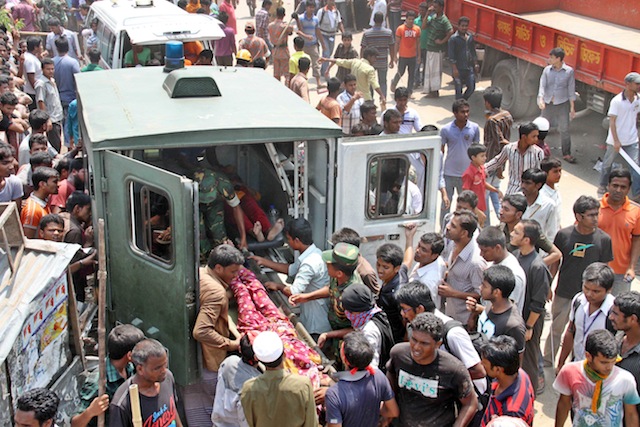
Compensation Fund for Victims of Bangladesh Factory Collapse Reaches 30-Million-Dollar Target
UNITED NATIONS, Jun 09 (IPS) - Two years after a massive garments factory collapsed in a suburb of Bangladesh's capital, Dhaka, killing over 1,100 people and leaving more than 2,500 injured, a major international fund has met its target of raising 30 million dollars to be paid out in compensation to the victims and their families.
Set up in 2013 under the aegis of the International Labour Organisation (ILO), the Rana Plaza Coordination Committee represents all stakeholders in the massive global apparel trade.
Its mission was to ensure fair and equitable compensation to those who survived, including making up lost income, providing funds for medical needs and assisting families who lost breadwinners on that fateful day.
In January 2014, the ILO created the Rana Plaza Donors Trust Fund to streamline the process of financing the Committee's efforts.
On the second anniversary of the tragedy, in April this year, the Fund was still three million dollars short of its goal, and had paid out just 70 percent of the promised aid to some 2,800 claimants.
But a large injection of funds by an anonymous donor in the first week of June has enabled the fund to meet its target.
According to the Clean Clothes Campaign (CCC), an alliance of organisations in 16 European countries pushing for improved workers' rights in the apparel and sportswear sectors, this represents a major milestone in an international movement to hold stakeholders accountable for the industrial disaster, considered one of the worst in modern history.
A spokesperson for the campaign, Ineke Zeldenrust, said in a statement on Jun. 8, "This day has been long in coming. Now that all the families impacted by this disaster will finally receive all the money that they are owed, they can finally focus on rebuilding their lives."
The general consensus, however, is that this is only a first step.
In a statement released Tuesday, ILO Director-General Guy Ryder stressed, "This is a milestone but we still have important business to deal with. We must now work together to ensure that accidents can be prevented in the future."
Rights groups also say that major international brands must do more to ensure workers' safety, while local trade unions have been up in arms at the government's inability – or unwillingness – to implement reforms in a sector that employs four million people and exports 24 billion dollars worth of merchandise every year.
Approximately 20 million of the country's 156 million people depend directly or indirectly for their livelihood on the garments industry, which accounts for 80 percent of the country's export earnings and contributes 10 percent of annual gross domestic product (GDP).
Despite its importance to the Bangladeshi economy, the government has done little to ensure labour standards and safety protocols within the sector. A Human Rights Watch report released in April found that workplace abuse is common, and documented countless cases of attacks, violence and intimidation of labour organisers.
Based on interviews with over 160 workers in 44 factories, predominantly manufacturing items for large retailers based in Australia, Europe and North America, the report detailed the extent of ‘union busting' that goes on in the approximately 4,536 factories across Bangladesh.
Though the government recently raised the minimum wage to 68 dollars a month, up from 39 dollars at the time of the Rana Plaza accident, workers say they will hold out for a 100-dollar monthly salary, which is the bare minimum required to feed and clothe their families.
Safety standards, too, leave a lot to be desired, according to activists and workers, although the increase from 56 to 800 ILO-trained inspectors signals progress.
Meanwhile the Accord on Fire and Building Safety, tasked with overseeing safety protocols in 1,600 factors at the behest of retailers based primarily in Europe, has also given industry experts reason to celebrate, albeit cautiously.
Edited by Kitty Stapp
© Inter Press Service (2015) — All Rights Reserved. Original source: Inter Press Service
Where next?
Browse related news topics:
- Trade, Economy, & Related Issues
- Causes of Poverty
- Non-governmental Organizations on Development Issues
- Third World Debt Undermines Development
- Free Trade and Globalization
- Geopolitics
- Foreign Policy — Projecting Power
- Human Rights Issues
- Human Population
- Consumption and Consumerism
- Sustainable Development
- Natural Disasters
- G8: Too Much Power?
- Food and Agriculture Issues
- Democracy
- Global Financial Crisis
Read the latest news stories:
- Grand Planetary Challenges Need a Grand Coalition to Solve Them Wednesday, August 26, 2026
- A Divided Vote for the UN’s Human Rights Chief Wednesday, August 26, 2026
- Retired in Ukraine: One Cheese, Two Chickens and a Dozen Eggs Tuesday, August 25, 2026
- Colombia Declares State of Emergency Following Deadly Earthquake Tuesday, August 25, 2026
- South Africa’s Anti-Immigrant Violence Slows SDG Goals, Rips Apart Africans’ Free Movement Call Tuesday, August 25, 2026
- Haiti ramps up the fight against gangs in the capital, but violence spreads elsewhere Tuesday, August 25, 2026
- One million children in Afghanistan face deadly malnutrition Tuesday, August 25, 2026
- As wars spread, the global food system unravels Tuesday, August 25, 2026
- Rohingyas in Myanmar suffering ‘heartbreaking’ misery and cruelty Tuesday, August 25, 2026
- Land degradation is costing far more than restoring: UN deputy chief Tuesday, August 25, 2026
Learn more about the related issues:
- Trade, Economy, & Related Issues
- Causes of Poverty
- Non-governmental Organizations on Development Issues
- Third World Debt Undermines Development
- Free Trade and Globalization
- Geopolitics
- Foreign Policy — Projecting Power
- Human Rights Issues
- Human Population
- Consumption and Consumerism
- Sustainable Development
- Natural Disasters
- G8: Too Much Power?
- Food and Agriculture Issues
- Democracy
- Global Financial Crisis
Share this
Bookmark or share this with others using some popular social bookmarking web sites:
 Bluesky