Post COP21: Costa Rica’s Innovation Must Become the Global Norm
UNITED NATIONS, Mar 14 (IPS) - The Paris agreement means countries and corporations will be compelled to act much more quickly on making agricultural commodity production more sustainable. Companies must look beyond their supply chains. Farmers need support to overcome barriers such as: struggle with ineffective farming practices, lack of investment and fluctuating commodity prices.
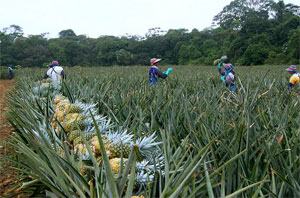
In 2010, Costa Rica started responding to the environmental and social impact of the pineapple sector's rapid expansion. The country set-up the National Platform for the Responsible Production and Trade of Pineapple in Costa Rica, designed to bring every group with a stake together. Supported by the UN Development Programme (UNDP) Green Commodities initiative, this government-led platform engaged 900 people representing big companies, such as TESCO and Walmart, small-scale farmers, traders, government and civil society.
The group came up with the Action Plan for Strengthening the Responsible Production and Trade of Pineapple in Costa Rica. This groundbreaking Plan has 12 sets of actions that represent a national response to the problems and now everyone owns that response.
This is reflected in the fact that a monitoring committee made up of government, civil society and business will oversee its implementation. It is also acknowledged at the highest levels, with the President of Costa Rica, Luis Guillermo Solis, signing a decree making the National Action Plan official last week.
Costa Rica is the first country to devise and adopt such a national response and is now leading the way for other countries that are working to create similar transformative plans.
These efforts are important because they offer concrete solutions to companies ready to move beyond simply addressing sustainability and environment issues through certifications and corporate social responsibility schemes, to devise ways to incorporate sustainable practices across their own supply chains together with government, farmers and civil society.
This is where the real and lasting differences will be made – when countries have national responses to overcome critical problems in commodity production. These efforts also empower small-scale farmers as they are able to bring their concerns and insights to the table and to get the support they need.
This is what is happening in Costa Rica, where the majority of pineapple producers are small-scale farmers who will soon be able to access training and other support to improve their practices and livelihoods.
If we are to achieve the Sustainable Development Goals and address climate change, national responses that are devised and owned by all stakeholders, which address environmental and social issues, then the Costa Rica's example must become the new norm for agricultural commodity sectors around the world.
(End)
© Inter Press Service (2016) — All Rights Reserved. Original source: Inter Press Service
Where next?
Browse related news topics:
- Trade, Economy, & Related Issues
- Causes of Poverty
- Third World Debt Undermines Development
- Free Trade and Globalization
- Environmental Issues
- Biodiversity
- Nature and Animal Conservation
- Climate Change and Global Warming
- Consumption and Consumerism
- Sustainable Development
- Food and Agriculture Issues
- Global Financial Crisis
Read the latest news stories:
- Systematic Vilification of Russian LGBTQ+ Community Pushes Them Underground Tuesday, June 16, 2026
- This Is Not Just Ukraine: The Global Danger of Normalising Russia’s Occupation Crimes Tuesday, June 16, 2026
- The Last Bottle of Halothane: Why Africa Cannot Wait Tuesday, June 16, 2026
- From Victoria to Mombasa: Will Africa’s Ocean Voice Be Heard? Monday, June 15, 2026
- World Cup Preparation Scores a Goal against the Environment Monday, June 15, 2026
- How the G7 Can Reset Global Finance Monday, June 15, 2026
- Chatbots & AI Companions: From Science Fiction to Everyday Reality Monday, June 15, 2026
- Erdoğan’s Race to Avoid Orbán’s Fate Monday, June 15, 2026
- Nuclear Nonproliferation Outcomes Stall in Backdrop of Geopolitical Strife Monday, June 15, 2026
- World News in Brief: Risky return home in Lebanon, displacement in Gaza, emergency funding for Somalia Monday, June 15, 2026
Learn more about the related issues:
- Trade, Economy, & Related Issues
- Causes of Poverty
- Third World Debt Undermines Development
- Free Trade and Globalization
- Environmental Issues
- Biodiversity
- Nature and Animal Conservation
- Climate Change and Global Warming
- Consumption and Consumerism
- Sustainable Development
- Food and Agriculture Issues
- Global Financial Crisis
Share this
Bookmark or share this with others using some popular social bookmarking web sites:
 Bluesky