

The Tale of Two Countries: Elite Stake and Development
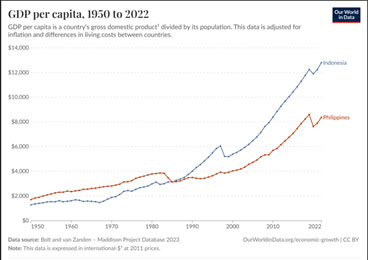
SYDNEY, July 14 (IPS) - Philippines was the most advanced Southeast Asian country with the highest per capita GDP until about the early 1960s. Its per capita GDP in purchasing power parity terms were about the same as South Korea’s and above that of Thailand in the early 1970s.
The Nobel Laureate economist, Gunnar Myrdal, did not have much hope for “disease infested” Indonesia when in 1968 he published his famous Asian Drama: An Enquiry Into the Poverty of Nations. But Indonesia surged ahead since the late 1960s with growth acceleration exceeding that of Philippines; thus, eventually overtaking Philippines in GDP per capita in the mid-1980s. What factors separated Indonesia from Philippines?
Elite Stake
It has been the elite stake in the country that played the critical role. The Indonesian elite put their trust in the country, whereas the Filipino elite began to think that their future was in the United States (US). Incidentally, this coincided with President Ferdinand Marcos’ turning into a despot by imposing martial law in 1972 and embracing a policy of “constitutional authoritarianism”.

The Indonesian elite built the national system, e.g., reasonably well-resourced public health and education facilities. On the other hand, the Filipino elite took their money to the US. For example, over 52 years (1960-2011), an estimated US$133 billion was taken out of Philippines illicitly primarily through trade mis-invoicing. Estimates have consistently ranked Philippines among the top 20 countries with the highest illicit flow of funds (IFFs) worldwide.
It does not mean that IFFs do not occur in Indonesia. In recent years, IFFs have become a major concern for Indonesia; however, there the main actors are multinational corporations, especially in the mining sector. The mining sector in Indonesia accounted for 10.5% of total of IFFs out of Indonesia.
The difference is in the scale and actors.
Good governance myth
Poor governance, especially corruption, is seen as a critical barrier to development. However, the Philippines and Indonesia tale casts doubt on the “good governance” thesis.
Indonesia ranks 109th out of 180 countries in the Corruption Perceptions Index (CPI), while Philippines ranks 120th. Although Philippines is placed at a lower place than Indonesia, corruption is endemic in both countries and the scale is not much different.
However, the difference is where the ill-gotten money is being invested. Without condoning corruption, the tale of these two countries implies that if the ill-gotten money is invested domestically instead of siphoned-off, the country will experience a better development outcome. One can call this “patriotic” corruption as a means of primitive capital accumulation. Where the corrupt money is siphoned-off, corruption is “predatory” analogous to colonial plundering.
Bangladesh is a glaring example of predatory corruption. A 2011 UNDP report ranked Bangladesh no 1 among least developed countries in IFFs. Between 1990 and 2008 the cumulative illicit outflow of funds from Bangladesh was estimated at US$34.8 billion. An estimated US$234 billion was plundered from Bangladesh during Sheikh Hasina’s 15-year autocratic reign.
Authoritarianism debunked
The East Asian development success created a perception, codified in the “Lee hypothesis”, that authoritarian regimes deliver better development outcomes than democracies. Sheikh Hasina, like many other despots, used this argument to consolidate her autocratic rule by brutal suppression of human and democratic rights.
As highlighted earlier, in the case of Indonesia, the elite displayed trust in the country, while in the case of Philippines and Bangladesh, the elite plundered to siphon-off with the aid of repressive kleptocratic regimes.
At the end, however, all three autocratic regimes collapsed; but rebuilding the trust and elite stake in the country remains a challenge in plundered countries like Philippines and Bangladesh.
Anna Karenina principle
Leo Tolstoy in his 1877 novel, Anna Karenina, laid down the Anna Karenina principle: “All happy families are alike; each unhappy family is unhappy in its own way”. The Anna Karenina principle implies that a deficiency in any one of several critical factors dooms a complex endeavour to failure even if all other essential factors are present. In technical jargons, they constitute the “sufficient” condition for the “necessary condition” to work.
Both Indonesia and Philippines share many common factors – they are both archipelago consisting of thousands of small islands dispersed over vast areas of the South China Sea like a garland. They are ethnically diverse; while Indonesia is a Muslim majority country, Catholics dominate in Philippines. Both faiths are regarded as un-worldly, focusing more on the hereafter compared with the Protestant ethics, which is more conducive for capitalism to flourish. Both countries also experienced ethnic separatist armed conflicts.
Both Indonesia and Philippines had pro-US regimes, and the two countries witnessed repressive autocratic rules lasting for decades. Both pro-US regimes also received large US aid and access to the US market as well as foreign direct investment.
Yet their development experiences have differed.
The missing factor is elite stake, the glue to hold all other essential conducive factors together.
Anis Chowdhury, Emeritus Professor, Western Sydney University (Australia). He held senior UN positions in Bangkok and New York and served as Special Assistant to the Chief Advisor for Finance (with the status and rank of State Minister) in the Professor Yunus-led Interim Government. Anis has written extensively on East and Southeast Asian economies, including The Newly Industrialising Economies of East Asia (Routledge) and The Political Economy of East Asia (Oxford University Press). E-mail: [email protected]; [email protected]
IPS UN Bureau
© Inter Press Service (20260714051648) — All Rights Reserved. Original source: Inter Press Service