

Family Law Reforms Are Needed to Advance Gender Equality
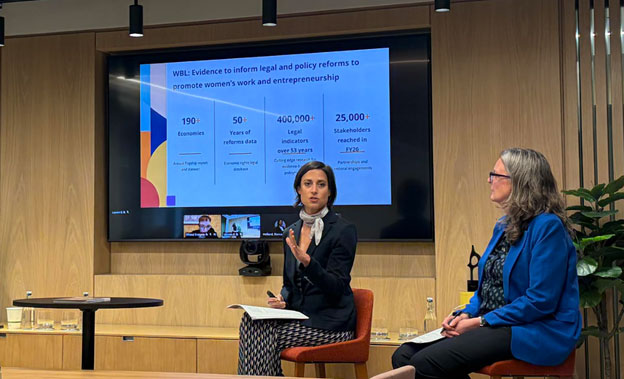
UNITED NATIONS, September 22 (IPS) - On September 16, at the lead-up to the 81st UN General Assembly, Equality in Family Law (GCEFL), Equality Now, TrustLaw, and the World Bank Group convened in New York City for the event titled The Gender Equality Dividend: Investing in Women’s Economic Prosperity Through Family Law Reform. Hosted by APCO, the event introduced new data on barriers to family law reform and highlighted strategies to help the international community maximize women’s economic participation.
Bringing together experts in legal reform and economic development, the event marked the launch of a landmark joint brief by the World Bank Group and Equality Now, titled Unlocking Women’s Economic Rights through Family Law Reform: Lessons from Case Studies across Five Regions. Drawing upon data collected from Chile, Kenya, Malaysia, Morocco, and Nepal, the brief examines the legal, social, and economic barriers that hinder gender equality, economic growth, and sustainable development.
Targeting the reform of 20 discriminatory laws by 2030, the report highlights the persistent and widespread disparities that women around the world continue to face in marriage, divorce, inheritance, and household decision-making. At the event, Antonia Kirkland, Director of Legal Equality and UN Liaison at Equality Now, stressed that no country has achieved full legal equality for women in terms of economic autonomy and social freedoms.
Additional data from the World Bank Group’s Women, Business, and the Law 2026 project reveals that 22 economies still lack laws granting women equal rights to immovable property, while 43 economies continue to deny women equal inheritance rights. Furthermore, women are estimated to be 33 percent less likely than men to participate in the formal labor market.
Over the past 50 years, family law reform has enabled more than 600 million women to access better economic opportunities, while approximately 118 countries have enacted laws that allow women improved access to employment. However, progress has stalled in recent decades, largely because family law reform is rarely treated as an interconnected policy, cultural, and economic issue.
Removing systemic discriminatory barriers against women yields immense social, financial, and developmental benefits. Granting women control over economic and financial resources can significantly strengthen their household bargaining power, foster greater individual autonomy, and considerably expand their access to formal employment.
Julia Braunmiller, Senior Private Sector Development Specialist with Women, Business and the Law, informed reporters at the briefing that if women had equal access to employment, global GDP could increase by up to 20 percent. Figures from UN Women’s Gender Snapshot 2026 report show that not a single indicator on the Sustainable Development Goal for gender equality (SDG 5) is on track to be met by 2030.
“Family law is economic policy. It is not something private,” Braunmiller said. “Marriage, divorce, and inheritance; these are the rules that can change who can work, who can own property, who can make financial decisions, who can earn and spend money. When rights are restricted, we are limiting the productive potential of half our societies. Family law is an overlooked driver of growth, productivity, and economic resilience.”
When women have equal access to formal employment, they are able to achieve significantly greater influence in decision-making, household affairs, and the ability to support themselves, separate from their husbands. In Nepal, landmark legal reforms have enabled widows to access marital assets and property, allowing families to stay afloat during periods of economic hardship.
“Many women, particularly in rural areas, who have lost their husbands or are divorced are in financially precarious situations. Obtaining a share of marital property enables them to invest in income-generating opportunities, educate their children, and even obtain further education themselves to better their lives,” said Gyanu BC, a Nepali women’s rights advocate.
Furthermore, improved family laws could significantly accelerate national productivity, strengthen social security systems, and benefit all household members. Control over family resources, such as access to credit, inheritance, and immovable property, is directly linked with household wellbeing.
Amy Hutchinson, Chief Development Officer of Equality Now, noted that working women invest roughly 90 percent of their incomes in their families, which has “profound” impacts on child nutrition, development, and education. National economies could also save significant aid dollars in social services and programs addressing and preventing gender-based violence by investing in family law reform. According to Hutchinson, women who lack access to formal employment are “infinitely” more vulnerable to violence and exploitation.
“This is not charity, this is an investment that is not just in women and girls, but in sustainable development and economic prosperity for all,” said Hutchinson. “It’s an investment in families, communities, and our global economies…this is an opportunity to invest in ground-floor systemic solutions that scale, not just mitigating the symptoms in perpetuity. Unfortunately, gender equality has become very polarizing and political.”
All of the speakers at the event emphasized that continued support from the international community in establishing legal equality is a crucial first step in closing persistent gender gaps, underscoring the global benefits in driving sustainable growth, preventing gender-based violence, and strengthening community resilience to economic shocks. GCEFL, Equality Now, TrustLaw, and the World Bank Group continue to work alongside national governments to close these gaps and secure a safe and equitable future for all.
IPS UN Bureau Report



© Inter Press Service (20260922040142) — All Rights Reserved. Original source: Inter Press Service