Saving Kenya’s Maize Crop
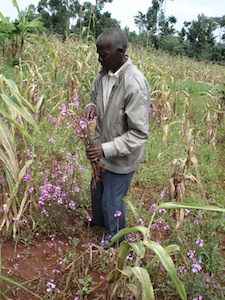
While some maize farmers in Kenya’s Western Province are stilling living off the produce from last season’s harvest, Robert Oduor is counting his losses after the deadly Striga weed infested his one-hectare maize field.
'Previously, I harvested up to 14 90-kilogramme bags of maize per half hectare. But due to the infestation of the weed, which I was not able to control, I harvested a total of two and a half bags of maize from my field,' said Oduor, who is from the Sega area in Western Province.
But he hopes that next season’s harvest will be better. That is if he can get his hands on a new variety of maize, which was developed by scientists to survive against a Striga weed infestation.
Striga weed, also known as witches weed, is a plant with either bright pink or red flowers, depending on the species. However, it is a parasite and also infests sorghum, millet and sugarcane fields. Once a maize plantation is infested by the weed, experts say the loss ranges from 70 to 100 percent of the harvest.
And for the past 10 years, research scientists from the International Maize and Wheat Improvement Center (CIMMYT), the Kenya Agricultural Research Institute, the Weizmann Institute and BASF-Chemical Company have been developing a high- yielding maize variety resistant to the herbicide used to kill the Striga weed.
'This maize variety is not resistant to the Striga weed,' explained Dr. Gospel Omaya, the Seed System manager at the African Agriculture Technology Foundation, which facilitates public-private partnerships. 'The variety is resistant to one of the most effective herbicides, Imazapyr, which kills other plants, including the Striga weed.'
The maize seeds are coated with the herbicide before being packaged and this coating makes it resistant to weeds.
The Imazapyr-resistant variety has been named as 'UaKayongo', which is Swahili for 'kill the Striga weed.'
A herbicide-resistant variety of maize was discovered in Kenya almost a decade ago. However, maize breeders in Kenya have been hybridising it by cross-pollinating different parents of the variety to produce a hybrid that produces a high yield.
'We first cross pollinated different parents of the herbicide-resistant variety to come up with the first generation hybrids, which were immediately put on trial. The best-performing plant was selected and cross pollinated with another plant of the same variety, but with high-yielding attributes. This gave us the second generation, which was later cross-pollinated with another good performing variety,' explained Haron Karaya, a research assistant and maize breeder at the CIMMYT.
Trials for the third generation hybrid variety have just been concluded and according to the researchers, it has produced satisfactory results. 'UaKayongo III, which is a three-way cross hybrid, has demonstrated that it can yield up to five tonnes per hectare, up from the yield of three tonnes per hectare realised from the first generation,' said Karaya.
The new variety will released at the end of March and distributed by the Kenya Seed Company, which has the ability to produce the seed on a large scale.
'We are in the process of harvesting the first batch, which will benefit just a few lucky farmers at the moment. But sufficient seed will be available come the planting season next year,' said Willy Bett, the company’s managing director.
However, because the seed is coated in a herbicide, it poses a challenge for handling and evening planting.
'The UaKayongo seed must never be mixed with any other types of seeds, because the herbicide will affect them. However, one can intercrop it with crops like beans, groundnuts or any other convenient crop so long as the crops are not planted in the same hole,' said Omaya.
He further advised that farmers who chose to plant the UaKayongo seed use gloves, and wash their hands afterwards to avoid contaminating other seeds that are not resistant to the herbicide.
'We have acknowledged the handling challenge, and we are putting relevant measures in place,' said Bett.
The company has already started training programs for agro-dealers and for small-scale farmers through community-based and non-governmental organisations.
'When packaging, each package will come with two pairs of gloves for convenience, and a manual with illustrations on how to handle the seed,' said Bett. In Western Province, where maize is the main cash and food crop, it is estimated that the Striga weed affects 250,000 hectares of maize.
And the new variety it is a welcome relief for farmers like Oduor. 'I was planning to quit maize farming for some time after having made huge losses. But with the new development, I will give it a second chance and plant the weed tolerant seed,' said Oduor.
© Inter Press Service (2012) — All Rights Reserved. Original source: Inter Press Service
Where next?
Browse related news topics:
Read the latest news stories:
- For Brazil’s Indigenous youth, visibility is resistance Saturday, August 08, 2026
- In Taliban-Ruled Afghanistan, One Woman Refuses a Life of Dependence Friday, August 07, 2026
- Hiroshima’s Question: Will We Continue to Live Under the Nuclear Shadow? Friday, August 07, 2026
- Burkina Faso’s Cancelled Democracy Friday, August 07, 2026
- The World’s Aid Workers Must Be Protected Friday, August 07, 2026
- The Mediterranean’s own odyssey: An ecological treasure feels the strain Friday, August 07, 2026
- ‘Sudan is losing another generation’ to war, Mohammed warns Friday, August 07, 2026
- Peacock party takes pride of place in nod to decades of turbulent history Friday, August 07, 2026
- Ebola in DR Congo: Childhood deaths rise; hopes raised over new vaccine Friday, August 07, 2026
- Food prices edged up in July amid heatwaves and energy price hikes Friday, August 07, 2026
Learn more about the related issues:
Share this
Bookmark or share this with others using some popular social bookmarking web sites:
 Bluesky