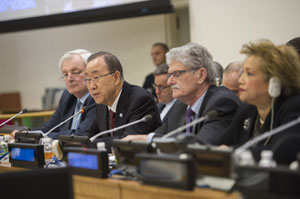
UN Chief Focuses on World’s First Humanitarian Summit
UNITED NATIONS, Feb 10 (IPS) - As the global humanitarian crisis continues to devastate civilian lives in conflict zones, UN Secretary-General Ban Ki-moon appealed to the international community to ensure "no-one in conflict, no-one in chronic poverty, and no-one living with the risk of natural hazards and rising sea levels, is left behind."
The report, "One Humanity: Shared responsibility", was released Tuesday three months ahead of the summit meeting of world leaders scheduled to take place in Istanbul, Turkey, on May 23-24.
The United Nations says it needs more than 20 billion dollars to feed and care for over 60 million people who are either displaced internally or who have fled their home countries becoming refugees virtually overnight. And there are about 40 countries – out of the 193 UN member states – which are engulfed in "high-level, medium-level and low-level crises and violence," according to Ban
"Given the current crises in our global political economy, along with climate change", Ban warned, violent extremism, terrorism, transnational crime and persistent brutal conflicts are devastating the lives of millions of people and destabilizing entire regions.
"Today's complex challenges cross borders and surpass the capacity of any single country or institution to cope," the Secretary-General said.
"We need to restore trust in our global world order and in the capacities of our national and regional institutions to confront these challenges effectively."
According to a senior U.N. official, who provided a background briefing last week, the report contains a personal plea from the Secretary-General to "restore humanity", while guaranteeing dignity and safety to all people, in accordance with the U.N. Universal Declaration of Rights and the 2030 Agenda.
Countries in Europe, Asia, Africa, North and South America, along with civil society, showed their positive response to Ban's initiative.
Oxfam's Humanitarian Representative, Charlotte Stemmer, said: "The humanitarian system is overwhelmed with the amount of rising needs in a world racked by crises. (World leaders) should not pay lip service to this, as concrete action is urgently needed. The World Humanitarian Summit's greatest legacy would be a real commitment to change this."
According to the new report, "the international community is increasing its response to crises while struggling to find sustainable political and security solutions to end them."
In 2014, the economic and financial cost of conflicts was estimated to be around 14.3 trillion dollars (13.4 percent of the global economy).
The five core shared responsibilities are: One, political leadership to prevent and end conflicts. Rather than investing in humanitarian assistance, the international community should prioritize political solutions, unity, and create peaceful societies.
Two, enforcing and abiding to international laws in order to protect civilians, respect human rights, restrict the use and transfer of certain arms and ammunition, halt bombings and strengthen the global justice system.
Three, "leaving no one behind" -- which is also the central theme of the U.N.'s 2030 Development agenda - and reaching out to the poorest and the most vulnerable men, women and children in war-torn areas or in case of natural disasters. It also includes the protection of women and girls and focuses on the right to education for all.
Data from the report highlights that in 2014, conflicts and violence forced around 42.500 people to flee their homes daily. This resulted in 60 million internally displaced peoples, refugees and asylum-seekers by the first half of 2015.
About half of the world's refugee children are missing out on primary education and three quarters do not have access to secondary education, according to a UN report.
Four, changing people's lives. Currently, nearly 1.4 billion people live in fragile situations, and figures are estimated to grow up to 1.9 billion by 2030, says the report.
Therefore, it is fundamental to develop coordinated actions to anticipate crises, reinforce local institutions and governments, build community resilience, and invest in data and risk analysis.
Five, investing in humanity. Ban highlighted the concept of "grand bargain" urging donors and national authorities to change their mindset "from funding to financing" local actors and local institutions, while increasing cost-efficiency and transparency.
Organised by the U.N. Office for the Coordination of Humanitarian Relief (OCHA) the WHS summit offers for the first time the opportunity to reflect on a new humanitarian aid framework - explained Ban.
The summit also aims at bringing together the international community –- civil society, world leaders, private sector, peace-builders representatives, peace-keepers, and NGOs --- to design new policies and set new strategies for humanitarian assistance and relief in affected countries.
In a preface to the report, Ban wrote: "I ask global leaders to come to the World Humanitarian Summit prepared to assume their responsibilities for a new era of international relations; one in which safeguarding humanity and promoting human progress drives our decision-making and collective actions."
(End)
© Inter Press Service (2016) — All Rights Reserved. Original source: Inter Press Service
Where next?
Browse related news topics:
- Trade, Economy, & Related Issues
- Causes of Poverty
- United Nations on Development Issues
- Non-governmental Organizations on Development Issues
- Third World Debt Undermines Development
- Geopolitics
- Arms Control
- Arms Trade—a major cause of suffering
- International Criminal Court
- Foreign Policy — Projecting Power
- Human Rights Issues
- Consumption and Consumerism
- Sustainable Development
- Natural Disasters
- Food and Agriculture Issues
- Democracy
Read the latest news stories:
- The Takeaway: UN General Assembly debate Day 5 Sunday, September 27, 2026
- Canada urges stronger partnerships as global order faces ‘rupture’ Saturday, September 26, 2026
- Countries far from conflict paying the price for wars not their own, India tells UN Saturday, September 26, 2026
- Saudi Arabia warns Gulf security inseparable from global stability amid regional tensions Saturday, September 26, 2026
- Cuba warns against ‘law of the jungle’ as Foreign Minister denounces US pressure Saturday, September 26, 2026
- Lavrov issues call for new Eurasian ‘security architecture’ Saturday, September 26, 2026
- ‘Safeguard the postwar order,’ China tells UN General Assembly Saturday, September 26, 2026
- Countries adopt global blueprint to tackle fast-evolving crime in digital age Saturday, September 26, 2026
- The Takeaway: UN General Assembly debate Day 4 Saturday, September 26, 2026
- Nepal’s Devastating Floods Have Put Women and Girls at Greater Risk Friday, September 25, 2026
Learn more about the related issues:
- Trade, Economy, & Related Issues
- Causes of Poverty
- United Nations on Development Issues
- Non-governmental Organizations on Development Issues
- Third World Debt Undermines Development
- Geopolitics
- Arms Control
- Arms Trade—a major cause of suffering
- International Criminal Court
- Foreign Policy — Projecting Power
- Human Rights Issues
- Consumption and Consumerism
- Sustainable Development
- Natural Disasters
- Food and Agriculture Issues
- Democracy
Share this
Bookmark or share this with others using some popular social bookmarking web sites:
 Bluesky