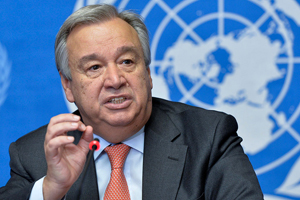
Mistrust Hindering Global Solutions, says Secretary General
UNITED NATIONS, Feb 13 (IPS) - The global lack of confidence and trust is undermining the ability to solve the world's complex problems, said UN Secretary-General during an international conference.
Speaking at the second day of the conference, Secretary-General Antonio Guterres noted the growing lack of confidence in institutions, as many people feel left behind from progress.
"It is clear that globalisation has been an enormous progress…but globalisation had its losers," Guterres said, pointing to the example of frustrated youth in countries unable to find jobs or "hope."
"Lots of people they were left behind and that the political establishments of their countries have not taken care of them," he continued.
The former High Commissioner for Refugees cited the migration crisis in Europe, stating that countries' inability to implement a fair and coordinated response spurred a sense of abandonment, fear and frustration among the public.
"This is the best ground for populists, for xenophobes, for those that develop forms of anti-Muslim hatred, or anti-Semitism…to play a role in our societies. And I think that it is not enough to condemn xenophobia, it is not enough to condemn populism, I think we need to be able to engage in addressing the root causes that lead to the fact that to be populist is so simple in today's world," Guterres told delegates, urging for reform to reconcile people with political institutions and to empower citizens and young people.
He also noted that the deep mistrust between countries is contributing to the multiplication of conflicts and the difficulties in solving them.
Most recently, the U.S. blocked the Secretary General's appointment of former Palestinian Prime Minister Salam Fayyad as the new UN peace envoy in Libya after U.S. Ambassador to the UN Nikki Haley said the UN has been "unfairly biased" for too long in favor of the Palestinian Authority.
Though he highlighted the need for impartiality, Guterres said that there was no valid reason to have rejected the nomination.
" is the right person for the right job at the right moment…he has a competence that nobody denies and Libya requires the kind of capacity that he has and I think it's a loss for the Libyan peace process and for the Libyan people that I am not able to appoint him," he stated, adding that bringing an end to the conflict in Libya is in everybody's interest.
When moderator and CNN anchor Becky Anderson asked about the new U.S. administration's "America First" principle, Guterres noted the need for the UN to respect its values but also stressed the importance of multilateral solutions to global problems.
"In a world in which everything is global, in which the problems are global – from climate change to the movement of people – there is no way countries can do it by themselves. We need global responses, and global responses need multilateral institutions able to play their role," Guterres stated.
"That is where the other gap of confidence becomes extremely important," he continued, proposing reforms in the UN system to help build trust in such institutions.
Despite 2016 being a "chaotic" year, Guterres followed after French diplomat Jean Monnet in expressing his hope for the future.
"I'm not optimistic, I'm not pessimistic, I am just determined," he concluded.
© Inter Press Service (2017) — All Rights Reserved. Original source: Inter Press Service
Where next?
Browse related news topics:
- Trade, Economy, & Related Issues
- Causes of Poverty
- Third World Debt Undermines Development
- Free Trade and Globalization
- Geopolitics
- Conflicts in Africa
- Human Rights Issues
- Women’s Rights
- Consumption and Consumerism
- Sustainable Development
- Natural Disasters
- Immigration
- G8: Too Much Power?
- Food and Agriculture Issues
- Democracy
- Global Financial Crisis
Read the latest news stories:
- Overshoot of Paris Agreement and the Looming Super El Niño Drive Urgent Calls for Global Climate Action at UNGA 81 Tuesday, September 29, 2026
- India Still Needs to Address Harmful Dark Skin Stereotypes Monday, September 28, 2026
- Pension Peril Among Populations Monday, September 28, 2026
- Rohingya Camps: Children in Frontline of Food Rationing Crisis Monday, September 28, 2026
- The Takeaway Day 6: General Debate ends with a plea to turn words into action Monday, September 28, 2026
- UN leaders renew push to defeat racism, 25 years after Durban Monday, September 28, 2026
- DPR Korea tells UN its nuclear status is ‘irreversible’, rejects outside pressure Monday, September 28, 2026
- ‘Ballot must replace the bullets’, South Sudan tells General Assembly ahead of elections Monday, September 28, 2026
- Sudan tells UN: No imposed solutions to country’s conflict Monday, September 28, 2026
- From energy crisis to energy transition: How renewables are reshaping energy security Monday, September 28, 2026
Learn more about the related issues:
- Trade, Economy, & Related Issues
- Causes of Poverty
- Third World Debt Undermines Development
- Free Trade and Globalization
- Geopolitics
- Conflicts in Africa
- Human Rights Issues
- Women’s Rights
- Consumption and Consumerism
- Sustainable Development
- Natural Disasters
- Immigration
- G8: Too Much Power?
- Food and Agriculture Issues
- Democracy
- Global Financial Crisis
Share this
Bookmark or share this with others using some popular social bookmarking web sites:
 Bluesky