

Q&A: The Global Compact that Respects Human Rights During all Stages of Migration
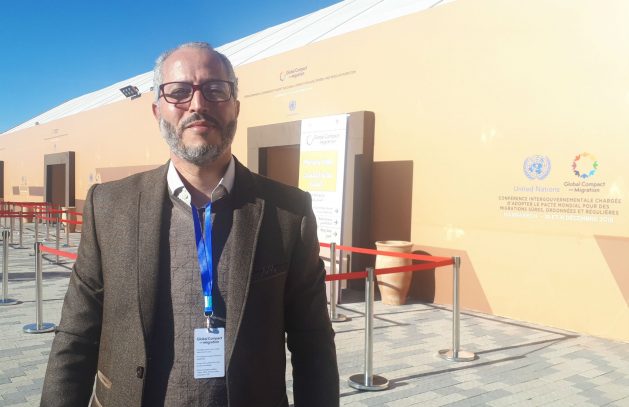
MARRAKECH, Morocco, Dec 12 (IPS) - IPS Correspondent Youssef Lakhder spoke to YOUNOUS ARBAOUI, advocacy and coordination officer at the National Migrant Protection Platform (PNPM).
Amid the hustle and bustle of the two-day Global Compact for Safe, Orderly and Regular Migration (GCM), IPS spoke to Younous Arbaoui, advocacy and coordination officer at the National Migrant Protection Platform (PNPM), about the importance of the GCM in tackling the migration challenge facing the world.
Inter Press Service (IPS): What is National Migrant Protection Platform (PNPM)?
Younous Arbaoui (YA): Formed in 2009, the National Migrant Protection Platform (knowns by its French acronym PNPM) is a network of civil society associations working on and advocating for migration. Thanks to their fieldwork, the PNPM capitalises on information in order to advocate for human rights of migrants. We work on three main axes: the first is the legal protection of migrants, the second is the protection of children, and the third is access to health services. Recently we started working on access to socio-professional training and to employment.
IPS: What is the purpose of your associative work in Morocco?
YA: We focus on advocacy, so we do not provide direct services to migrants. We advocate for their rights, such as the right of justice that is still not effective in Morocco. We also engage in dialogue with ministers, particularly on health, to encourage the authorities to provide access to health services for migrants, especially secondary and tertiary services, which is not yet guaranteed.
When it comes to child protection, we are advocating for the rights of children, such as the right to identity. This was achieved recently, after the Minister of Health issued a ministerial letter explaining the need to give birth notices to ensure children has the right to confirm their identities.
IPS: What are the benefits of the adopted Global Compact for Migration?
YA: The Compact, even if it is not legally binding, it is a document of reference for us as an advocacy player, and as Morocco welcomed this conference, it will have a moral obligation to respect and implement it. Usually, we refer to the convention of human rights, but now it is possible to use the Compact, in particular with regard to access to services, as objective 15 recommends states provide basic services to migrants no matter their status. It's true that things won't change immediately, it takes time.
IPS: What will change at the global level?
YA: The Compact emphasises a global collaboration between States on migration, and the countries that refuse the pact say it only serves the interests of northern countries and not southern countries, because it will facilitate re-admission and return of migrants who are, for example, in Europe. Yes, it is true, but re-admission and the return are aspects of migration policy to the migratory question; there is immigration and departure and return. The good thing about the Compact is that it emphasises respect of human rights during all the stages of the migratory process, from country of origin until the operation of return.
The Compact emphasises a global collaboration between states with regard to migration, and the countries that refuse the pact say that it only serves the interests of the northern countries and not the southern countries because it will facilitate re-admission and return of migrants who are for example in Europe, yes it is true, but the re-admission and the return are aspects of the migration policy inherent to the migratory question, there is immigration and departure and return.
The good thing about the Compact is that it says to respect the human rights during all the stages of the migratory process, from country of origin until the operation of return.
IPS: How do you react to accusations that some NGOs receive money to prevent migrants ?
YA: Yes, it is true that this accusation exists—they say that civil society receives money from the European Union to hold migrants in Morocco. But it is an old story that should be dismissed. Morocco has been a country of reception for several years, and the fact that the Kingdom has introduced a policy for national asylum and a migration strategy to integrate them, and the fact that associations help migrants here in Morocco, is testament that the accusation is unfounded.
Let us not forget that the way to Europe is dangerous. There are a lot of migrants who die at sea, and this factor should not be forgotten. Contrary to the accusation, what should be noted are the humanist efforts by associations and the State who try by all means to save migrant lives. After all, the control of the Moroccan maritime borders is the country's responsibility, and carrying that out does not mean the country is one of the constables of Europe. We must not see things like that, because doing this saves lives.
© Inter Press Service (2018) — All Rights Reserved. Original source: Inter Press Service