

Filipino Indigenous Leader Takes Ancient Wisdom to the Global Stage
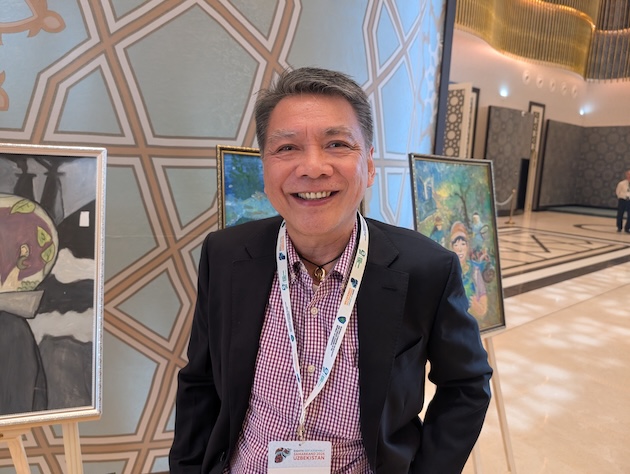
SAMARKAND, Uzbekistan, June 3 (IPS) - Every year, when dark clouds gather above the dense forests of the Philippines, 56-year-old Mini Baeyens, of the Aplay Kankanaey tribe, vigilantly watches the sky.
One afternoon, as he prepared to trek into the forest to gather medicinal plants, a majestic Philippine eagle emerged from the canopy and hovered above. To outsiders, it was simply a rare bird in flight. To Baeyens, it was a messenger.
His grandfather had taught him to observe carefully. The eagle’s appearance at unusual times and the direction of its flight often signal changes in weather or warn of danger.
That day, Baeyens abandoned his journey. Hours later, heavy rains pounded the mountains, triggering cascading floods and landslides that swept through nearby communities.
For generations, Indigenous peoples in the Philippines have relied on traditional knowledge to survive in landscapes increasingly battered by environmental degradation.
“There is this certain time of the day or week or month that the eagle appears and it’s only the indigenous community in that area that can interpret what the message is that the wildlife in the form of a Philippine eagle provides,” Giovanni Reyes, an Indigenous leader from the Philippines, explained using the anecdote based on Baeyens’ experience.
Such warnings, Reyes tells IPS, create a relationship of reciprocity between wildlife and people.
“When the eagle provides you warnings, the people will in turn protect the habitat,” Reyes says. “The protection of that habitat resulted in conservation of the territory.”
Sometimes, he explains, the eagle’s appearance signals danger.
“They will say that there is going to be a big storm coming because of the appearance of the eagle and so therefore nobody should go out because of the danger that it poses.”
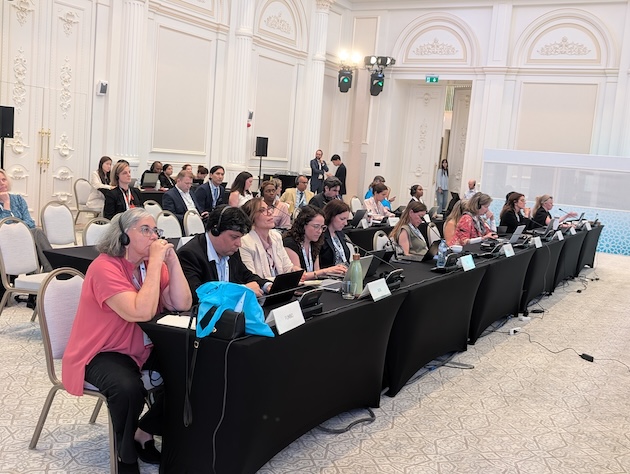
As government ministers, environmental experts, and civil society representatives gather this week in Samarkand for the Eighth Global Environment Facility (GEF) Assembly in search of solutions for financing the global environmental crisis, Indigenous leaders say stories like Baeyens’ reveal an often-overlooked truth: Indigenous knowledge is not only cultural heritage but also a practical tool for survival.
For the first time in the history of international environmental finance, Indigenous peoples are increasingly being recognised not merely as beneficiaries of conservation projects but as partners, advisers and rights holders whose knowledge systems are essential for achieving global climate and biodiversity goals.
The GEF-9 replenishment cycle marks a significant shift, with Indigenous Peoples set to be formally recognised and engaged as key partners in safeguarding the world’s remaining natural ecosystems and in incorporating their contributions into global conservation efforts.
At the centre of this shift is Giovanni Reyes, Chair of the Indigenous Peoples Advisory Group (IPAG) to the GEF, one of the world’s largest environmental funding mechanisms.
Born in Sagada in the mountainous Cordillera region of the northern Philippines, Reyes belongs to the Kankana’ey Indigenous people. His advocacy emerged from witnessing what he describes as “development aggression” in Indigenous territories.
“One of the compelling reasons why I had to develop a position for and on behalf of Indigenous communities is because of development aggression that has taken place in our region, including large-scale logging and dams that would have put communities underwater,” he says.
His work has taken him from remote mountain villages to global environmental negotiations, where he argues that Indigenous communities must be recognised not as obstacles to development but as guardians of ecosystems.
A defining moment came in 2011 when Reyes participated in a nationwide effort to map Indigenous territories across the Philippines.
For Indigenous communities, mapping involves far more than drawing boundaries. It means translating centuries of oral knowledge into evidence that is recognised by governments and institutions.
“We have to translate the indigenous knowledge about terrain, about their landscapes – about their boundaries and translate this in their physical dimension in the form of maps,” Reyes explains.
The resulting maps became powerful tools in legal and political struggles.
“The mapping will show or demonstrate to government that not only are we capable of oral presentations about who we are, but we also have evidence to show that this is the territory in the form of a map in which indigenous peoples themselves develop.”
What emerged was a rare partnership between ancient knowledge and modern science.
“There is this harmonisation of traditional knowledge and science,” Reyes says.
Today, that combination is helping Indigenous communities monitor forests, measure carbon storage and assess ecosystem health using technologies such as GPS mapping.
“If you harmonise your traditional knowledge and your practices with science, you can come up with an inventory that will result in determining the state of health of forests,” he says.
Yet protecting those territories remains a challenge.
According to Reyes, the deep spiritual connection Indigenous peoples have with their lands often puts them at odds with development projects.
“They (Indigenous peoples) have their own sacred sites and sacred ritual areas, in much the same way as the Catholics and the Church have their cathedrals.”
Rivers, streams and forests are not merely natural resources but parts of living cultural landscapes.
“These religious and spiritual values have shaped the vehemence to protect these areas by whatever means.”
Too often, however, resistance comes at a cost.
“When development takes place in their areas, and when they say no to this for reasons of culture and spiritual values, then they are criminalised and they are considered terrorists.”
Reyes says the struggle facing Indigenous peoples in the Philippines mirrors challenges confronting Indigenous communities worldwide.
Globally, land grabbing has emerged as a growing challenge for Indigenous peoples, pastoralists and smallholder farmers, particularly in developing countries where weak land tenure systems, poor documentation of ownership and governance failures leave communities vulnerable to dispossession.
From Africa to Asia and Latin America, rising demand for agricultural land, minerals, conservation areas and large-scale investment projects has intensified competition over land, often placing local communities at odds with governments and private investors.
Often, communities that have occupied and managed land for generations lack formal title deeds, making it easier for powerful interests to acquire vast tracts through questionable deals, corruption or legal loopholes.
The east African country of Tanzania has attracted huge interest from foreign investors seeking land for agriculture and other commercial ventures, but the absence of secure land tenure has exposed many rural communities to land loss. Analysts say some investors have bypassed official acquisition procedures by negotiating directly with village authorities, which has fuelled disputes, undermined trust and triggered accusations of land grabbing.
As traditional systems of land protection weaken, affected communities have increasingly turned to courts, public protests and participatory land mapping to defend their rights and secure legal recognition of their ancestral and communal lands.
In Brazil, Indigenous groups continue to confront illegal logging, mining and deforestation in the Amazon while enduring intensifying droughts and fires linked to climate change.
In Eswatini, formerly Swaziland, rural communities increasingly struggle with recurring droughts, water scarcity and declining agricultural productivity.
Despite vast cultural differences, Indigenous peoples share a common reality: they often live in some of the world’s most biodiverse landscapes while shouldering the heaviest burden of environmental degradation and climate disruption.
It is precisely these concerns that Reyes now raises before the GEF Council.
“The role of indigenous peoples here is to provide advice to the council on matters that have an effect on indigenous communities,” he says.
A key issue is ensuring that projects funded through the GEF respect the principle of Free, Prior and Informed Consent (FPIC).
“I advise the council about certain rights, including the free, prior and informed consent, that projects entering into IP territories, no matter who the GEF agency implementing them is, should go through a free and prior informed consent.”
The growing recognition of Indigenous peoples within the GEF marks a significant milestone. Historically, major environmental finance institutions were largely designed by governments and international agencies, with limited Indigenous participation in decision-making.
Today, Indigenous representatives have a formal advisory role, which reflects a broader realisation that global environmental targets cannot be achieved without Indigenous stewardship.
Indeed, Reyes argues that Indigenous peoples have already surpassed one of the world’s most ambitious biodiversity goals.
The Kunming-Montreal Global Biodiversity Framework calls for protecting 30 percent of the planet’s lands and waters by 2030.
“But that has already been achieved by Indigenous peoples,” Reyes says. “The areas currently managed by Indigenous peoples are about 32 to 40 percent (protected).”
In other words, many Indigenous communities have been safeguarding ecosystems at a scale that governments are only now striving to achieve.
The achievement, Reyes argues, stems not from billion-dollar programmes but from centuries of stewardship embedded in culture, belief systems and traditional practices.
“The Indigenous peoples’ territories provide the most in terms of capacity to absorb carbon because of the watersheds and the mountains that they have protected,” Reyes says.
As delegates in Samarkand debate funding priorities, biodiversity targets and climate ambitions, Reyes offers a simple but powerful message.
“May I inform the state parties to the conventions, whether it is in climate or whether it is in biodiversity, that the Indigenous people’s territories form the heart of the planet?”
He pauses before extending the metaphor.
“And if a person is destroyed or harmed, the body collapses in much the same way as when the Indigenous territories are harmed, then the ecosystems will collapse, and biodiversity will collapse.”
Back in the forests of the Philippines, where communities still look to the eagle for guidance, that truth has long been understood.
The challenge now, Indigenous leaders say, is to ensure that the rest of the world listens.
Note: The Eighth Global Environment Facility Assembly is underway until June 6, 2026, in Samarkand, Uzbekistan.
This feature is published with the support of the GEF. IPS is solely responsible for the editorial content, and it does not necessarily reflect the views of the GEF.
IPS UN Bureau Report
© Inter Press Service (20260603041600) — All Rights Reserved. Original source: Inter Press Service