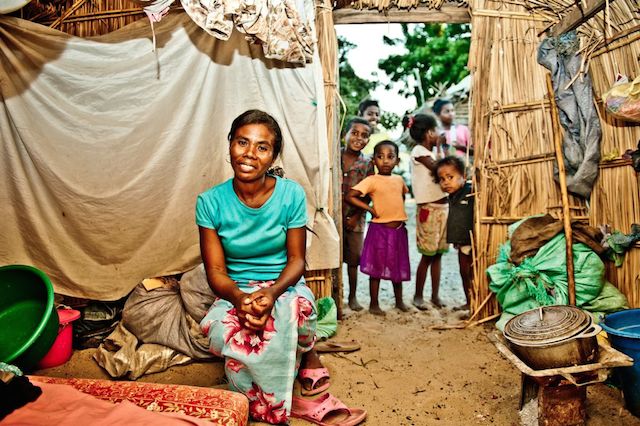
OP-ED: Why Ending Child Marriage in Africa Can No Longer Wait
"I tried to escape but I was caught. I found myself with a husband three times older than me... School was over, just like that. Ten months later, I found myself with a baby in my arms," she says.3
Clarisse is one of millions of girls around the world, and especially in Africa, who are married off each year. Many of them become wives as early as eight years old, often to much older men.
Globally, one in three girls from low and middle income countries is married before the age of 18, and one in nine by age 15. It is estimated that every year, over 15.1 million girls will become brides, if this trend continues.
Of the 41 countries worldwide with a child marriage prevalence rate of 30 percent or more, 30 countries are located in Africa. The practice is most severe in West Africa, where two women out of five are married before age 18; and one woman out of six is married by the time she turns 15.
Several social, cultural, religious and traditional beliefs and norms are known to fuel the continuation of child marriage in Africa.
In addition, the economic dimension is a driving force of the practice. To many families living in poverty, child marriage is a source of income and therefore an economic survival strategy.
The impact of child marriage
Regardless of the contributing factors and justifications cited for the practice, child marriage has a severe and harmful impact on our girls, and on society at large. It compromises the girl child's health, education and opportunities to realise her potential.
Many ‘child wives' are exposed to repeated pregnancies and childbirth before they are physically and psychologically ready.
In Sudan, Awatif, now 24, was married off at age 14 while still in school. Against her will, she dropped out of school in the fifth grade and immediately became pregnant. "I went through days of obstructed labour at home; it was painful and I thought I would die. My family took me to the hospital for assistance. I survived but my son didn't and I contracted obstetric fistula," she says. As a consequence, her husband abandoned and divorced her.
United Nations Population Fund (UNFPA) executive director Dr. Babatunde Osotimehin says that "no society can afford the lost opportunity, waste of talent or personal exploitation that child marriage causes."
Child marriage can be challenged
Child marriage is a human rights and public health issue, which cannot be left unchallenged. First and foremost, it is a violation of human rights instruments, such as the Convention on the Rights of the Child and the African Charter on the Rights and Welfare of the Child.
It is therefore an obligation of policy makers on the continent to protect the rights of the girl child that their governments have committed themselves to uphold. This includes putting an end to child marriage.
If the practice of child marriage is to be halted, action is needed at all levels to change harmful social norms and to empower girls. Specifically, governments, civil society, community leaders and families that are serious about ending child marriage should consider promulgating, enforcing and building community support for laws on the minimum age of marriage.
Ending child marriage would not only help protect girls' rights but would go a long way towards reducing the prevalence of adolescent pregnancy. Zero tolerance of child marriage should be our goal. Enacting laws that ban child marriage is a good first step – but unless laws are enforced and communities support these laws, there will be little impact.
Great efforts yielding promising results are being undertaken across the continent to challenge the status quo of this harmful practice. We have witnessed good practices such as the Schools of Husbands in Niger and the Adolescent Girls Initiatives in many African countries.
In Mozambique, the initiative known as "Girls' Forum" has provided a platform for girls to improve their decision-making powers; to increase their sense of empowerment; and to build their understanding regarding questions of marriage and sexual and reproductive health.
Education is not only the key to unlocking girls' potential; but it also contributes to girls delaying marriage across the continent. Studies have established that girls with low levels of education are more likely to be married early, while those with secondary education are up to six times less likely to marry as children.
Compulsory education for all, especially girls, is therefore a key intervention for policy makers to put into practice.
The African Union and the End Child Marriage campaign
The continent has witnessed renewed political commitment to addressing the problem of child marriage by African Union Commission (AUC) Chairperson Dr. Nkosazana Dlamini-Zuma. "We must do away with child marriage," she says. "Girls who end up as brides at a tender age are coerced into having children while they are children themselves." This commitment is being taken into practice through the launch of a new campaign to end child marriage in Africa.
The overall aims of the campaign are to:
- end child marriage by supporting policy and action in the protection and promotion of human rights,
- mobilise continental awareness of child marriage,
- remove barriers to and bottlenecks in law enforcement,
- determine the socio-economic impact of child marriage, and
- increase the capacity of non-state actors to undertake evidence-based policy dialogue and advocacy.
UNFPA believes the AU campaign to end child marriage represents a turning point in the fight to end child marriage in Africa. It is time that we no longer tolerate children becoming brides. The time has come to commit to ensuring our girls are able to achieve their full potential.
The African continent has tolerated child marriage for too long, based on a host of ill-conceived justifications and arguments. But our young girls, who have borne the brunt of this detrimental practice to date, cannot wait to see it banished forever. Child marriage should not be allowed to continue. Not one day longer.
© Inter Press Service (2014) — All Rights Reserved. Original source: Inter Press Service
Where next?
Browse related news topics:
Read the latest news stories:
- Africa Has the Technology to Achieve Food Security—Now It Needs Coordinated Deployment Tuesday, September 22, 2026
- Family Law Reforms Are Needed to Advance Gender Equality Tuesday, September 22, 2026
- United Nations Least Developed Country Category – Curse or Boon? Monday, September 21, 2026
- UN condemns attempted Houthi strike on Riyadh as Yemen displacement surges past 130,000 Monday, September 21, 2026
- ‘Nowhere is safe’: UN experts detail Ukraine war’s toll and Russia’s reach beyond its borders Monday, September 21, 2026
- ‘We are not powerless’: UN chief urges world leaders to invest in peace Monday, September 21, 2026
- Why climate action now comes down to speed, finance and cooperation Monday, September 21, 2026
- Ebola vaccine trial begins in DR Congo Monday, September 21, 2026
- UN panel calls for stronger safeguards as AI agents advance Monday, September 21, 2026
- Sudan: Blood on Foreign Powers’ Hands Monday, September 21, 2026
Learn more about the related issues:
Share this
Bookmark or share this with others using some popular social bookmarking web sites:
 Bluesky