

Brazil: Democracy Defended from Below
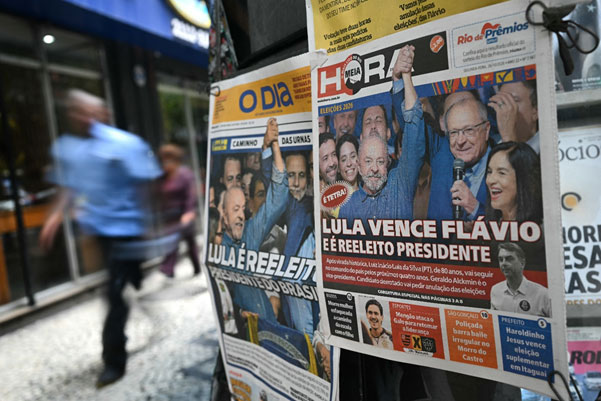
MONTEVIDEO, Uruguay, November 27 (IPS) - Brazil’s President Lula da Silva owes his fourth term less to his campaign than to the people who mobilised to stop his far-right opponent. Three weeks after losing the first round, the 80-year-old was elected for another term in the 25 October runoff with around 52 per cent of the valid vote. This was the first such comeback since Brazil’s return to democracy. Online activists, students, trade unionists and millions of voters who stayed home for the first round turned the result around by mobilising on the streets, online and at the polls. The question now is whether that mobilisation will last beyond the electoral emergency, and whether it can help Lula push his agenda through a Congress where the right holds the upper hand.
A defeat that woke people up
In the first round, Flávio Bolsonaro, son of jailed former president Jair Bolsonaro, took 47 per cent of the vote against Lula’s 45 per cent. Lula’s government had gone into the race weighed down by concerns about debt, inflation and crime. Over 21 per cent of the electorate stayed home, the highest abstention rate since 1998.
But coming second may have saved Lula. A narrow first-round lead would have rewarded the complacency that kept many of his voters at home. Defeat made the threat tangible. People who had abstained or backed Lula without enthusiasm suddenly faced the prospect of losing welfare payments, education funding, labour protections and the freedom to protest, on top of seeing Jair Bolsonaro and his fellow plotters, convicted of trying to overturn the 2022 election, walk free.
Flávio Bolsonaro kept saying he would free his father from his 27-year sentence and promised to ‘change the constitution’ to ‘redemocratise’ Brazil, a pledge widely read as aimed at the Supreme Court that convicted his father. He insisted his family would ‘govern for decades’. With four other Bolsonaros having won seats in Congress, many Brazilians saw a dynasty in the making, giving them a strong reason to get out and vote.
Streets and screens
Within days of the first round, the National Union of Students called protests in at least 16 states and the Federal District, tying its support for Lula to demands for public education funding and an end to the six-day working week. By the end of the campaign, rallies had been held in 11 state capitals. Online, progressives reclaimed ground that had been far-right territory since 2018. Federal deputy André Janones turned his ‘Exército do Lula’ (Lula’s army) WhatsApp channel into a hub with over 10 million subscribers. Students and everyday people led on both fronts, and the Lula campaign followed, swapping the stage for marches and selfie-style videos.
The resistance mobilised on an uneven field. Lula’s campaign accused Meta of limiting the reach of its posts and complained that the company’s AI tool would generate images of Bolsonaro but not of Lula. The Superior Electoral Court had to step in and order Meta to treat both campaigns equally. But the court came under suspicion when a media report found that its president, a Jair Bolsonaro appointee, had ruled in favour of 17 per cent of Lula’s injunction requests and 69 per cent of Flávio Bolsonaro’s.
Civil society pushed back. Hundreds of activists and organisations protested outside Meta’s São Paulo offices under the slogan ‘Meta, não se meta’ (Meta, don’t meddle), and over 100 organisations signed an open letter against big tech interference.
Between rounds, Lula gained 10.4 million votes against Flávio Bolsonaro’s 3.7 million, and abstention fell significantly, with around three million more people turning out. Over-70s, for whom voting is optional, made up around 40 per cent of the additional voters, propelled by Bolsonaro’s treatment of Lula’s age as a weakness.
Flávio Bolsonaro refused to concede. When a Supreme Court justice ordered him to hand over his passports as part of a money-laundering investigation, he left the country, reportedly crossing into Argentina before turning up in Miami. US Secretary of State Marco Rubio said President Donald Trump had personally authorised his entry.
In 2022, Jair Bolsonaro’s supporters blocked roads and camped outside army barracks. This time, with its leader a fugitive focused on saving himself, Flávio Bolsonaro’s Liberal Party recognised the result. Instead, students who had mobilised for Lula took to the streets to celebrate and defend their win.
Pressure from below needed
As he begins his final term in January, Lula will face a Congress further tilted to the right. He can reliably count on only 124 deputies and 16 senators, against 143 and 34 firmly opposed. To keep a working majority, he will need to hand more ministries to the Centrão, a group of parties that back whichever government is in power in exchange for funds and posts. Meanwhile the far right will be able to organise against the government from US soil. Flávio Bolsonaro and his brother Eduardo, who also lives in the USA and lobbied the Trump administration to impose sanctions and tariffs on Brazil, can count on a US president who has called the election ‘rigged’.
The campaign made clear where Lula’s power comes from. Ahead of the runoff, street and online pressure pushed Congress to approve a reduction of the working week from 44 to 40 hours without loss of pay. In his first national address after the vote, Lula thanked the people who went ‘to the streets and to social media to defend their rights’ and said popular mobilisation would guide his government. His opponents have noticed. Some complaints before the electoral court target the role of social movements and trade unions in his campaign.
Millions mobilised to keep the far right out of the presidency, and they succeeded. The key question now is whether they can stay engaged after the emergency has passed, and whether a government that owes them its re-election will keep listening to their demands for action on climate change and inequality.
Inés M. Pousadela is CIVICUS Head of Research and Analysis, co-director and writer for CIVICUS Lens and co-author of the State of Civil Society Report. She is also a Professor of Comparative Politics at Universidad ORT Uruguay.
For interviews or more information, please contact [email protected].



© Inter Press Service (20261127045709) — All Rights Reserved. Original source: Inter Press Service