

When Disasters Strike, LGBTQIA+ Communities Are Too Often Left Out of Humanitarian Response
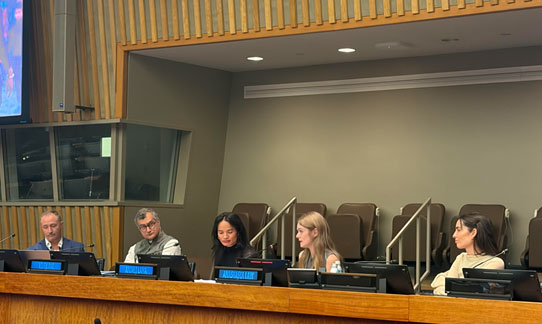
UNITED NATIONS, November 26 (IPS) - On November 20, in commemoration of Transgender Day of Remembrance, the United Nations (UN) Permanent Missions of Nepal, France, Norway, and Brazil partnered with Outright International to host a panel discussion on the importance of inclusive disaster planning and protecting LGBTQIA+ rights in crisis settings.
The discussion followed a screening of Elephants in the Fog, directed by Abinash Bikram Shah—Nepal’s official submission for the Academy Award for Best International Feature Film. Centered around the matriarch of a Kinnar transgender community in Nepal, the film’s UN screening marks the latest stop in an advocacy-driven Oscars campaign. Instead of relying on a traditional campaign budget or large-scale U.S. distribution, the effort focuses on impact screenings aimed at supporting the LGBTQIA+ community in rooms where critical decisions are made.
Titled “Leaving No One Behind: Including LGBTI People in Humanitarian Response,” the panel featured remarks from Anjali Lama, Nepal’s first transgender model and a transgender activist; Vivek Rai, deputy director of UN Women’s Civil Society Division; André du Plessis, an international human rights lawyer and UN program director at Outright International; and Ana Seco Díaz, impact producer of Elephants in the Fog.
The discussion built on an October report to the General Assembly by Graeme Reid, the UN independent expert on sexual orientation and gender identity. The report found that LGBTQIA+ individuals face heightened, multifaceted exclusion in crisis settings when response efforts fail to account for their specific circumstances. Reid described LGBTQIA+ individuals struggling after the August flash floods in Nepal as “invisible in humanitarian response,” warning that the consequences can be “catastrophic.”
Echoing these concerns, Lama recalled Nepal’s devastating 2015 earthquakes, underscoring how government-run relief shelters were unsafe for LGBTQIA+ people and lacked adequate accommodations or recognition. She also reflected on the August flash floods, recounting her move from Nuwakot to Kathmandu, where she and other transgender individuals faced severe barriers to employment and basic opportunities because of their gender identities.
Du Plessis stressed the importance of hearing directly from impacted communities, stating that discussions in the General Assembly Third Committee showed how transgender people are often “painted as an ideology” rather than treated as human beings in humanitarian responses. He added that when crises descend, people tend to look out for themselves and leave marginalized groups behind.
“We saw that in COVID times when relief supplies were going out there, that trans people were consistently unable to get hormone treatment, or that there were gendered rules they had to follow in order to access aid during the Ukraine crisis,” he noted. “Do the pre-planning. Talk to us beforehand so that you don’t have a panic-station feeling in a moment, and you’re prepared to roll out aid in a humanitarian crisis situation. I think too often we see situations where it falls on the communities themselves, and we can always applaud LGBTI communities for the way they hustle and get things done.”
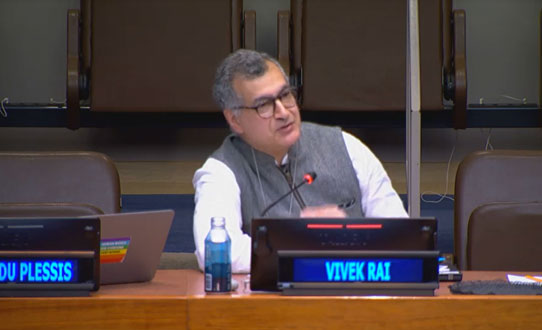
Speaking on how aid groups can dismantle persistent barriers to assistance and opportunity, Rai stated that crisis responses must include women’s and LGBTQIA+ voices in decision-making. Although UN Women is a relatively new entrant in the humanitarian space, he said agencies must improve how they collect data on the realities of marginalized groups.
He pointed to UN Women’s Gender Flash Appeal, which called for women and LGBTQIA+ individuals to hold seats on assessment teams, relief distribution committees, and planning bodies. Rai added that responders must remove barriers to gender assistance and establish comprehensive feedback and complaint mechanisms to hear directly from affected communities about what is—and isn’t—working in response efforts.
“It’s not just about listening, but also making sure that LGBTQIA+ people are actually manning and running the shelters,” Rai said. “So I think it’s important to recognize the kind of pushback that we’re seeing. We’re seeing pushback within multilateral spaces. We’re seeing pushback around the world. The pushback is on inclusiveness, and I think a recognition of where it is coming from is critical for us to look at how we do work together.”
Rai also called on women’s rights organizations and LGBTQIA+ support groups to coordinate on emergency preparedness, arguing that a joint effort yields a much more comprehensive response. He stated that joint contingency plans, shared contact lists, and referral pathways should be mobilized before crises hit, and that they should hold seats “side by side” in cluster coordination and decision-making.
“It is absolutely imperative that we look at this in terms of making cases for funding together. Otherwise, it becomes about who gets a piece of the pie,” he said. “A joint ask for direct, flexible funding is stronger than competing for the same shrinking part.”
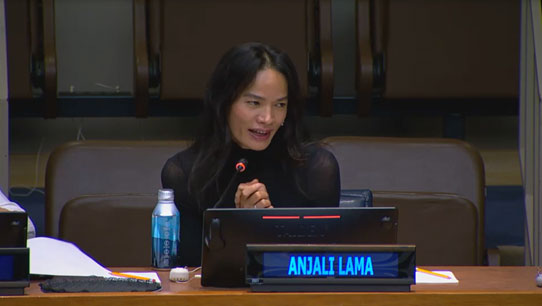
Addressing these gaps in funding and cooperation, Lama highlighted the role of groups like Blue Diamond Society, Nepal’s leading LGBTQIA+ rights organization, and the impact of its frontline work on her community. She noted that Blue Diamond Society has established nine shelter homes for LGBTQIA+ people experiencing gender-based violence, discrimination, family rejection, or homelessness, while also providing direct relief to LGBTQIA+ civilians displaced to Kathmandu by the August floods.
“I believe the biggest difference is that organizations like Blue Diamond Society understand our communities because we are part of them. We know their realities, fears, and specific needs,” she said. “Wherever I went, I continued to face barriers because of my gender identity. However, this experience has helped me to understand my own strength and value. Over time, the way I see myself has changed. I no longer see myself through the limitations that society places on transgender people. I see myself as a woman, a leader, and someone who can contribute to society and bring change.”
IPS UN Bureau Report



© Inter Press Service (20261126065144) — All Rights Reserved. Original source: Inter Press Service