

COP17 Celebrates Indigenous Leaders Amid Demand for Greater Inclusion in Biodiversity Decisions
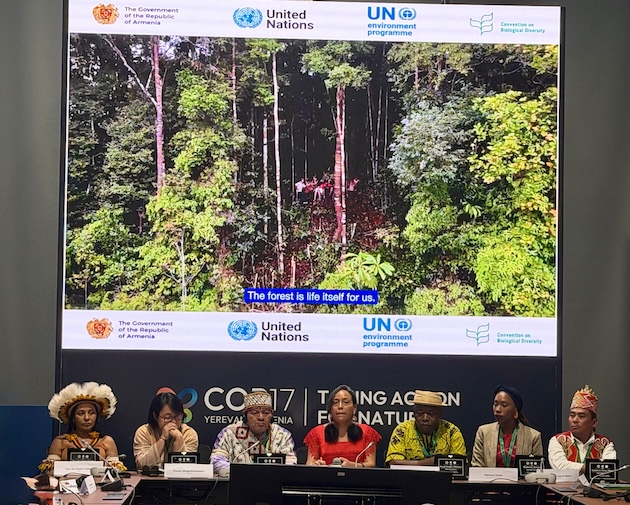
YEREVAN, Armenia, October 29 (IPS) - At the Convention on Biological Diversity (CBD) COP17, the presence of Indigenous Peoples and Local Communities (IPLCs) is impossible to miss. Indigenous representatives speak at side events, participate in contact groups, advise negotiators and engage across multiple forums shaping the future of global biodiversity policy.
Yet amid this growing visibility, one message resonates throughout the conference halls: implementation of the Kunming-Montreal Global Biodiversity Framework (KMGBF) will fall short unless Indigenous peoples are meaningfully involved at every stage, from decision-making and policy design to implementation and monitoring.
Many Indigenous leaders attending COP17 say that reality remains far from that goal. While governments increasingly acknowledge the role of IPLCs in protecting nature, participation is often limited to consultation rather than genuine partnership, they argue. This is particularly concerning because many biodiversity policies directly affect Indigenous territories, traditional knowledge systems, food sovereignty and cultural practices.
For communities that have stewarded ecosystems for generations, the challenge is no longer visibility. It is influence.
Against this backdrop, COP17 offered a rare moment of celebration. Six Indigenous leaders from Brazil, Peru, Indonesia, Thailand, The Gambia and the Democratic Republic of the Congo were named Indigenous Peoples Ambassadors for Primary Forests in recognition of their efforts to protect some of the world’s most ecologically important forests.
Leading the Good Fight for Nature
The awardees, Maimuna Jawara, Pirawan Wongnithisathaporn, Puyr dos Santos Tembé, Joseph Itongwa Miukumo, Julio Cusurichi Palacios and Herkulanus Sutomo Manna, share a common mission: protecting, restoring and stewarding forest ecosystems that sustain biodiversity, store vast amounts of carbon and support traditional ways of life.
The recognition came through the inaugural Indigenous Peoples and Local Communities Award, a joint initiative of the International Union for Conservation of Nature (IUCN), the Global Environment Facility (GEF) and the United Nations Forum on Forests (UNFF). The six winners were selected through an open nomination process that attracted 73 nominations from 27 countries.
Organisers said the award seeks to spotlight individuals whose leadership has helped safeguard primary forests while strengthening the rights and resilience of the communities that depend on them.
“Today we recognise six of these leaders, several of whom the GEF has had the privilege of working alongside in their territories. Their leadership offers important lessons, and we look forward to continuing to learn from it across all our work,” said Diego Mesa, Chief Executive Officer of the Global Environment Facility, during the award ceremony.
The recognition also reflects growing scientific evidence linking Indigenous stewardship with successful conservation outcomes.
“Evidence has shown that securing Indigenous Peoples’ land rights and recognising and respecting traditional knowledge are among the most effective ways to protect forests and biodiversity. Yet Indigenous-led conservation is about more than environmental results; it is about recognising rights, upholding dignity and delivering justice,” said Grethel Aguilar, Director General of IUCN.
Farming, Forests and Cultural Knowledge
For Maimuna Jawara of The Gambia, environmental stewardship begins with everyday life.
Jawara, one of the award recipients from Banjul, is the founder of 1802lab, a research and design laboratory exploring the connections between cultural identity, ecological knowledge and sustainable futures for African fashion. Yet the role she identifies with most deeply is that of a farmer and community agroecology educator.
Growing up in a farming family, Jawara learned to read the seasons, save seeds and care for the soil from an early age. Living close to nature, she came to see environmental stewardship not as a profession but as a way of life.
“As I got older, I realised that agroecology is just remembering how to live in harmony with nature,” Jawara said.
Earlier this year, she was named a Transformative Partnership Platform (TPP) Agroecology Ambassador.
Jawara’s recognition comes at a difficult moment for her country. The Gambia no longer has any primary forests. Studies have attributed their disappearance to fuelwood collection, land clearing for livestock, hunting and advancing desertification.
While the government has enacted laws promoting sustainable natural resource management, implementation remains challenging because of limited financial and human resources. Conservation regulations are also often poorly understood by rural communities.
Yet there are signs of hope. According to Food and Agriculture Organization (FAO) figures, forest cover in The Gambia has increased in recent years through plantations and community-led restoration efforts.
For Jawara, the award is both an honour and a responsibility.
“I hope to amplify voices from the ground and contribute to a transition that is not only ecological but also socially just, inclusive, and rooted in dignity,” she said.
Protecting Ancestral Forests
Another recipient, Herkulanus Sutomo Manna of West Kalimantan, Indonesia, represents the Dayak Iban Menua Sungai Utik Indigenous community, which has gained international recognition for protecting its ancestral forests.
For Herkulanus, protecting forests is inseparable from protecting Indigenous identity, culture and livelihoods.
The community’s struggle dates back to 1998, when it initiated participatory mapping efforts in response to increasing threats from illegal logging. Those efforts helped document customary lands and strengthened the community’s ability to defend its territory from encroachment.
Over time, the initiative became an important example of how Indigenous communities can use traditional knowledge, customary governance and local leadership to conserve forests while maintaining cultural continuity.
Receiving the award at COP17, Herkulanus emphasised that the recognition belonged not only to him but to the broader Indigenous movement. He urged Indigenous communities around the world to continue protecting and managing their ancestral territories, stressing that safeguarding forests today is essential for the survival and well-being of future generations.
Indigenous Voices Across Continents
Among the award recipients was Puyr dos Santos Tembé of Brazil, a leader from the Tembé People and the Alto Rio Guamá Indigenous Territory in the Brazilian Amazon.
Tembé’s work supports ecosystem restoration through native species, community seed collection, agroforestry initiatives and sustainable livelihoods connected to standing forests.
Unlike many Indigenous leaders, she has also developed a strong social media presence and uses digital communication platforms to raise awareness about Indigenous peoples, their cultures and their rights among broader audiences.
Pirawan Wongnithisathaporn is a Karen Indigenous leader who works through the Asia Indigenous Peoples Pact (AIPP), a regional network representing Indigenous communities, including those displaced from their ancestral lands and living in exile.
She serves as a bridge between these communities and regional and global biodiversity and climate negotiations, advocating for Indigenous rights, community forestry, environmental governance and more.
Other recipients included Joseph Itongwa Miukumo of the Democratic Republic of the Congo, a leading advocate for Indigenous and community-conserved territories, and Peru’s Julio Cusurichi Palacios, whose work has advanced forest protection and Indigenous participation in national decision-making.
Recognition Amid Continuing Frustrations
While the awards were welcomed as an important recognition of Indigenous leadership, they also highlighted a wider debate unfolding at COP17 over the place of Indigenous peoples within biodiversity governance.
Many Indigenous representatives attending the conference point out that, despite repeated commitments from governments and international institutions, Indigenous communities remain excluded from many key decisions affecting their territories and livelihoods.
That frustration has surfaced repeatedly during discussions around implementation of the Kunming-Montreal Global Biodiversity Framework.
At COP16 in Colombia, parties agreed to establish a permanent body for Indigenous Peoples and Local Communities to help ensure their effective inclusion across all aspects of the framework’s implementation. The decision was widely hailed as a breakthrough for Indigenous participation.
Two years later, however, many delegates argue that progress has been slow.
IPLC representatives say they continue to face exclusion from decision-making processes at local, sub-national and national levels. Concerns have also intensified around the implementation of the framework’s flagship 30×30 target, which seeks to conserve 30 percent of the world’s lands and waters by 2030.
Many Indigenous organisations argue that their rights over traditional territories are still not being adequately respected as governments pursue conservation commitments.
The debate raises a broader question: can recognition of individual Indigenous leaders help shift political realities on the ground?
For some participants, initiatives such as the Indigenous Peoples Ambassadors for Primary Forests programme could help bring greater visibility to Indigenous leadership and strengthen advocacy for rights-based conservation. Others caution that recognition alone will not address the structural barriers that continue to limit Indigenous participation in decision-making.
“Announcing the new cohort of Indigenous Peoples Ambassadors for Primary Forests is only the beginning. We will continue to partner with and elevate the ambassadors and their communities,” said Paula Prist, Senior Programme Coordinator at IUCN.
IPS UN Bureau Report



© Inter Press Service (20261029135953) — All Rights Reserved. Original source: Inter Press Service