

Africa’s Just Transition Ambitions Face Hurdles at COP31
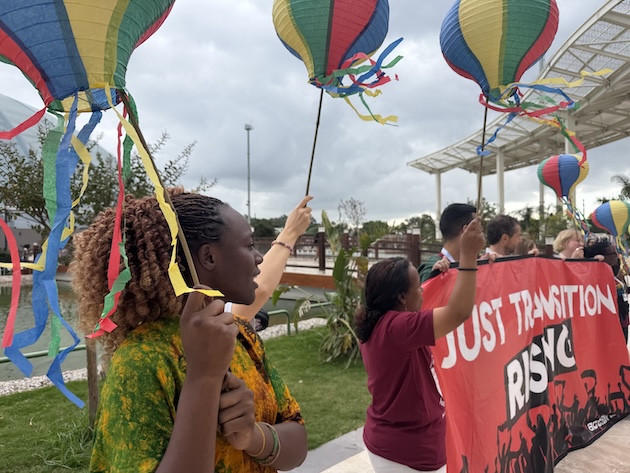
ANTALYA, Türkiye, November 20 (IPS) - Valepi Banda still remembers the day she lost dozens of chickens in June last year in Zambia’s capital, Lusaka, after the heating system failed due to power cuts.
The southern African nation was experiencing load-shedding schedules lasting eight hours a day, and the 22-year-old poultry farmer had no backup power.
Zambia, which relies on hydropower plants, was struggling after consecutive droughts caused low water levels in Lake Kariba, its largest, triggering a power crisis.
“We created a timetable for load shedding, but they never followed it. It made me sluggish,” Banda, a student at a university in Zambia, told IPS at the United Nations climate summit in Antalya, Turkey.
“I was raising some chickens in the backyard. And because broilers need heating every time, most of the chickens died.”
Banda has since stopped rearing chickens and is now keeping goats.
“I stopped chicken farming because it was too risky, and I had no buffer,” she said.
Countries like Zambia that generate about 90% of their electricity from renewables are banking on the Belém Action Mechanism (BAM), an UNFCCC framework created at COP30 in Belém, Brazil, to support workers, communities, and countries shifting toward low-carbon economies.
For Zambia and Kenya, the challenge involves not only shutting down coal-fired power plants but also expanding renewables and building electricity infrastructure to provide access to affordable electricity for poor communities.
They also want fossil-dependent countries to shift away from dirty fuels because it is their vulnerable communities who suffer from extreme weather events like floods and droughts.
Parties at COP31 in the resort of the Mediterranean country are negotiating about BAM’s operational and governance details.
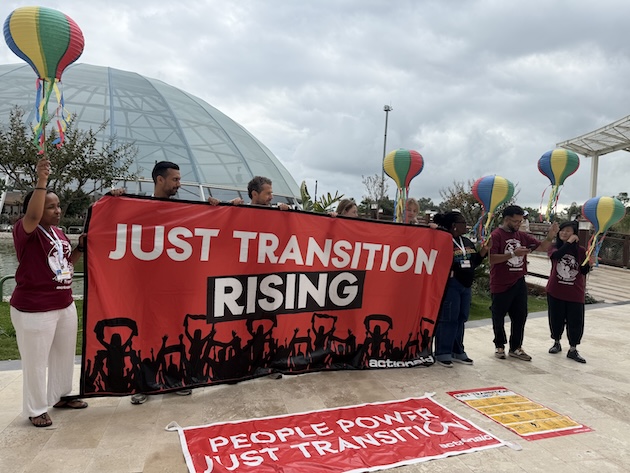
Deadlock
Developing countries want a new institution to coordinate global “just transition” efforts as nations shift away from fossil fuels as agreed at COP30 in Belém.
But developed countries are opposing this proposal, insisting that the UNFCCC coordinate the just transition.
Brandon Wu, director of policy and campaigns at ActionAid USA, said that there is no progress on the just transition.
“This is frustrating because that is what they agreed to last year. Certainly, they are worried that it will require resourcing,” he said.
“They are afraid that a powerful just transition mechanism will require some financing.”
Nona Chai of the Just Transition Alliance, a network of environmental justice groups and local unions tackling polluting extractive industries causing harm to communities and workers, said the European Union, United Kingdom and Japan are trying to weaken the Just Transition Mechanism and running away from their responsibility to fund Global South countries.
“That is not acceptable because the whole reason civil society proposed the BAM in the first place is that existing resources are insufficient for a just transition,” she said.
“It is sad. It is shameful. It should not be happening. They are reversing course on all the progress that was made on the Belem-Antalya Mechanism at COP 30 last year. It was a historic win for our movements.”
Global South Demands Finance, Technical Support for Shifting From Fossil Fuels
Wu said they want a Just Transition Mechanism that provides support for developing nations.
“Whether it is technical support or capacity building. It does not all have to be just money. Money is part of it, but a lot of it is technical support and capacity building for how we design just transition plans, how we plan for changes in the economy so that we are not leaving workers behind,” he said.
Chai said that the funding must come as grants to ensure that Global South countries avoid being trapped in debt.
“We need a mechanism that will actually promote grant-based, non-debt-creating funding for Global South countries and affected groups,” she said.
Developing nations have often resorted to debt to fund renewable energy projects, adaptation and other mitigation projects. This has left many countries in debt distress.
In 2022, public debt in Africa reached USD 1.8 trillion, according to the UN Conference on Trade and Development (UNCTAD).
For Banda, she wants a Just Transition Mechanism that can help her country expand renewables to complement hydro power plants exposed to droughts.
“We are looking at how best we can supplement our electricity generation because we are a country that depends on hydroelectricity. And because of the repeated effects of climate change and the drought, we have seen a decrease in the amount that we generate,” she said.
Power crisis affects small businesses, and just transition will help them access affordable clean energy, Banda said.
Africa possesses world-class solar, wind, and hydropower potential, alongside critical minerals needed for clean technologies.
It contains 60% of the world’s best solar resources, yet accounts for only about 1% of installed solar PV, according to the International Energy Agency (IEA).
But about 600 million people lack electricity access, with half of them living in three countries, namely Nigeria, Ethiopia and the Democratic Republic of Congo, according to the IEA.
Sub-Saharan Africa accounts for roughly 85% of the global population lacking electricity.
Nearly a billion people in Sub-Saharan Africa lack access to modern and clean cooking solutions.
Banda said that on a policy level, the government is trying to diversify its energy mix, but a lack of funding is a setback.
Authorities expect water levels to drop again this year in Lake Kariba, shared between Zimbabwe and Zambia, because of the anticipated El Niño.
“I am already anxious. It is triggering. I do not know how bad it will be,” she said.
IPS UN Bureau Report



© Inter Press Service (20261120080922) — All Rights Reserved. Original source: Inter Press Service