New Evidence Confirms Risk That Mideast May Become Uninhabitable
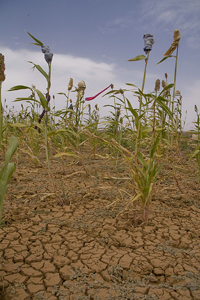
ROME, Mar 13 (IPS) - New evidence is deepening scientific fears, advanced few years ago, that the Middle East and North Africa risk becoming uninhabitable in a few decades, as accessible fresh water has fallen by two-thirds over the past 40 years.
This sharp water scarcity simply not only affects the already precarious provision of drinking water for most of the region's 22 countries, home to nearly 400 million inhabitants, but also the availability of water for agriculture and food production for a fast growing population.
The new facts are stark: per capita availability of fresh water in the region is now 10 times less than the world average. Moreover, higher temperatures may shorten growing seasons in the region by 18 days and reduce agricultural yields a further 27 per cent to 55 per cent less by the end of this century.
Add to this that the region's fresh water resources are among the lowest in the world, and are expected to fall over 50 per cent by 2050, according to the United Nations leading agency in the field of food and agriculture.
Moreover, 90 per cent of the total land in the region lies within arid, semi/arid and dry sub/humid areas, while 45 per cent of the total agricultural area is exposed to salinity, soil nutrient depletion and wind water erosion, adds the UN Food and Agriculture Organization (FAO).
Meanwhile, agriculture in the region uses around 85 per cent of the total available freshwater, it reports, adding that over 60 per cent of water resources in the region flows from outside national and regional boundaries.
Meantime, the rising sea level in the Nile Delta –which hosts the most fertile lands in Egypt-- is exposing the region's most inhabited country (almost 100 million people) to the danger of losing substantial parts of the most productive agriculture land due to salinisation.
"Competition between water-usage sectors will only intensify in the future between agriculture, energy, industrial production and household needs," on March 9 warned Graziano da Silva.
FAO's chief attended in Cairo a high-level meeting on the Rome-based organisation's collaboration with Egypt on the "1.5 million feddan initiative" {1 feddan is equivalent to 0.42 hectares, or 1.038 acres}, the Egyptian government's plan to reclaim eventually up to two million hectares of desert land for agricultural and other uses.
What to Do?
Egypt's future agenda is particularly tough as the country "needs to look seriously into the choice of crops and the patterns of consumption," Graziano da Silva also warned, pointing to potential water waste in cultivating wheat in the country.
"Urgent actions supporting it include measures aimed at reducing food loss and waste and bolstering the resilience of smallholders and family farmers, that require implementing a mix of social protection interventions, investments and technology transfers."
Several scientific studies about ongoing climate change impact on the Middle East region, particularly in the Gulf area, had already sounded loud warning drums.
"Within this century, parts of the Persian Gulf region could be hit with unprecedented events of deadly heat as a result of climate change, according to a study of high-resolution climate models," a Massachusetts Institute of Technology (MIT) research said.
The research–titled "Persian Gulf could experience deadly heat", reveals details of a business-as-usual scenario for greenhouse gas emissions, but also shows that curbing emissions could forestall these "deadly temperature extremes."
The study, which was published in detail ahead of the Paris climate summit in the journal Nature Climate Change, was conducted by Elfatih Eltahir, a professor of civil and environmental engineering at MIT, and Jeremy Pal of Loyola Marymount University.
The authors conclude that conditions in the Persian Gulf region, including its shallow water and intense sun, make it "a specific regional hotspot where climate change, in absence of significant mitigation, is likely to severely impact human habitability in the future."
Running high-resolution versions of standard climate models, Eltahir and Pal found that many major cities in the region could exceed a tipping point for human survival, even in shaded and well-ventilated spaces. Eltahir says this threshold "has, as far as we know … never been reported for any location on Earth."
For its part, the IPCC – Intergovernmental Panel on Climate Change latest assessment warns that the climate is predicted to become even hotter and drier in most of the Middle East and North of Africa region.
Higher temperatures and reduced precipitation will increase the occurrence of droughts, an effect that is already materializing in the Maghreb," said the World Bank while citing the IPCC assessment.
© Inter Press Service (2017) — All Rights Reserved. Original source: Inter Press Service
Where next?
Browse related news topics:
- Trade, Economy, & Related Issues
- Causes of Poverty
- World Hunger and Poverty
- United Nations on Development Issues
- Third World Debt Undermines Development
- Geopolitics
- Conflicts in Africa
- Middle East
- Environmental Issues
- Biodiversity
- Nature and Animal Conservation
- Climate Change and Global Warming
- Human Population
- Consumption and Consumerism
- Sustainable Development
- Natural Disasters
- Water and Development
- G8: Too Much Power?
- Food and Agriculture Issues
Read the latest news stories:
- The Global Leaders Network Pushes to Protect Women’s and Children’s Health Monday, September 28, 2026
- BRAZIL: ‘Resistance Is Intergenerational, and Art Is How Energy Gets Renewed’ Monday, September 28, 2026
- The Dollar-Gold Standard’s Lingering Demise Monday, September 28, 2026
- The Takeaway: UN General Assembly debate Day 5 Sunday, September 27, 2026
- Canada urges stronger partnerships as global order faces ‘rupture’ Saturday, September 26, 2026
- Countries far from conflict paying the price for wars not their own, India tells UN Saturday, September 26, 2026
- Saudi Arabia warns Gulf security inseparable from global stability amid regional tensions Saturday, September 26, 2026
- Cuba warns against ‘law of the jungle’ as Foreign Minister denounces US pressure Saturday, September 26, 2026
- Lavrov issues call for new Eurasian ‘security architecture’ Saturday, September 26, 2026
- ‘Safeguard the postwar order,’ China tells UN General Assembly Saturday, September 26, 2026
Learn more about the related issues:
- Trade, Economy, & Related Issues
- Causes of Poverty
- World Hunger and Poverty
- United Nations on Development Issues
- Third World Debt Undermines Development
- Geopolitics
- Conflicts in Africa
- Middle East
- Environmental Issues
- Biodiversity
- Nature and Animal Conservation
- Climate Change and Global Warming
- Human Population
- Consumption and Consumerism
- Sustainable Development
- Natural Disasters
- Water and Development
- G8: Too Much Power?
- Food and Agriculture Issues
Share this
Bookmark or share this with others using some popular social bookmarking web sites:
 Bluesky