

Beyond Resilience: Climate Change and the Rights of Char Dwellers in Bangladesh
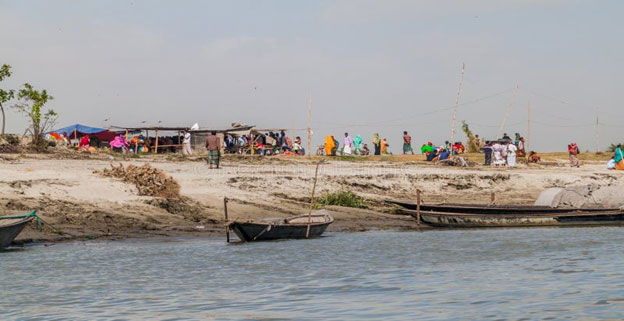
DHAKA, Bangladesh, August 31 (IPS) - Bangladesh’s riverine and coastal chars have always been landscapes of movement, but climate change is making that movement more violent, frequent, and unequal. The shifting islands of the Jamuna, Brahmaputra, Padma, and other rivers now reveal how climate stress multiplies deprivation, weakens citizenship, and forces char dwellers to absorb the costs of a crisis they did little to create.
After years of researching and writing about Bangladesh’s chars, I see them not as marginal landscapes, but as frontline climate geographies. They show how river erosion becomes repeated displacement, flooding brings livelihood collapse, and administrative neglect heightens vulnerability. Char people rebuild, migrate, and diversify under extreme uncertainty, but their resilience should not be romanticized. It is being stretched by intensifying hazards and institutions still designed for fixed land, fixed addresses, and orderly poverty. This is why the issue should be framed not simply as adaptation to hazards, but as a question of rights. The central problem is not that char dwellers fail to cope with a moving river; it is that institutions repeatedly ask them to cope without secure recognition, services, or protection.

Among the many myths about char people, the most dangerous is that they are naturally resilient. The phrase is flattering but evasive: it turns political abandonment into cultural strength. Families rebuild homes on land that may disappear, cultivate fields that may be swallowed before harvest, and send children to distant or fragile schools. These are not free choices; they are decisions made within a landscape shaped by erosion, floods, poverty, invisibility, and underinvestment.
Chars are marginal because state planning treats them as temporary spaces for poor and landless people. Some estimates suggest that chars cover roughly 8% of Bangladesh’s land area and are home to 15 to 20 million people. For char communities, migration is not a rupture in char life; it is a recurring way of organizing and rebuilding, often annually. But climate change is turning mobility from strategy into necessity. For many char dwellers, migration may begin as seasonal labour, become repeated relocation, and finally harden into permanent detachment from land, kinship, and legal security.
In 2024, according to the Internal Displacement Monitoring Centre’s Bangladesh country profile, monsoon floods triggered 1.3 million movements, while its disaster displacement risk reporting records more than 21 million disaster displacements in Bangladesh between 2008 and 2024. Among char people, climate change is felt through household decisions made under pressure: whether to rebuild on the same island, move to another char, keep children in school, or migrate to Dhaka for work. These choices are rational and strategic, but the field of options is narrowing under climate stress, vulnerability, and social exclusion.
Migration from char areas also reflects intelligence and aspiration: young people leave for wages, education, electricity, phones, clinics, and futures beyond subsistence and uncertainty. The tragedy is that climate-stressed households often move without skills, savings, documents, safe housing, or labour protection. The river follows them into the garment line, the rickshaw garage, the brick kiln, the domestic workplace, and the rented slum room.
How should these heightened risks from flooding and displacement be addressed? Adaptation is necessary, but it is not enough. Raised plinths, early warnings, flood-resistant crops and community preparedness may save lives, yet adaptation without land rights, education, healthcare, social protection and safe migration routes becomes a way of managing dispossession. Climate change deepens vulnerability because it strikes people who already lack secure tenure, dependable services and political recognition.
In Bangladesh, climate policy should stop treating char dwellers as humanitarian exceptions and start treating them as political subjects. Public services must be redesigned for moving landscapes through boat schools, mobile clinics, digital civil registration, portable social protection, and weather-responsive transport. Land administration must recognize erosion and accretion, while migration should be planned as adaptation through skills training, safe housing, labour rights, and social insurance. Gender must be central to this agenda. Women and girls often carry these risks most directly, through interrupted schooling, unsafe travel for work or services, increased care burdens during floods, and reduced voice in decisions about land, migration, and relief. Policies that imagine the household as a single male-headed unit misread both vulnerability and agency.
The politics of the char is the politics of who counts in a warming world. Fixed maps assume that citizenship has a stable address and that development follows roads. Char life challenges those assumptions. It shows that climate vulnerability is produced not only by hazards, but by institutions unable or unwilling to recognize lives shaped by unstable land.
Bangladesh can praise char people for endurance, or it can confront the uncomfortable truth: the river will keep moving; that is its nature. But if the rights of char people move more slowly than the river, the failure is political. Their future will not be secured by teaching them to adapt endlessly to disappearance, but by ensuring that no citizen has to prove belonging on land that may not be there tomorrow.
The experience of Bangladesh’s char dwellers shows that climate change is not only an environmental crisis, but also a crisis of rights, recognition, and governance. River erosion, floods, and displacement become devastating because they intersect with insecure land tenure, weak services, gendered risks, and limited political voice. A just response must therefore go beyond short-term adaptation and treat char communities as full citizens whose mobility, livelihoods, and claims to belonging deserve protection in a warming and increasingly unstable world.
Dr. Mohammad Zaman has lived and conducted extensive field research in the Kazipur-Sirajganj chars and has written widely on char land tenure, livelihoods, and social organization. He is the lead editor, with Mustafa Alam as co-editor, of Living on the Edge: Char Dwellers in Bangladesh (Springer, 2021). He can be reached at [email protected].
IPS UN Bureau
© Inter Press Service (20260831084108) — All Rights Reserved. Original source: Inter Press Service