

If We Can Start an Epoch, We Can Start a Farming Revolution
NEW YORK, October 2 (IPS) - In November 1952, the United States detonated the world’s first thermonuclear device at Enewetak Atoll in the Marshall Islands. The test, code-named Ivy Mike, erased the island of Elugelab and scattered a signature of plutonium across the planet that remains in lake beds, ice sheets and ocean sediments today.
This month, scientists writing in Nature Reviews Earth & Environment proposed this moment as the start of the Anthropocene, a geological epoch shaped by human activity. Co-author Victor Galaz of the Stockholm Resilience Centre called the date “a tragic reminder of the highly unjust impacts of planetary change.”
I take that proposal seriously, because it carries hope as well as warning, and it connects to the argument of my new book, Whole Earth Farming.

A few years ago I proposed the word epoch to describe the period we are living through. It has two meanings. A historical epoch is a period set off by significant change, such as the Renaissance. A geological epoch is defined by rock layers and usually spans millions of years, though the current Holocene began only about 11,700 years ago. The two have never arrived together in human history. I believe they are arriving together now.
The idea of the Anthropocene was popularized in 2000 by Nobel laureate Paul Crutzen. In 2020, a paper in Nature found that human-made materials now outweigh all living things on Earth. Yet in 2024, the International Union of Geological Sciences declined to formally recognize the Anthropocene. Officially, we are still in the Holocene.
The new paper, led by Jan Zalasiewicz, Colin Waters and Martin J. Head, draws on 12 stratigraphic records worldwide and identifies the 1952 rise in plutonium as the clearest marker of the new epoch. Whatever the geologists decide, the substance stands: human beings have become a force of planetary consequence.
Nobody set out to launch a new geological epoch. The Anthropocene is the unintended result of billions of decisions about energy, industry, consumption and land use. That is sobering. It is also, strangely, encouraging.
If humanity can alter the chemistry of the atmosphere without meaning to, then we are clearly capable of transformation at planetary scale. The only question is whether we can do it on purpose, in a direction that heals rather than harms.
Galaz’s point about injustice matters too. The Marshall Islanders had no say in what happened at Enewetak, yet bore its consequences. Those who contributed least to planetary change are often hit hardest, among them the world’s smallholder farmers. Any real transformation must put them at the center.
There are some 475 million smallholder farming families in the world, roughly one quarter of humanity, and yet they are largely absent from conversations about the future of food and climate.
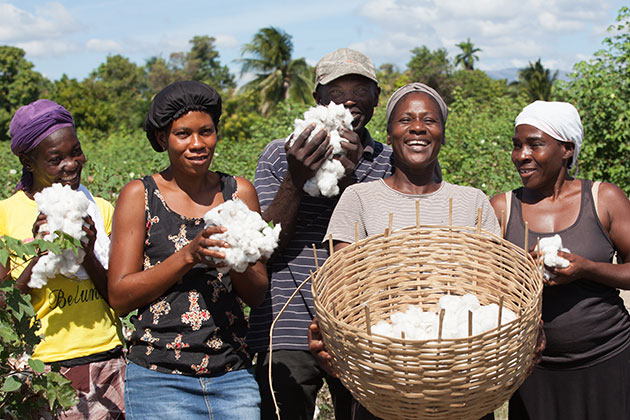
Whole Earth Farming argues that these families could lead an agricultural revolution. It draws on 21 farmer stories from 18 countries and on decades of work, including in Haiti, where I co-founded the Smallholder Farmers Alliance. Its central argument is that if half the world’s smallholders adopted regenerative practices, they could produce all the additional food needed by 2050 while reducing agriculture’s net climate impact.
There is a fitting symmetry here. The Holocene began with a climate stable enough for humans to start farming. The Anthropocene could likewise coincide with a new global agricultural movement, one that restores the land rather than depleting it.
The changes of the 1950s spread without any global plan, as new tools and habits moved from place to place until they gathered their own momentum. A regenerative transformation can spread the same way: through practices that work, farmers who see them working on a neighbor’s land, and the support to adopt them.
The farmers in the book are already rebuilding soil, planting trees alongside crops and restoring water cycles. What they lack is not ingenuity but recognition, investment and connection to one another.
I once suggested that the historical epoch now taking shape will one day be named for the moment we began to reorganize ourselves around the principle of oneness. I still believe that.
The Anthropocene is, in one sense, the geological record of our failure to see ourselves as one people sharing one planet. A regenerative transformation led by smallholders would be the opposite: a practical expression of oneness, rooted in the recognition that the health of the land, the wellbeing of the farmer and the future of humanity are inseparable.
If a single morning in 1952 can mark a new chapter in the Earth’s geological history, then surely the choices of hundreds of millions of farming families can mark a new chapter in human history. We have already proven that we can change the planet. Now it is time to prove that we can do so with intention, with justice, and with the whole Earth in mind.
Hugh Locke is president and co-founder of the Smallholder Farmers Alliance, president of the Impact Farming Foundation and author of Whole Earth Farming: Smallholders and the Great Regenerative Transformation (George Ronald Publisher, 2026).
IPS UN Bureau



© Inter Press Service (20261002050132) — All Rights Reserved. Original source: Inter Press Service